On this date, August 31, in 1928,
Die Dreigoschenoper (
Threepenny Opera) premiered in Berlin at the
Theater am Schiffbauerdamm.
This is an
original cast recording of a performance in 1928 of that production which included
Lotte Lenya (Jenny), Erika Helmke (Polly),
Willy Trenk-Trebitsch (Macheath),
Kurt Gerron (Moritatensänger; Brown), and
Erich Ponto (Peachum). Lewis Ruth Band, conducted by
Theo Mackeben.
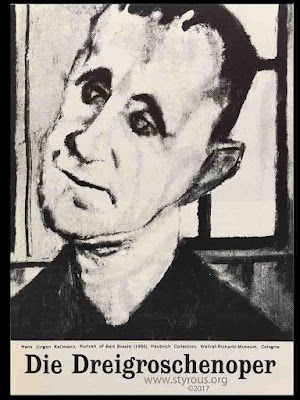
The album cover is actually completely blank except for a sticker on the front with an image of a portrait by
Hans Jürgen Kallmann of
Bertolt Brecht. The sticker was mounted side wise and off-center for some reason.
The Threepenny Opera (
Die Dreigroschenoper) is a "
play with music" by
Bertolt Brecht and
Elisabeth Hauptmann, adapted from
John Gay's 18th-century English
ballad opera,
The Beggar's Opera, with music by
Kurt Weill and
insertion ballads by
François Villon and
Rudyard Kipling. Although Hauptmann produced 80 to 90 percent of the text, Brecht suppressed this and assumed sole credit, and is usually listed as sole author in printed versions.

German theater poster - 1928
 premiere performance playbill
Theater am Schiffbauerdamm
Berlin, 31 August 1928
premiere performance playbill
Theater am Schiffbauerdamm
Berlin, 31 August 1928
Entartete Kunst
In the thirties,
Adolph Hitler opened a
Museum of Degenerate Art in
Nuremburg.
Entartete Kunst (
Degenerate Art) was a term adopted by the
Nazi regime in
Germany to describe
Modern art. Such art was banned on the grounds that it was un-German,
Jewish, or
Communist
in nature, and those identified as degenerate artists were subjected to
sanctions. The collection was of the sane and the insane, the artistic and the politically démodé.
An entire room was devoted to the music of
Kurt Weill, the main feature was this very recording of
Die Dreigoschenoper which was played continually. However, it was removed after it attracted too large an audience.
Degenerate Art was the title of
an exhibition, held by the Nazis in
Munich in 1937, consisting of
modernist
artworks chaotically hung and accompanied by text labels deriding the
art. Designed to inflame public opinion against modernism, the
exhibition subsequently traveled to several other cities in Germany and
Austria.
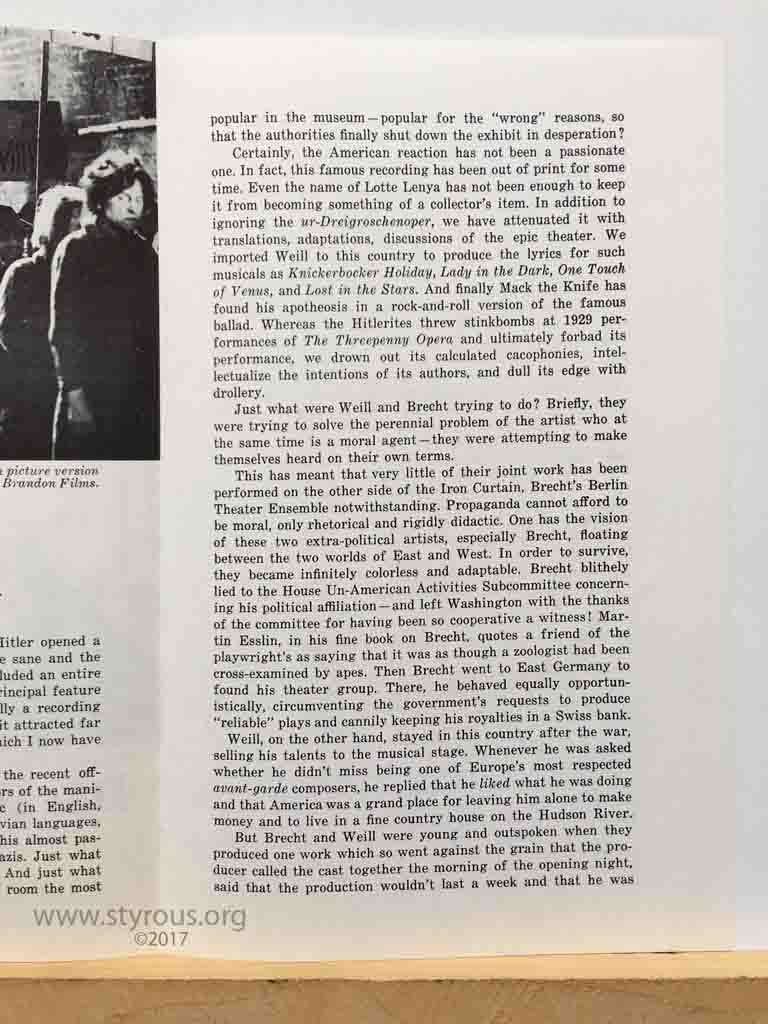
There is a small pamphlet included with the record; an 8½" x 11" sheet printed on both sides and folded in half so it's final size is 5½" x 8½". Written by Thomas Lowery, it tells the history of the play, the actors, the times in which it was made and the Nazi reaction to it (
click on any image to see a larger size for reading).

Die Dreigoschenoper pamphlet front
Bertolt Brecht by
Hans Jürgen Kallmann
photo by Styrous®
Die Dreigoschenoper pamphlet interior
photo by Styrous®
Die Dreigoschenoper pamphlet interior detail
detail photo by Styrous®
Blitzstein tells the story of his scandalizing his fellow students at
Arnold Schoenberg’s Master class at the Berlin
Hochschule, when he sat down at the piano and croaked out in bad German and a composers squeal,
Mac the Knife and the jealousy duet just as Schoenberg entered the room. He gave this new music the name of misuk because it was different.
Mac the Knife has become a popular
standard recorded by many artists, including a US and UK number one hit for
Bobby Darin in 1959.
The records
The records are still in their original
glassine record sleeves.