Exactly fifty years ago today, on Sunday, October 24, 1971, Pablo Casals conducted the premiere of his Hymn to the United Nations with text by W.H. Auden, in New York City, on the occasion of the 25th anniversary of the United Nations.
The work is a beautiful, glorious and exuberant paean to the
hope of peace in the world by a mixed chorus of what sounds like a
bazillion people with full orchestra (link below).
There is an audio of Auden reciting his poem, Hymn to the United Nations, on the United Nations Audiovisual Library website and the words to his poem can be found on the bartleby.com website (links below).
I
have been a collector of almost everything including postage stamps. I
have a huge collection of them which was started by my father in the
30's before I was born; I remember looking at them when I was a kid and
dreaming of the exotic places they represented, so, they have been a
part of me my whole life
and fascinate me to this day.
Listed
below are links to articles on the Viewfinder about stamps or include
references to them. As new articles are added the list will increase
over time.
Today is the birthday of Catalan musician, Pau Casals i Defilló, who was born on December 29, 1876, in El Vendrell, Cataluña, Spain. He is better known to the world as Pablo Casals.
In 2010 I enjoyed doing a photo shoot in the tiny village where he was born, El Vendrell (link below). Although I've known of Casals almost all my life, at the time I did not realize he was born there; to me, it was just a beautiful village I wanted to photograph.
The works are suites for unaccompanied cello by Johann Sebastian Bach.
They are some of the most frequently performed and recognizable solo
compositions ever written for cello. Bach most likely composed them
during the period 1717–23, when he served as Kapellmeister in Köthen. The title given on the cover of the Anna Magdalena Bach manuscript was Suites à Violoncello Solo senza Basso (Suites for cello solo without bass).
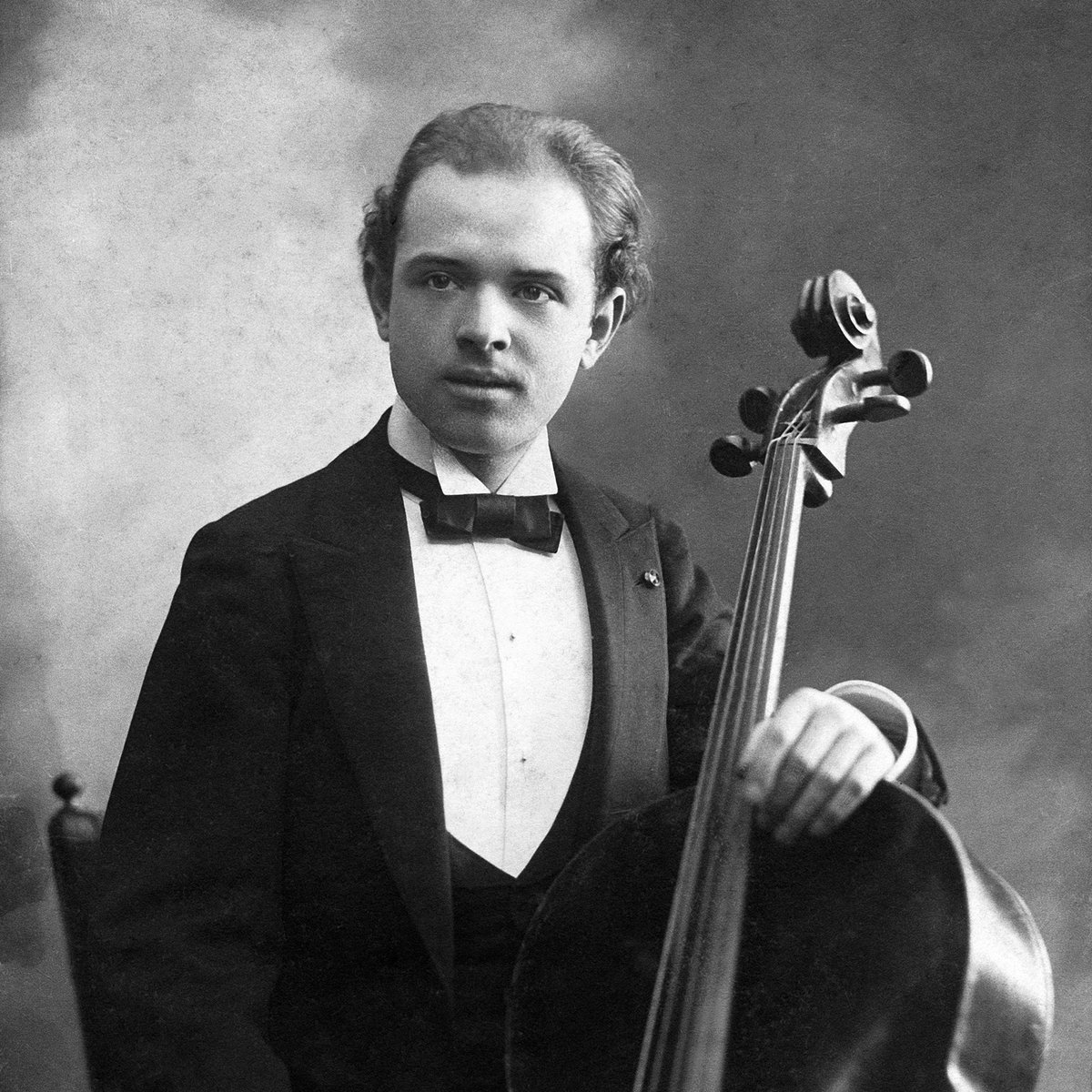
Pablo Casals, Barcelona - 1915
photographer unknown
In 1966, he made a recording, Pablo Casals ~ A Living Portrait, for the Columbia Masterworks series. Although
there is a person telling the story of Mr. Casals, and speaking by Mr.
Casals himself, there are several music pieces through-out both sides of
this LP, including several short, cello solo playing, some with
complete orchestra backing, some while teaching students on "how to"
play both the cello, and in an orchestra arrangement.
Included are rehearsals for a performance that he conducted. It is interesting to hear him demonstrate how he wants the music to be performed; he was very precise about this. He talks about the performance of the work in the time of Bach. He talks about the instruments of the Baroque era and the improvisation. The liner notes were written by classical musicproducer, Thomas Frost.
He speaks of his early years in Spain and how his music career got its start and the journeys he traveled to become the fantastic cellist he was. But he doesn't limit himself to only music. In his late teenage years, already a prodigy, he underwent a spiritual crisis and came close to suicide. He speaks of the horrors of the Spanish Civil War, how it affected his life and the cruel suppression by the Francisco FrancoFashist regime that followed. He self-exiled from Spain and settled in Puerto Rico.
In 1955 Casals married his second wife, long-time associate and cellist, Francesca Vidal de Capdevila, who died that same year.
Francesca Vidal de Capdevila
date & photographer unknown
In 1957, he married Marta Montañez y Martinez; he was 80 years old and she was 20 at the time. When asked if marrying a girl 60 years his junior might be hazardous, he replied, "I look at it this way: if she dies, she dies." The two settled in Ceiba, Puerto Rico. He speaks of her in loving tones, saying, "With Martita I have had the best years of my life". She is still aliver today.
He discusses the politics of the time. It was a time of turmoil in the United States with demonstration against the war. Which one? Who cares? We are always at war with someone and he was just against any war, period! He talks about Vietnam (the war at the time) but still raged on into the seventies (link below).
He tells about performing for President John F. Kennedy, who awarded him the Presidential Medal of Freedom in 1963, and for the United Nations to promote peace. He talks of the weapons being developed and the nuclear danger that threatens the world. He said his weapon was the cello.
Pablo Casals died in 1973 at Auxilio Mutuo Hospital in San Juan, Puerto Rico, at the age of 96, from complications of a heart attack he had three weeks earlier.
He did not live to see the end of the Franco Fashist State, which occurred
two years later, but he was posthumously honored by the Spanish
government under King Juan Carlos I which in 1976 issued a commemorative postage stamp depicting Casals, in honour of the centenary of his birth.
Trained
as a photographer, he specialized in travel photography for
years, shooting for Holiday and Town and Country magazine. He also
served as director of photography for the film version of 1963 Lord of the Flies.
Hollyman Thomas Benton was born in Denver in
1919. He graduated from Central Missouri State University in 1940 and
became one of the students to obtain a Master’s degree in
Photojournalism from the University of Missouri. From there, he joined
the Chicago Acme Newspictures Bureau, and later became staff
photographer for the St. Louis Post-Dispatch.
In World War II Hollyman served in the Air Force and stationed at the Pentagon working in the intelligence picture.
Tom Hollyman died on November 14, 2009, in Austin, Texas, after a struggle against COPD (chronic obstructive pulmonary
disease). He was 89 years old.
Part 1 A1 On His Youth And Education A2 Casals Teaching
Side 2:
Part 2 B1 Casals Conducting B2 On Bach B3 On Liberty B4 On War And The Hope For Peace
Credits:
Engineer, Script By, Edited By – H. L. Kirk* Liner Notes – H.L.K.* Musical Assistance [Special Assistance By] – Ruth Chapman Narrator [Commentary] – Isaac Stern Photography By – Tom Hollyman Producer, Sleeve Notes – Thomas Frost
Notes:
Label variation, grey background with black and white letters.
Although
there is a person telling the story of Mr. Casals, and speaking by Mr.
Casals himself, there are several music pieces through-out both sides of
this LP, including several short, cello solo playing, some with
complete orchestra backing, some while teaching students on "how to"
play both the cello, and in an orchestra arrangement.
Casals* – Casals: A Living Portrait Label: Columbia Masterworks – PC 1 Format: Vinyl, LP, Mono Country: US Released: 1966 Genre: Non-Music Style: Interview, Monolog