Showing posts with label Oscar Brand. Show all posts

February 7, 2021

Oscar Brand ~ A man of varied tastes

 ~      
Oscar Brand - ca. late 70’s - early 80’s
 
 
Today is the birthday of Oscar Brand, a Canadian-born American folk singer-songwriter and author with a career spanning 70 years. He composed at least 300 songs and released nearly 100 albums, among them Canadian and American patriotic songs. Brand's music ran the gamut from novelty songs to serious social commentary and spanned a number of genres from folk music to Doris Day to Ella Fitzgerald.    
 
His music was not for everyone. You had to be a person who loved the rich variety of the music traditions, history, language and sounds of different cultures and countries from Appalachia to Zimbabwe. He was known for composing catchy and themed folk songs.     

Brand also wrote a number of short stories. And for 70 years, he was the host of a weekly folk music show on WNYC Radio in New York City, which is credited as the longest running radio show with only one host in broadcasting history.              


Oscar Brand - 1960
 photographer unknown
 
 
He hosted the radio show Oscar Brand's Folksong Festival on Saturdays at 10:00 p.m. on WNYC-AM 820 in New York City, which ran into its 70th year. The show ran more or less continuously since its debut on December 10, 1945, making it the longest-running radio show with the same host, according to the Guinness Book of World Records. Over its run it introduced such talents to the world as Bob Dylan, Joan Baez, Woody Guthrie, Arlo Guthrie, Huddie Ledbetter, Joni Mitchell, Peter, Paul & Mary, Judy Collins, the Kingston Trio, Pete Seeger and the Weavers. In order to make sure that his radio program could not be censored he refused to be paid by WNYC for the next 70 years.          


 date & photographer unknown
 
 
He played with such legends of folk music as Lead Belly, Woody Guthrie, Josh White, Jean Ritchie, the Weavers and Pete Seeger. He wrote various books on the folk song and folk song collections, including The Ballad Mongers: Rise of the American Folk Song, Songs Of '76: A Folksinger's History Of The Revolution and Bawdy Songs & Backroom Ballads, the latter comprising four volumes (link below).   
 

Oscar Brand
 date & photographer unknown 

 
He wrote the lyrics to the song A Guy is a Guy, which was recorded by Ella Fitzgerald in 1951 and became a hit for Doris Day in (1952). His score for the 1968 Off-Broadway show, How to Steal An Election sent up the current belief that charisma would help a candidate win. You think?           


date & photographer unknown 
 
 
Oscar Brand was born to a Jewish family in Winnipeg, Manitoba, Canada. His father was a Romanian-born flooring contractor, Isidore Brand. His mother was named Beatrice. In 1927, the family moved to Minneapolis, then to Chicago and ultimately to New York City. As a young man, Brand lived in Borough Park, Brooklyn and graduated from Erasmus Hall High School and later from Brooklyn College with a BS in psychology.         
 
Although Brand was anti-Stalinist and was never a member of any Communist party, the House Committee on Un-American Activities referred to his show as a "pipeline of communism", because of his belief in the rights under the First Amendment of blacklisted artists to have a platform to reach the public. Accordingly, in June 1950, Brand was named in the premier issue of Red Channels as a Communist sympathizer, along with Paul Robeson, Josh White and Pete Seeger. A few years before Mr. Brand was targeted by Red Channels, he had been accused of playing Nazi music by Mayor Fiorello H. La Guardia, whose third and last term was ending around the time Brand’s radio career was beginning. Called to the mayor’s office, Brand explained that the German songs he had played were actually centuries old. As pleased as the mayor was to hear that Nazis had not infiltrated the municipal radio station, he was even more delighted to learn that Mr. Brand worked without pay.      

While Brand was not as well-known or radical an activist as some of his contemporaries, he was a long-standing supporter of civil rights. He told stories of buying food for Leadbelly when the two traveled together in segregated areas, and participated in the 1965 Selma to Montgomery marches.        
       
Brand was given the Peabody Award for broadcast excellence in 1982 for his broadcast The Sunday Show on National Public Radio, and was awarded the Personal Peabody Award in 1995 which he shared with Oprah Winfrey.      
 
On February 7, 2010, CBC Radio Sunday Edition celebrated Brand's life on the occasion of his 90th birthday.

Oscar Brand died of pneumonia on September 30, 2016, at his home in Great Neck, New York. He was 96 years old.        

On June 25, 2019, The New York Times Magazine listed Brand among hundreds of artists whose material was reportedly destroyed in the 2008 Universal fire (link below).             


Viewfinder links:
      
2008 Universal fire         
Joan Baez        
Oscar Brand     
Judy Collins     
Doris Day      
Ella Fitzgerald      
Woody Guthrie      
The Kingston Trio      
Joni Mitchell        
Peter, Paul & Mary       
Paul Robeson        
Pete Seeger         
The Weavers       
Oprah Winfrey      
     
Net links:
      
Billboard ~ Oscar Brand, 'Radio Host, Dies at 96      
Oscar Brand discography         
NY Times ~ Oscar Brand, Folk Singer, Dies at 96          
Vintage Music FM ~ Oscar Brand       
WNYC ~ Oscar Brand     
     
YouTube links:
      
Oscar Brand ~ Bawdy Songs         
Doris Day ~ A Guy is A Guy      
Ella Fitzgerald ~ A Guy is A Guy            


Styrous® ~ Sunday, February 7, 2021   


MAIN MENU - Blog Articles
~


Peter, Paul & Mary articles/mentions

  ~         
Joan Baez ~ Farewell, Angelina     
Chickens on Wood String Band ~ Freight Train     


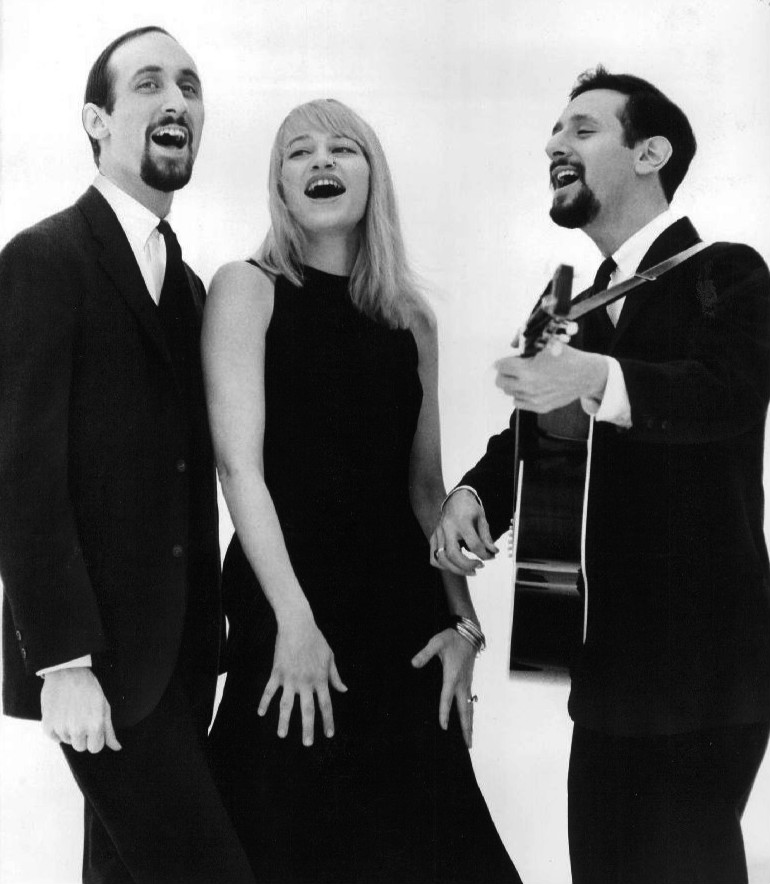
Peter, Paul & Mary - 1963    
photographer unknown     


20,000 vinyl LPs 273: Oscar Brand ~ Bawdy Songs & Backroom Ballads Vol 2

  ~       

vinyl LP front cover
illustration by Irving Sloane 
photo of album cover by Styrous®


Oscar Brand was a Canadian-born American folk singer whose music ran the gamut from novelty songs to serious social commentary. I said in his profile page (link below) his music was not for everyone.   


Bawdy Songs & Backroom Ballads Vol 2 fits snugly into the novelty songs category. And bawdy is a perfect description of the songs. There is nothing subtle nor discrete about them; Mae West would definitely NOT have approved (link below).     
 
He wrote the song, A Gob Is a Slob, which is a story of a girl of dubious virtue! In 1951 it was recorded by Ella Fitzgerald under the title, A Guy Is a Guy; and in 1952 Doris Day recorded it with the same title. In both versions the story is WAY cleaned up!!!! (link below)       


vinyl LP back cover details
detail photo by Styrous®


The graphics for the album cover were by Irving Sloane who illustrated the Oscar Brand Bawdy Songs series as well as dozens of other album covers for Audio Fidelity Records.       


vinyl LP back cover details
illustrations by Irving Sloane 
detail photos by Styrous®


Tracklist:

Side 1:

A1    Zulaika
A2    Winnipeg Whore
A3    Chris Colombo
A4    Ball O' Yarn
A5    Squire Of Great Renown
A6    A Gob Is A Slob
A7    Limericks

Side 2:

B1    Erie Canal
B2    Crusher Bailey
B3    The Same The 'Ole World Over
B4    The Hermit
B5    Foggy Dew
B6    Darby Ram
B7    Black Eyed Susie

Companies, etc.

    Copyright © – Audio Fidelity, Inc.
    Pressed By – Capitol Records Pressing Plant, Scranton

Credits:

    Artwork – Irving Sloane*
    Vocals, Guitar – Oscar Brand

Notes:

 Stereo reissue; black labels with small Audio Fidelity logo printed to the left.
 
Barcode and Other Identifiers

    Matrix / Runout (Side A, runout, etched): AFSD 5806A TVCA [TV vertical, V underneath T]]
    Matrix / Runout (Side B, runout, etched): AFSD 5806B TVCA [TV vertical, V underneath T]]
    Matrix / Runout (Both sides, runout, stamped): Anvil symbol
 
Oscar Brand – Bawdy Songs And Backroom Ballads Vol. 2
Label: Audio Fidelity – AFSD 5806
Format: Vinyl, LP, Album, Reissue, Stereo
Country: US
Released: 1956
Genre:Folk, World, & Country
Style: Folk, Ballad
   
         
Viewfinder links:        
         
Doris Day           
Ella Fitzgerald      
Mae West ~ Queen of the Double Entendres        
        
Net links:        
        
WorldCat Identities ~  Irving Sloane        
        
Audio links:        
         
Bawdy Songs And Backroom Ballads Volume 2 (Complete) (31:34)      
Pro Studio Masters ~ Bawdy Songs and Backroom Ballads       


Styrous® ~ Sunday, February 6, 2021       


Oscar Brand articles/mentions

  ~         
         
mentions:
Roy Acuff ~ w/The Smoky Mountain Boys  


Oscar Brand - 1945     
WNYC New York
publicity photo       
WNYC Archives


The Weavers articles/mentions

   ~        
      
     
Joan Baez ~ Farewell, Angelina     
MacArthur ~ Legend Of 'The Old Soldier'   


The Weavers      
photo: Michael Ochs Archives/Getty Images     


September 15, 2018

78 RPMs 6: Roy Acuff & the Smoky Mountain Boys

Roy Acuff & the Smoky Mountain Boys
side 1: Streamlined Cannon Ball 
Shellac, 10", 78 RPM, Single
photo by Styrous®

Today, September 15, 2018, is the birthday of Roy Acuff. He was an American country music singer, fiddler, and promoter, born 115 years ago. Known as the "King of Country Music," Acuff is often credited with moving the genre from its early string band and "hoedown" format to the singer-based format that helped make it internationally successful. In 1952, Hank Williams told Ralph Gleason, "He's the biggest singer this music ever knew. You booked him and you didn't worry about crowds. For drawing power in the South, it was Roy Acuff, then God."    


Roy Acuff
Library of Congress, Washington, D.C.
(LC-USZ62-124418)
photographer unknown 


Acuff was born on September 15, 1903, in Maynardville, Tennessee. His father gave him several records of regionally renowned fiddlers, such as Fiddlin' John Carson and Gid Tanner, which were important influences on his early style.        
       
In 1932, Dr. Hauer's medicine show, toured the southern Appalachian region, and hired Acuff as one of its entertainers. The purpose of the entertainers was to draw a large crowd to whom Hauer could sell medicines (of suspect quality) for various ailments. While on the medicine show circuit, Acuff met the legendary Appalachian banjoist Clarence Ashley, from whom he learned The House of the Rising Sun and Greenback Dollar, both of which Acuff later recorded. As the medicine show lacked microphones, Acuff learned to sing loud enough to be heard above the din, a skill that would later help him stand out on early radio broadcasts.


 Roy Acuff  
date & photographer unknown
 

Acuff began his music career in the 1930s and gained regional fame as the singer and fiddler for his group, the Smoky Mountain Boys. He joined the Grand Ole Opry in 1938, and although his popularity as a musician waned in the late 1940s, he remained one of the Opry's key figures and promoters for nearly four decades.            

In 1938, he changed the name of his band to Roy Acuff & the Smoky Mountain Boys, a name that was to stick, and recruited long time band members Bashful Brother Oswald, Howdy Forrester and Jimmie Riddle.       


The popularity of Acuff's rendering of the song The Great Speckled Bird (link below) helped the group land a contract with ARC, for which they recorded several dozen tracks (including the band's best-known track, Wabash Cannonball (link below) in 1936.


Roy Acuff  
date & photographer unknown


 Bang, Bang, Lulu

Needing to complete a 20-song commitment, the band recorded two ribald tunes—including When Lulu's Gone—but released them under a pseudonym, the Bang Boys. I remeber when I was in the boy scouts and we would march in the woods we would sing songs including the tune, Bang, Bang, Lulu, with MANY Stanza variations, which was based on When Lulu's Gone. The one Stanza that has always stuck in my brain is:  

"Lulu had a boyfriend, his name was Diamond Dick 
She never saw the Diamond but always saw the . . . 
Bang, Bang, Lulu
 Bang, Bang, Lulu 
Bang, Bang, Lulu
She'll do it every time!"

When you're twelve years old, with dozens of other boys the same age, you have to prove how manly you are. Of all the versions of the tune I've heard, the one that comes closest to the sound and tempo we sang in the scouts is by the German band, Boney M. (link below).     

Another version, Lulu, was recorded by the very rowdy Oscar Brand on his 1958 Old Time Bawdy Sea Shanties.      


Shellac, 10", 78 RPM, Single
photo by Styrous®


In 1942, Acuff and Fred Rose founded Acuff-Rose Music, the first major Nashville-based country music publishing company, which signed such artists as Hank Williams, Roy Orbison, and the Everly Brothers. It was estimated that Acuff earned more than $200, 000 in 1942.      

This November, 1943, file photo shows Acuff, second from left, performing with the Smoky Mountain Boys at the Grand Ole Opry in Nashville, Tennessee. From left are Lonnie Wilson, Acuff, Jimmy Riddle, Pete Kirby, and Velma Williams, partially hidden behind Kirby.


On September 18, 1947, Ernest Tubb and Acuff performed at Carnegie Hall in New York City, NY. It was the first country performance to appear there.     

He was so popular in Tennessee that the Republican Party begged Acuff to run for the governorship in 1948. Acuff garnered more votes than any GOP candidate before him, but it was not enough to win in the then solidly Democratic state.      


Roy Acuff - 1948 
photographer unknown 


His tremendous contribution to country music was recognised in November 1962 when Acuff became the first living inductee into the Country Music Hall of Fame in Nashville, Tennessee, one of the world's largest museums and research centers dedicated to the preservation and interpretation of American vernacular music. Chartered in 1964, the museum has amassed one of the world's most extensive musical collections.      


date & photographer unknown


In 1972, Acuff's career received a brief resurgence in the folk revival movement after he appeared on the Nitty Gritty Dirt Band album, Will the Circle Be Unbroken. The appearance paved the way for one of the defining moments of Acuff's career, which came on the night of March 16, 1974, when the Opry officially moved from the Ryman Auditorium to the Grand Ole Opry House at Opryland. The first show at the new venue opened with a huge projection of a late-1930s image of Acuff and the Smoky Mountain Boys onto a large screen above the stage. A recording from one of the band's 1939 appearances was played over the sound system, with the iconic voice of George Hay introducing the band, followed by the band's performance of Wabash Cannonball. That same night, Acuff showed President Richard Nixon, an honored guest at the event, how to yo-yo, and convinced the president to play several songs on the piano (link below).    

In 1979, Opryland opened the Roy Acuff Theatre, which was dedicated in Acuff's honor (it was demolished in 2011 after suffering extensive damage in the 2010 Tennessee floods).


date & photographer unknown
 

In 1991, he was awarded the National Medal of Arts, and given a lifetime achievement award by the John F. Kennedy Center for the Performing Arts, the first Country music act to receive the esteemed honor.      
      
Roy Acuff died in Nashville, Tennessee on November 23, 1992, of congestive heart failure. He was 89 years old.               
     

side 1: Streamlined Cannon Ball 
Shellac, 10", 78 RPM, Single, Side 1 label
photo by Styrous®

side 2: Mule Skinner Blues 
Shellac, 10", 78 RPM, Single, Side 1 label 
photo by Styrous®

    
Tracklist:

Side 1:

A - The Streamlined Cannon Ball, written by Acuff*
   
B - Mule Skinner Blues (Blue Yodel #8), written by Rodgers*
   
Barcode and Other Identifiers

    Matrix / Runout (Side A Label): DAL 949
    Matrix / Runout (Side B Label): DAL 958

Roy Acuff And His Smoky Mountain Boys ‎– The Streamlined Cannon Ball
Label: Columbia ‎– 37012
Format: Shellac, 10", 78 RPM, Single, Reissue
Country: US
Released: 1946
Genre: Folk, World, & Country
Style: Country


Viewfinder links:        
       
Roy Acuff     
Chickens on Wood String Band        
Everly Brothers        
Radio       
      
Net links:        
       
Roy Acuff Discography 
Alan Cackett ~ Roy Acuff biography 
xRoads Virginia ~ Roy Acuff: Making Hillbilly Music Respectable 
Oldies.com ~ Roy Acuff Biography    
     
YouTube links:        
       
Roy Acuff ~     
             The Streamlined Cannon Ball       
             Mule Skinner Blues     
             The Great Speckled Bird
             Wabash Cannonball  
             When Lulu's Gone     
Boney M - Bang Bang Lulu 1986      
Roy Acuff talks about the new Opry house     


The US Postal Service issued a 37-cent Roy Acuff commemorative stamp in a pressure-sensitive adhesive pane of twenty stamps on September 13, 2003, in Nashville, Tennessee. The stamp, designed by Richard Sheaff, Scottsdale, Arizona, went on sale nationwide September 14, 2003.    


US Postal Service stamp - 1962


Styrous® ~ Saturday, September 15, 2018