Showing posts with label 1812 Overture. Show all posts

June 12, 2025

20,000 vinyl LPs 386: Eugene Ormandy ~ 1812 Overture

 ~  
vinyl LP front cover 
photo of album cover by Styrous®


On June 12, 1812, the French invasion of Russia led by Napoleon began; the invasion became known as The War of 1812.     


vinyl LP back cover 
photo of album cover by Styrous®
 
 
I also did an entry about the 1812 Overture conducted by Antal Doráti that included real life cannons and bells (links below).       


vinyl LP side 1 & 2 
photos by Styrous®


Tracklist:
       
Side 1:
        
A1 - Tchaikovsky* – Overture "1812", Op. 49, composed by Tchaikovsky*

A - Borodin* – In The Steppes Of Central Asia, composed by Borodin*
       
Side 2:
       
Borodin* - Polovtsian Dances (From "Prince Igor"), composed by Borodin*
           B1a - Dance No. 1    
           B1b - Dance No. 2    
           B1c - Dance No. 3    
           B1d - Dance No. 4    
           B2 - Moussorgsky*–    Night On Bald Mountain, composed by Moussorgsky*
        
Companies, etc.
       
    Pressed By – Columbia Records Pressing Plant, Hollywood
       
Credits:
       
    Conductor – Eugene Ormandy
    Orchestra – The Philadelphia Orchestra
        
Notes:
       
Jacket back lower right corner has "6" printed.
Pressed by Columbia Records Pressing Plant, Hollywood identified by the etched H in the deadwax.
Deep groove pressing rings, 69 / 71mm.
Gray 6-eye Columbia Masterworks labels, ɴᴏɴʙʀᴇᴀᴋᴀʙʟᴇ to the left of the spindle hole, in use from 6/1955- 6/1962

LP title located above spindle hole on the labels on both sides.
       
Barcode and Other Identifiers
        
    Other (Jacket back bottom right corner): 6
    Pressing Plant ID (Runout etched): H
    Matrix / Runout (Label side A): x"Lp" 45887
    Matrix / Runout (Label side B): x"Lp" 45888
    Matrix / Runout (Variant 1, side A): XXLP45887-1F I
    Matrix / Runout (Variant 1, side B): XXLP45888-1AC H /
    Matrix / Runout (Variant 2, side A): XXLP45887-1AD I
    Matrix / Runout (Variant 2, side B): XXLP45888-1F H /IIIII
    Matrix / Runout (Variant 3, side A): XXLP45887-1G H II
    Matrix / Runout (Variant 3, side B): XXLP45888-1AL H I 

The Philadelphia Orchestra, Eugene Ormandy / Tchaikovsky*, Borodin*, Mussorgsky* – 1812 Overture
Label: Columbia Masterworks – ML 5392
Format: LP, Album, Mono, Hollywood Pressing
Country US
Released: Sep 1959
Genre:Classical
Style:Romantic
         
Viewfinder links:        
        
Alexander Borodin        
Antal Doráti                 
Eugene Ormandy        
        
Net links:        
Steve Hoffman ~ 1812 Overture with Real Cannons                
YouTube links:        
Antol Dorati ~ 1812 Overture         
Eugene Ormandy ~ 1812 Overture         


Styrous® ~ Thursday, June 12, 2025        


Antal Doráti articles/mentions

 ~        
1812 Overture reel to reel tape      
     
     
mentions:     


Antal Doráti     
photo by Gordon Anthony      


September 2, 2021

1812 Overture articles/mentions

 ~      
1812 Overture reel to reel tape     
1812 Overture vinyl LP           
1812 Overture flash mob      
 
mentions:      
Cirque Du Soleil     
Pyotr Ilyich Tchaikovsky     


November 12, 2020

Nikolai Rimsky-Korsakov articles/mentions

 
~  
     
     
mentions:      
Ken Russell ~ The Planets     
Tchaikovsky ~   
   1812 Overture     


Nikolai Rimsky-Korsakov - January 1, 1866
photographer unknown


November 5, 2020

Alexander Borodin articles/mentions

mentions:     
Pyotr Ilyich Tchaikovsky
Tchaikovsky ~ 1812 Overture     


photographer unknown


April 24, 2018

Tchaikovsky ~ 1812 Overture flash mob

~


screenshot by 


I have always loved viewing flash mob videos. It is delightful to watch the reaction of the people present; the surprised looks at first then the realization of something unexpectedly new, uplifting and even educational happening in their lives.  

The first flash mob video I saw was in 2010. It was a performance of the song Do-Re-Mi sung by Julie Andrews from the of the 1965 film version of Sound of Music. It was performed in a train station in Antwerp, Belgium (link below).   

When I was 18 the very first classical music album I bought was the Arthur Fiedler version of the Tchaikovsky, 1812 Overture (link below); it was and will always remain my favorite piece of "pop" classical music. I still get chills listening to the climax of the work even without cannons.   

It is interesting that Tchaikovsky actually hated the Overture even though it won him fans all over the world and made him a household name.  
   
Last week I saw a flash mob video from September 3rd, 2016, at Algemesí (Spain); the Banda Simfònica d'Algemesí, performed the Tchaikovsky, 1812 Overture in a Flash Mob. It is a delight to watch the gradual "growth" of the orchestra and the reactions of the people as it does (link below).   


Viewfinder links:       
     
1812 Overture & Arthur Fiedler      
Arthur Fiedler articles/mentions      
      
Net link:       
     
Classical FM ~ The 1812 Overture: the hit that Tchaikovsky hated    
     
YouTube links:         

Banda Simfònica d'Algemesí: Tchaikovsky ~ 1812 Overture
Antwerp train station flash mob ~ Do-Re-Mi (2010)     


. . . very loud and noisy and completely without artistic merit, obviously written without warmth or love.”  
                               ~ Pyotr Ilyich Tchaikovsky


Styrous® ~ Tuesday, April 24, 2018       


December 9, 2017

The San Francisco Civic Auditorium, Motorama & Arthur Fiedler

date & photographer unknown


104 years ago this month, in 1913, ground was broken for construction of the San Francisco Civic Center Auditorium.


The auditorium had a huge pipe organ. The Opus 500 was built for the 1915 Panama Pacific International Exhibition in San Francisco.         


The organ stood majestically at the World’s Fair and then the Civic Center Auditorium, until the 1989 Loma Prieta Earthquake, when it was damaged and dismantled.     


Motorama

I saw various events at the Civic Center Auditorium (now called the Bill Graham Civic Auditorium) on Grove Street in San Francisco. I only remember two, one of which was an annual presentation by General Motors called the Motorama.     

The General Motors Motorama was an auto show staged by GM from 1949 to 1961. These automobile extravaganzas were designed to whet public appetite and boost automobile sales with displays of fancy prototypes, concept vehicles and other special or halo models. Motorama grew out of the Alfred P. Sloan yearly industrial luncheon at the New York City Waldorf Astoria, beginning in 1931. They were almost invariably held in conjunction with the New York Auto Show, that for many years was held traditionally in the first week of January.            

There was a live musical number staged at various times during the day. I remember one year the performance was set in the future with all the gadgets it was imagined we would have. They had no idea how far off but at the same time right on target they were.           

This performance had a man and a woman, each on a small raised stage on opposite sides of the main floor of the auditorium. They sang back and forth to each other with what were supposed to be wrist watch radios. As there was no such thing at the time except for in the Dick Tracy comic book . . .  

 
Dick Tracy USA stamp - 1995

. . . (and DECADES before iPhones) the music and vocal was prerecorded and lipped-synced, of course. I can still hear the song in my mind . . . 

🎵"My heart calling your heart, over"🎵


Arthur Fiedler @ the Civic

The other event I remember because I attended many of them and have fond memories of going to the Auditorium in the late fifties, early 60's to hear Arthur Fiedler as he led the San Francisco Pops Orchestra on wild and thrilling orchestral rides.


date & photographer unknown 


Most of the music was in the "Pop" vein of classical music: Ravel's Bolero, or the Tchaikovsky "Pop" works: the 1812 Overture (with no cannons) or the Capriccio Italien (links below) . . . 


. . . and other chestnuts like the William Tell Overture, Orpheus In The Underworld (which evolves into the notorious but energetic Can-Can at the end), the Sorcerer's Apprentice, the Maple Leaf Rag, orchestral covers of Beatles songs, etc. You get the idea!    

He would occasionally break into more serious work; he did perform a pretty spectacular version of the 1924 work for piano and orchestra, Rhapsody in Blue, by George Gershwin: it never failed to bring down the house. One of his concert favorites was Jalousie by Jacob Gade. However, Gade once presented Fiedler with a score for a symphony which Fiedler recalled as "one of the worst pieces of music I ever looked at." More on this Fiedler attitude by his daughter in the "Pop" King entry (link below)     


The San Francisco Civic Auditorium

The physical layout of the audience was unique for a concert venue. In the balcony overlooking the main floor of the San Francisco Civic Auditorium (now named the Bill Graham Civic Auditorium) there were typical, permanent theater seats.     
 
During the Fiedler concerts, however, the main floor was a different story; there were large tables covered in linen table cloths and napkins, candles and maybe even flowers (but I'm not certain about that). I tried to find a shot of the main floor during one of his concerts but couldn't. Drinks and dinner to enjoy during the concert was available. It was tons of fun!  

The auditorium was designed by Bay Area architects John Galen Howard, Frederick Meyer and John W. Reid, Jr. and built in 1915 as part of the Panama–Pacific International Exposition.    


photographer unknown


In 1992, the San Francisco Board of Supervisors voted to rename the auditorium after the rock concert impresario Bill Graham, who had died the previous year in a helicopter crash.     


Bill Graham - 1966 


Viewfinder link:               
                
         
Net links:               
                
PBS ~ Evening At the Pops with Arthur Fiedler          
         
YouTube links:               
                
Arthur Fiedler & the Boston Pops ~          
      Tchaikovsky ~ Capriccio Italien          
      Rosini ~  William Tell Overture    
      My Fair Lady!
      Sound Of Music Medley         
      Sousa ~ Stars and Stripes Forever               
      The Beatles ~ Eleanor Rigby     
                          ~ Let It Be      
      Gade ~ Jalousie   
      Gershwin / Earl Wild piano ~ Rhapsody in Blue - 1959     


All in all, it was a fun time!


Styrous® ~ Saturday, December 9, 2017       


November 24, 2017

Antal Dorati articles/mentions

~        
Tchaikovsky ~ 1812 Overture        
The Nutcracker & Joyous Tidings 
Pyotr Ilyich Tchaikovsky ~ 1812 Overture  


photographer unknown


November 6, 2017

20,000 Vinyl LPs 114: Pyotr Ilyich Tchaikovsky ~ 1812 Overture & Arthur Fiedler


vinyl LP album cover detail 
 detail photo by Styrous®


On this date, November 6, in 1893, Pyotr Ilyich Tchaikovsky (/ˈpjtər ɪˈljɪ ˈkɒfski/; Russian: Пётр Ильи́ч Чайко́вский) often anglicized as Peter Ilyich Tchaikovsky, died. He was a Russian composer of the late-Romantic period, some of whose works are among the most popular music in the classical repertoire. He was the first Russian composer whose music made a lasting impression internationally, bolstered by his appearances as a guest conductor in Europe and the United States.  

The first classical music album I bought was this recording of the 1812 Overture by Tchaikovsky, so, I have chosen it to commemorate him. The recording was conducted by the funky, fun and marvelous Arthur Fiedler.    


I would go to the Civic Center Auditorium (now called the Bill Graham Civic Auditorium) on Grove Street in San Francisco in the late fifties to hear him as he led the San Francisco Pops Orchestra on wild and thrilling orchestral rides (link below).      


vinyl LP album back cover
 photo by Styrous®


Fiedler was born in Boston, Massachusetts; he died on July 10, 1979. Composer John Williams succeeded Fiedler as the orchestra's nineteenth director (Pop King link below).         


vinyl LP album back cover detail
 detail photo by Styrous®
 

Fiedler was fascinated by the work of firefighters and would travel in his own vehicle to large fires in and around Boston at any time of the day or night to watch the firefighters at work. The biography of Fiedler reports that the conductor once helped in the rescue efforts at the tragic Cocoanut Grove fire in Boston in 1942 (link below).                 


vinyl LP album back cover detail
 detail photo by Styrous®
 

Peter Ilich Tchaikovsky was born on May 7, 1840, in Votkinsk, a small town in Vyatka Governorate (present-day Udmurtia) in the Russian Empire, into a family with a long line of military service. Although musically precocious, he was educated for a career as a civil servant.

He entered the new Saint Petersburg Conservatory and graduated from it in 1865. The formal Western-oriented teaching he received there set him apart from composers of the contemporary nationalist movement embodied by the Russian composers of The Five: Mily Balakirev (the leader), César Cui, Modest Mussorgsky, Nikolai Rimsky-Korsakov and Alexander Borodin all of whom lived in Saint Petersburg,     


vinyl LP album back cover detail
 detail photo by Styrous®


Tchaikovsky's training from the conservatory set him on a path to reconcile what he had learned with the native musical practices to which he had been exposed from childhood. From this reconciliation, he forged a personal but unmistakably Russian style; not an easy task. The principles that governed melody, harmony and other fundamentals of Russian music ran completely counter to those that governed Western European music; this seemed to defeat the potential for using Russian music in large-scale Western composition or for forming a composite style. Russian culture exhibited a split personality, with its native and adopted elements having drifted apart increasingly since the time of Peter the Great. This resulted in uncertainty among the intelligentsia about the country's national identity—an ambiguity mirrored in Tchaikovsky's career.       


vinyl LP, Side 1
 photo by Styrous®


Tchaikovsky's life was punctuated by personal crises and depression. Contributory factors included his early separation from his mother for boarding school followed by his mother's early death, the death of his close friend and colleague Nikolai Rubinstein, and the collapse of the one enduring relationship of his adult life, which was his 13-year association with the wealthy widow Nadezhda von Meck. His homosexuality, which he kept private, has traditionally also been considered a major factor, though some musicologists now downplay its importance.

While his music has remained popular among audiences, critical opinions were initially mixed. Some Russians did not feel it was sufficiently representative of native musical values and expressed suspicion that Europeans accepted the music for its Western elements. In an apparent reinforcement of the latter claim, some Europeans lauded Tchaikovsky for offering music more substantive than base exoticism and said he transcended stereotypes of Russian classical music. Others dismissed Tchaikovsky's music as "lacking in elevated thought," according to longtime New York Times music critic Harold C. Schonberg, and derided its formal workings as deficient because they did not stringently follow Western principles.       

However, Tchaikovsky was honored in 1884, by Emperor Alexander III, and awarded a lifetime pension. So there!  


vinyl LP label, Side 1
 photo by Styrous®


Tchaikovsky's sudden death at the age of 53 is generally ascribed to cholera; there is an ongoing debate as to whether cholera was indeed the cause of death, and whether it was accidental or self-inflicted.     

There is a recording of Tchaikovsky's voice made in Moscow in January 1890, by Julius Block on behalf of Thomas Edison on Wikipedia (link below).     


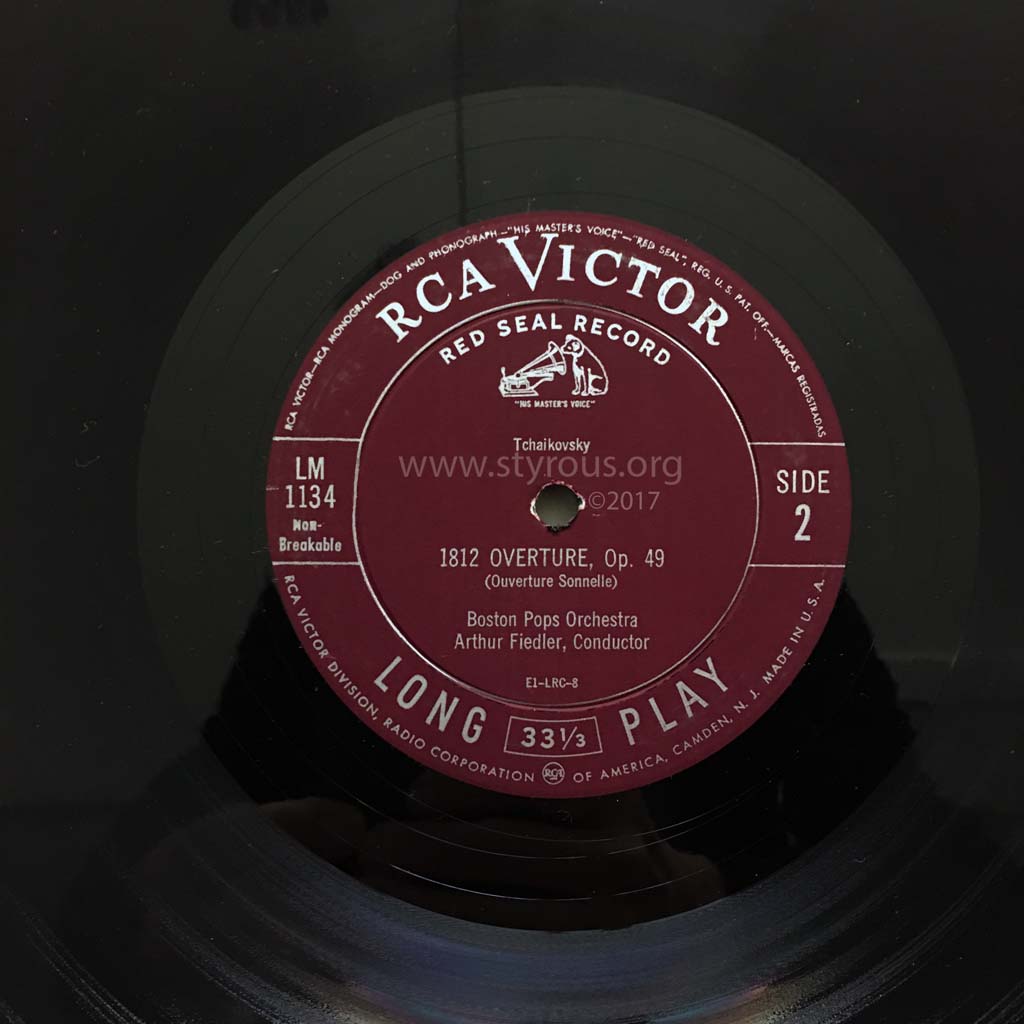
vinyl LP, Side 2
 photo by Styrous®


The Festival Overture In E major, Op. 49, popularly known as the 1812 Overture, was written in 1880 by Tchaikovsky to commemorate Russia's defence of its motherland against the Napoleon Grande Armée invasion  of 1812. The overture debuted in Moscow on August 20, 1882.

Some productions have chimes played and cannons fired in the finale. One famous version of this was performed and recorded by Antal Doráti in 1954 (link below).         


vinyl LP label, Side 2
 photo by Styrous®


Tracklist:

Side 1:

A1 - Capriccio Italien, Op. 45   

Side 2:

B1 - 1812 Overture, Op. 49   

Credits:

    Composed By – Tchaikovsky*
    Conductor – Arthur Fiedler
    Orchestra – Boston Pops Orchestra*
    
Notes:
  2nd cover version - Release with same cat # has different cover art and center labels thanks Capriccio Italien, 1812 Overture           

Tchaikovsky* - Boston Pops Orchestra*, Arthur Fiedler ‎– Capriccio Italien, 1812 Overture
Label: RCA Victor Red Seal ‎– LM 1134
Format: Vinyl, LP, Album
Country: US
Released: 1953
Genre: Classical


Viewfinder links:       
   
1812 Overture (Antal Dorati)       
1812 Overture (Arthur Fiedler)          
The Nutcracker        
Symphony #6: (Pathétique)         
Swan Lake       

Van Cliburn & Sputnik ~ 1958       
Arthur Fiedler articles/mentions        
Arthur Fiedler ~ The "Pop" King             
Arthur Fiedler, Mickey Alpert & the Cocoanut Grove fire 
The SF Civic Auditorium, Motorama & Arthur Fiedler       
John Willimas ~ A Soundtrack King                     
PIL (Public Image Ltd.)       
       

Net links:              
              
Scotty Moore ~ Civic Auditorium       
Tchaikovsky's voice on Wikipedia              
Recording history                       
      
YouTube links:             
           
Antal Doráti ~ 1812 Overture (w/chimes & cannons)          
Arthur Fiedler ~ Tchaikovsky: Overture 1812, Op.49                                


Styrous® ~ Monday, November 6, 2017