Showing posts with label Antal Doráti. Show all posts
Showing posts with label Antal Doráti. Show all posts
June 22, 2025


June 12, 2025

September 2, 2021


July 22, 2017
Pyotr Ilyich Tchaikovsky articles/mentions

~
Pyotr Ilyich Tchaikovsky
The Nutcracker & Joyous Tidings
The Nut Rocker
Shorty Rogers ~ The Swingin' Nutcracker
Symphony #6
Pyotr Ilyich Tchaikovsky
Painting by Nikolai Kuznetsov - 1893
mentions: The Nutcracker & Joyous Tidings
The Nut Rocker
Shorty Rogers ~ The Swingin' Nutcracker
Symphony #6
Pyotr Ilyich Tchaikovsky
Painting by Nikolai Kuznetsov - 1893
Victoria de los Ángeles
Antal Doráti ~ 1812 Overture
The Magical Music of Walt Disney
PIL (Public Image Ltd.) ~ Metal Box
Ken Russell ~ Gustav Holst's The Planets
PIL (Public Image Ltd.) ~ Metal Box
Ken Russell ~ Gustav Holst's The Planets
Adolphe Sax ~ The saxophone & other weird wonders
John WilliamsMay 7, 2016
101 Reel-to-Reel Tapes 117: Tchaikovsky ~ 1812 Overture

reel-to-reel tape cover
photo by Styrous®
~ ~ ~
I
started the Vinyl LP series because I have a collection of over 20,000 vinyl record albums I am
selling; each blog entry is about an album from my collection. The 101 Reel-to-Reel Tapes series is an extension of that collection. Inquire
for information here.
~ ~ ~
Pyotr Ilyich Tchaikovsky, aka Peter Ilyich Tchaikovsky, was born on this day, May 7, 1840, in Vyatka Governorate (present-day Udmurtia) in the Russian Empire, into a family with a long line of military service.
the 1812 Overture
The Tchaikovsky 1812 Overture, written in 1880, was my first experience in classical music. The first version of the Overture I purchased was the 1953 Arthur Fiedler (more on him in a future article) vinyl LP monophonic recording.

This reel-to-reel tape recording by Antal Doráti was purchased later in 1959. In the US, stereo magnetic tape recording was demonstrated on standard 1/4-inch tape for the first time in 1952, using two sets of recording and playback heads, upside-down and offset from one another. I remember being in awe at the lack of pops, snaps and crackles and did not mind the faint tape hiss.
It wasn't until November of 1957, when the Audio Fidelity Records label released the first mass-produced stereophonic disc, that the only stereo recordings were on reel-to-reel audio tape.

Dorati was the first conductor to make a recording of Tchaikovsky's "1812" Overture (featuring the Minneapolis Symphony Orchestra) with real cannons, brass band, and church bells, first in mono in 1954 and then in stereo in 1958. I remember I was 19, studying music in college when I discovered this recording. The fact that it utilized a REAL cannon, bronze bells and chimes was more than this 19-year-old boy could resist! The incredibly rousing finale is a sonic spectacle! WOW!

photo by Styrous®
This reel-to-reel tape recording by Antal Doráti was purchased later in 1959. In the US, stereo magnetic tape recording was demonstrated on standard 1/4-inch tape for the first time in 1952, using two sets of recording and playback heads, upside-down and offset from one another. I remember being in awe at the lack of pops, snaps and crackles and did not mind the faint tape hiss.
It wasn't until November of 1957, when the Audio Fidelity Records label released the first mass-produced stereophonic disc, that the only stereo recordings were on reel-to-reel audio tape.

reel-to-reel tape back cover
photo by Styrous®
Dorati was the first conductor to make a recording of Tchaikovsky's "1812" Overture (featuring the Minneapolis Symphony Orchestra) with real cannons, brass band, and church bells, first in mono in 1954 and then in stereo in 1958. I remember I was 19, studying music in college when I discovered this recording. The fact that it utilized a REAL cannon, bronze bells and chimes was more than this 19-year-old boy could resist! The incredibly rousing finale is a sonic spectacle! WOW!

detail photo by Styrous®
The 1812 festival overture in E♭ major, Op. 49, popularly known as the 1812 Overture, is an overture written in 1880 to commemorate Russia's defence of its motherland against Napoleon's invading Grande Armée in 1812. The opening is based on the first mode of the Kievan
chant.

scene depicting the French retreat from Russia in 1812,
painting by Illarion Pryanishnikov (1874)
The overture debuted in Moscow on 20 August 1882, conducted by Ippolit Al'tani under a tent near the then unfinished Cathedral of Christ the Saviour, which also memorialized the 1812 defense of Russia. The overture was conducted by Tchaikovsky himself in 1891 at the dedication of Carnegie Hall. The overture is best known for its climactic volley of cannon fire, ringing chimes, and brass fanfare finale. It has also become a common accompaniment to fireworks displays. The 1812 Overture became Tchaikovsky's most popular work.

reel-to-reel tape box spine
photos by Styrous®
There is a very beautiful recording of the Overture conducted by Vladimir Ashkenazy with full choral by the St.Petersburg Chamber Choir, the Leningrad Military Orchestra and the St. Petersburg Philharmonic Orchestra (link on YouTube below).

reel-to-reel tape back cover detail
detail photo by Styrous®
The Doráti 1954 Mercury Records recording (this one) with the Minneapolis Symphony Orchestra, was partially recorded at West Point, and used the Yale Memorial Carillon in New Haven, Connecticut, and a Napoleonic French single muzzleloading cannon shot dubbed in 16 times as written. On the first edition of the recording, one side played the Overture and the other side featured a narrative by Deems Taylor about how the cannon and bell effects were accomplished. The narrative is actually very interesting (links to Overture & ).
Both the mono and stereo "1812" versions sold over one million copies, and was awarded a gold disc by the RIAA.
Both the mono and stereo "1812" versions sold over one million copies, and was awarded a gold disc by the RIAA.

reel-to-reel tape
photo by Styrous®
In 1983, Queen Elizabeth II made Doráti an honorary Knight Commander of the Order of the British Empire
(KBE). This entitled him to use the post-nominal letters KBE. By
convention honorary knights do generally not use the "Sir" unless they
subsequently acquire UK citizenship.
His recording of Stravinsky's Le Sacre du Printemps with the Detroit Symphony Orchestra, received the coveted French award Grand Prix du Disque.
Doráti died on November 13, 1988.
Doráti died on November 13, 1988.

reel-to-reel tape label
photo by Styrous®
Track listing:
side one - 1812 Overture - 14:50
side two - narration by Deems Taylor (Commentary) - 12:02
side two - narration by Deems Taylor (Commentary) - 12:02
Minneapolis Symphony Orchestra, University Of Minnesota Brass Band, Tchaikovsky* – 1812 Festival Overture Op. 49
Label: Mercury – MCS 5-54
Label: Mercury – MCS 5-54
Series: Mercury Living Presence –
Format: Reel to Reel Tape, 7-1/2 IPS, Stereo
Country: US
Released: 1958
Genre: Classical
Style: Romantic
Credits:
A1 –Minneapolis Symphony Orchestra With University Of Minnesota Brass Band 1812 Festival Overture, Op. 49
Composed By – Tchaikovsky*
A2 –Deems Taylor Spoken Commentary (Beginning)
B1 –Deems Taylor Spoken Commentary -
Composed By – Tchaikovsky*
Companies, etc.
Recorded At – Northrop Memorial Auditorium
Credits:
Conductor – Antal Dorati (tracks: A1)
Directed By – Gale Sperry (tracks: A1)
Notes:
Also featured on A1:
Bronze Cannon, Duay, France (1775) Courtesy U. S. Military Academy, West Point, N. Y.
Bells of the Laura Spelman Rockefeller Memorial Carillon, The Riverside Church
Format: Reel to Reel Tape, 7-1/2 IPS, Stereo
Country: US
Released: 1958
Genre: Classical
Style: Romantic
Credits:
A1 –Minneapolis Symphony Orchestra With University Of Minnesota Brass Band 1812 Festival Overture, Op. 49
Composed By – Tchaikovsky*
A2 –Deems Taylor Spoken Commentary (Beginning)
B1 –Deems Taylor Spoken Commentary -
Composed By – Tchaikovsky*
Companies, etc.
Recorded At – Northrop Memorial Auditorium
Credits:
Conductor – Antal Dorati (tracks: A1)
Directed By – Gale Sperry (tracks: A1)
Notes:
Also featured on A1:
Bronze Cannon, Duay, France (1775) Courtesy U. S. Military Academy, West Point, N. Y.
Bells of the Laura Spelman Rockefeller Memorial Carillon, The Riverside Church
Net links:
1812 Instrumentation
Styrous® ~ Saturday, May 7, 2016
December 10, 2012
20,000 Vinyl LPs 15: The Nutcracker & Joyous Tidings

At
this time of year, beside Santa, Rudolph, Frosty the Snowman, Jesus,
Mary & Joseph, one of the great holiday traditions is The Nutcracker ballet. Every little kid thrills at the sight of the tree
growing (or Clara shrinking, depending on your point of view) in the first act. Through the magic of clever staging, lighting, incredibly dramatic but exquisitely beautiful ascending modulating music I still get goose-bumps when I see it happening. Watch it in action on YouTube.
I saw my first performance of the Nutcracker in 1962, performed by the Ballet Russe de Monte Carlo at the San Francisco Opera House. It featured George Zorich.
Zorich has been quoted as once saying, “Dance should live; if it doesn’t come from the heart, it is not dancing.” I had been dancing for four years by then and
was about to dance in a production of the Nutcracker. I absorbed every
move he made.
(click on any image to see larger size)

photo by Styrous® George Zoritch
April 11, 1942
photo by Carl Van Vechten
The Nutcracker was in the Ballet Russe repertoire
for almost the entirety of the company's existence, from 1940 to 1962, except in 1953 when it was not performed. I saw one of the last
performances of it by the company. There is actually a DVD of the
performance at the Chicago Public Library. It was originally filmed in 16 mm by Ann Barzel. She was 101 years old when she died as documented in the New York Times.
The Nutcracker is a two-act ballet originally choreographed by Marius Petipa and Lev Ivanov with a score by Pyotr Ilyich Tchaikovsky.
It was first performed on December 18th of 1892 at the Maryinsky Theatre in Saint Petersburg, Russia, with decor by Botcharov.

(1818-1910) (1834–1901)
photographer unknown

(1840-1893)
photographer unknown
The libretto is from an adaptation (The Tale of the Nutcracker) by Alexandre Dumas, père of the E.T.A. Hoffmann story "The Nutcracker and the Mouse King" written in 1816.

Hoffmann is the subject and hero of the opera, The Tales of Hoffmann, by Jacques Offenbach.

photographer unknown
Early images of the Nutcracker

original costume sketch
for The Nutcracker ca. 1890
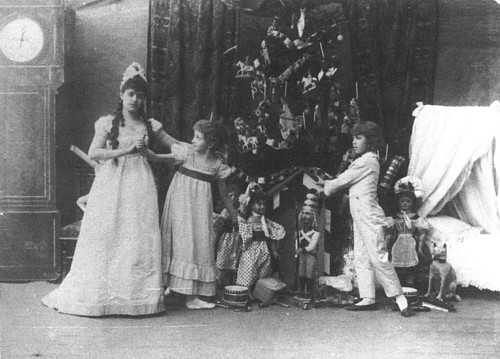
Photo of Stanislava Belinskaya as Clara (left),
an unknown performer (center), &
Vassily Stulkolin as Fritz (right)
in the Imperial Ballet's original production of
Circa December, 1892
Scanned from the book
"The Life and Ballets of Lev Ivanov"
by Roland John Wiley
Oxford University Press, 1997
Unknown photographer of the
Imperial Mariinsky Theatre
Oxford University Press, 1997
Unknown photographer of the
Imperial Mariinsky Theatre
St. Petersburg, Russian Empire

Konstantin Ivanov's original sketch
for the set of The Nutcracker (1892)

Photographic postcard of the ballerina
Olga Preobrajenskaya (1871-1962)
as the Sugarplum Fairy &
the danseur Nikolai Legat (1869-1937)
as Prince Coqueluche in the
original production of "The Nutcracker"
by the Imperial Ballet
(The Kirov Ballet under Soviet rule,
now the Mariinsky Ballet)
now the Mariinsky Ballet)
Circa 1900
Unknown photographer of the photography
department of the Imperial Mariinsky Theatre
St. Petersburg, Russian Empire.

Ivan Vsevolozhsky's original costume designs for
Some critics
called The Nutcracker "astonishingly rich in inspiration" and "from
beginning to end, beautiful, melodious, original, and characteristic."
But some critics found the party scene "ponderous" and the Grand Pas de
Deux "insipid" (You can't please everyone).
Many
recordings have been made since 1909 of the Nutcracker Suite (also see: Nutcracker Suite), which
made its initial appearance on disc that year in what is now
historically considered the first record album. Antal Doráti was especially well known for his recordings of Tchaikovsky's music.

photographer unknown
Doráti
was the first conductor to record the complete performances of all three of
Tchaikovsky's ballets - Swan Lake, Sleeping Beauty and The Nutcracker.
The albums were recorded in mono in 1954, for Mercury Records, with the Minneapolis Symphony Orchestra. All three ballets were first issued separately, but later re-issued in a 6-LP set.
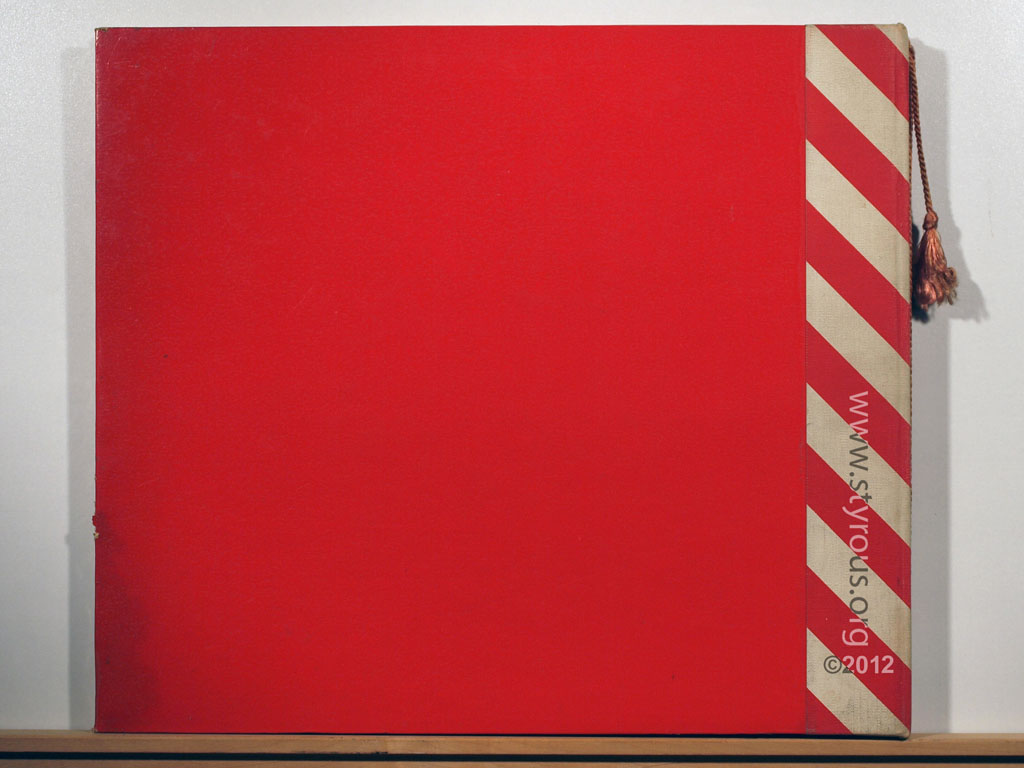
The photos below are of the first complete recording of the ballet issued in 1954, in mono, of course, with the red bookmark cord and tassel. I have loved looking at it all these years. It featured an elaborate and beautifully bound book with liner notes/descriptions of the story, the history of the Ballet and the recording of the ballet by Clair Van Ausdall; it has delicate line illustrations by Dorothy Maas and the cover design was by George Maas.
The photos below are of the first complete recording of the ballet issued in 1954, in mono, of course, with the red bookmark cord and tassel. I have loved looking at it all these years. It featured an elaborate and beautifully bound book with liner notes/descriptions of the story, the history of the Ballet and the recording of the ballet by Clair Van Ausdall; it has delicate line illustrations by Dorothy Maas and the cover design was by George Maas.
All photos of the Antal Dorati/Nutcracker album by Styrous®
(click on any image to see larger size)



So,
in closing, this is my way of wishing you all the best of the holiday
season. Here's hoping happiness and love find you well and hit you up one
good. All the best in the brand new year ahead of us.
And don't forget, dance brightly on.
Styrous® ~ December 10, 2012
And don't forget, dance brightly on.
The entire collection is for sale. Interested? Contact Styrous®
Styrous® ~ December 10, 2012
~
~
Subscribe to:
Posts (Atom)