Showing posts with label Al Jolson. Show all posts

June 28, 2026

Mel Brooks ~ Man of Many Dreams

 ~       


photo: HBO 
      
 
Today is the birthday of American actor, filmmaker, comedian, songwriter, and playwright Melvin James Brooks (né Kaminsky) better known as just plain Mel Brooks. But there is nothing plain about this guy! He has a career spanning over seven decades, he is known as a writer and director of a variety of successful broad farces and parodies. A recipient of numerous accolades, he is one of 28 entertainers to win the EGOT, which includes an Emmy, a Grammy, an Oscar, and a Tony. He received a Kennedy Center Honor in 2009, a Hollywood Walk of Fame star in 2010, the AFI Life Achievement Award in 2013, a British Film Institute Fellowship in 2015, a National Medal of Arts in 2016, a BAFTA Fellowship in 2017, and an Honorary Academy Award in 2024.     
 
Brooks was born on a tenement kitchen table on June 28, 1926, in Brownsville, Brooklyn to Katie (née Brookman) and Max Kaminsky. He grew up in Williamsburg, Brooklyn. His father's family were German Jews from Danzig (now Gdańsk, Poland). His mother was a Russian Jewish immigrant from Kiev, in the Pale of Settlement of the Russian Empire (now Ukraine). His father died of tuberculosis of the kidney at 34 when Brooks was two years old. He has said of his father's death, "There's an outrage there. I may be angry at God, or at the world, for that. And I'm sure a lot of my comedy is based on anger and hostility. Growing up in Williamsburg, I learned to clothe it in comedy to spare myself problems—like a punch in the face."            
 
He was a small, sickly boy, who often was bullied and teased by his classmates because of his size. At age nine, he saw Anything Goes with William Gaxton, Ethel Merman, and Victor Moore at the Alvin Theater. After the show, he told his uncle that he was not going to work in the garment district like everyone else, but instead wanted to go into show business.          
 
Brooks studied drums under jazz musician Buddy Rich, who had also grown up in Williamsburg and earned money as a musician from age 14. During his teens, he changed his name to Melvin Brooks, used his mother's maiden name Brookman, after being confused with trumpeter Max Kaminsky.     
 
In early 1944 in his senior year in high school, Brooks was recruited to take the Army General Classification Test, a Stanford–Binet-type IQ test. He received high scores and was sent to the Army Specialized Training Program at the Virginia Military Institute to be taught electrical engineering, horse riding, and saber fighting. In 1944, Brooks was drafted into the US Army. Twelve weeks later, when he turned 18, he officially joined the Army at Fort DixNew Jersey, induction center, and was sent to the Field Artillery Replacement Training Center at Fort Sill, Oklahoma, for basic and radio operator training. In December 1944, Brooks was transferred to the 1104th Engineer Combat Battalion as a combat engineer, participating in the Battle of the Bulge. Of his experience there, Brooks noted: 
"Along the roadside, you'd see bodies wrapped up in mattress covers and stacked in a ditch, and those would be Americans, that could be me. I sang all the time ... I never wanted to think about it ... Death is the enemy of everyone, and even though you hate Nazis, death is more of an enemy than a German soldier."   
Stationed in Saarbrücken and Baumholder, the battalion was responsible for clearing booby-trapped buildings and defusing land mines as the Allies advanced into Nazi Germany. Brooks was tasked with land-mine location; defusing was done by a specialist. Brooks has stated that when he heard Germans singing over loudspeakers, he responded by singing the American-Jewish singer Al Jolson hit "Toot, Toot, Tootsie (Goo' Bye!)" into a bullhorn.        
 
After the war, Brooks's mother secured him a job as a clerk at the Brooklyn Navy Yard, but Brooks "got into a taxi and ordered the driver to take him to the Catskills", where he started working in various Borscht Belt resorts and nightclubs in the Catskill Mountains as a drummer and pianist.  
       
In 1959, Brooks and Carl Reiner improvised and eventually developed the idea of the 2000-year-old man who had witnessed the crucifixion of Jesus Christ. They began performing the 2000 Year Old Man act on The Steve Allen Show. Their performances led to the release of the comedy album 2000 Years with Carl Reiner and Mel Brooks that sold over a million copies in 1961.[ It eventually became a comedy record album which ended up in my collection (link below).      
       
Brooks was involved in the creation of the Broadway musical All American, which debuted on Broadway in 1962. He wrote the play with lyrics by Lee Adams and music by Charles Strouse. It starred Ray Bolger as a southern science professor at a large university. During a press conference for All American, a reporter asked, "What are you going to do next?" and Brooks replied, "Springtime for Hitler," perhaps riffing on Springtime for Henry. For several years, Brooks toyed with a bizarre and unconventional idea about a musical comedy of Adolf Hitler. He explored the idea as a novel and a play before finally writing a script. He eventually found two producers to fund it, Joseph E. Levine and Sidney Glazier, and made his first feature film, The Producers (1968). The Producers was so brazen in its satire that major studios would not touch it, nor would many exhibitors. Brooks finally found an independent distributor who released it as an art film, a specialized attraction. At the 41st Academy Awards, Brooks won the Academy Award for Best Original Screenplay for the film over fellow writers Stanley Kubrick and John CassavetesThe Producers became a smash underground hit, first on the nationwide college circuit, then in revivals and on home video. It premiered to a limited audience in Pittsburgh, Pennsylvania, on November 22, 1967, before achieving a wide release in 1968.   
 
Brooks, along with his collaborator Thomas Meehan, later adapted it into a musical, which was hugely successful on Broadway and received an unprecedented 12 Tony awards. In 2000, Roger Ebert included The Producers in his canon of Great Movies, and remembered being in an elevator with Brooks and Anne Bancroft shortly after the movie was released: "A woman got on the elevator, recognized him and said, 'I have to tell you, Mr. Brooks, that your movie is vulgar.' Brooks smiled benevolently. 'Lady', he said, 'it rose below vulgarity.'"        


The Producers - 1968 
 
 
Viewfinder links:     
       
Anne Bancroft      
Ray Bolger       
Adolf Hitler         
Al Jolson       
Max Kaminsky        
Ethel Merman           
Buddy Rich        
Charles Strouse        


Net links:      


YouTubtre links:      
    
The 2000 Year Old Man 1967           
The 2000 Year Old Man album (11 mins., 46 secs.)            
Al Jolson ~ Toot, Toot, Tootsie (Goo' Bye!)      


October 3, 2025

20,000 vinyl LPs 400: Michael Gambon ~ The Singing Detective


Today is the birthday of Irish-English actor, Michael Gambon who was born in 1940, in the Cabra suburb of Dublin. He performed with Laurence Olivier as one of the original members of the Royal National Theatre. He received four BAFTA Awards for the British film The Singing Detective.        
  
 photo of album cover by Styrous®


The Singing Detective is a six-part BBC television serial drama, written by Dennis Potter, starring Michael Gambon and directed by Jon Amiel. Its six episodes are "Skin", "Heat", "Lovely Days", "Clues", "Pitter Patter" and "Who Done It". The serial was broadcast in the United Kingdom in 1986 on Sunday nights from 16 November to 21 December, with later PBS and cable television showings in the United States.  It won a Peabody Award in 1989 and ranks 20th on the British Film Institute list of the 100 Greatest British Television Programmes, as voted by industry professionals in 2000. It was included in the 1992 Dennis Potter retrospective at the Museum of Television & Radio and became a permanent addition to the museum's collections in New York and Los Angeles.         


The plot: Mystery writer Philip E. Marlow is suffering writer's block and is hospitalized because his psoriatic arthropathy, a chronic skin and joint disease, is at an acute stage, forming lesions and sores over his entire body and partially crippling his hands and feet. Dennis Potter suffered from this disease and he wrote with a pen tied to his fist in much the same fashion Marlow does in the last episode. (Although severe, Marlow's condition was intentionally understated compared to Potter's, whose skin would sometimes crack and bleed.) Being a sufferer of this condition, it is one of my favorite films of all time.                


As a result of constant pain, a fever caused by the condition and his refusal to take medication, Marlow falls into a fantasy world involving his Chandleresque novel The Singing Detective, an escapist and noir adventure about a detective (also named "Philip Marlow") who sings at a dance hall and takes the jobs refused by "the guys who don't sing". Marlow is "plot-dreaming", trying out various solutions to a working plot in his head, deciding as he goes what plot element works best with what character or situation, interspersed with bits of ideas that occur to him off the top of his head and discarding (with some afterthoughts) parts of his story that no longer work when other changes have been made.     
 
Some members of the cast play several roles. Marlow and his alter ego, the singing detective, are played by Michael Gambon. Patrick Malahide plays three characters—the contemporary Finney, who Marlow thinks is having an affair with his ex-wife Nicola, played by Janet Suzman; the imaginary Binney, a central character in the murder plot; and Raymond, a friend of Marlow's father who has an affair with his mother (Alison Steadman). Steadman plays Marlow's mother and the mysterious "Lili", one of the murder victims. At the end of the serial, Marlow and Nicola appear to have repaired their relationship.         

vinyl LP back cover 
photo of album cover by Styrous®


In Potter's original script, the hospital scenes were to be shot with television (video), the noir scenes with film cameras, and the period material (Marlow's childhood) filmed in black-and-white. All scenes were shot on film, over Potter's objections.         
 
Potter added autobiographical aspects (or, as he put it, deeply "personal" aspects), along with 1940s popular music and the noir style. The result is regarded by some as one of the peaks of 20th-century drama.         


vinyl LP back cover details 
photos by Styrous®


 photos by Styrous®


 photos by Styrous®


Tracklist:
       
Side 1:
        
A1 - Max Harris & His Novelty Trio – Peg O' My Heart, written by Bryan*, Fisher*
A2 - Ambrose & His Orchestra – Limehouse Blues, written by Furber*, Braham*
A3 - Anne Shelton – Blues In The Night, written by Arlen, Mercer*
A4 - Fred Waring & The Pennsylvanians – Dry Bones, written by Livingston Gearhart
A5 - Duke Ellington And His Famous Orchestra* – Rockin' In Rhythm, written by Ellington*, Carney*, Mills*
A6 - Lou Preager & His Orchestra – Cruising Down The River, Vocals – Paul Rich, written by Beadle*, Tollerton*
A7 - Bing Crosby & The Andrews Sisters – Don't Fence Me In, written by Cole Porter
A8 - Dick Haymes – It Might As Well Be Spring, written by Rodgers, Hammerstein*
A9 - The Mills Brothers – Paper Doll, written by J. Black*
A10 - Lale Anderson* – Lili Marlene, written by Leip*, Schultze*, Connor*
       
Side 2:
       
B1 - Sam Browne With The Lew Stone Band* – I Get Along Without You Very Well, written by Carmichael*
B2 - The Ink Spots – Do I Worry?, written by Worth*, Cowan*
B3 - Bing Crosby & The Andrews Sisters – Ac-cent-tchu-ate The Positive, written by Arlen, Mercer*
B4 - The Mills Brothers – You Always Hurt The One You Love, written by Roberts*, Fisher*
B5 - Al Jolson With Matty Malneck's Orchestra* And The Four Hits And A Miss* – After You've Gone, written by Creamer*, Layton*
B6 - Jack Payne & His Orchestra* – It's A Lovely Day Tomorrow, written by Berlin*
B7 - Ella Fitzgerald & The Ink Spots – Into Each Life Some Rain Must Fall, written by Roberts*, Fisher*
B8 - Al Bowlly With The Ray Noble Orchestra* – The Very Thought Of You, written by Noble*
B9 - Henry Hall & His Orchestra – The Teddy Bears' Picnic, written by Kennedy*, Bratton*
B10 - Vera Lynn With Arthur Young (2) – We'll Meet Again, Organ [Novachord] – Arthur Young (2), written by Charles*, Parker*
        
Companies, etc.
       
    Phonographic Copyright ℗ – BBC Enterprises Ltd.
    Copyright © – BBC Enterprises Ltd.
    Manufactured By – EMI Records
    Distributed By – EMI Records
        
Credits:
       
    Liner Notes – Dennis Potter, Kenith Trodd
    Producer [Album Production] – Bruce Talbot
    Remastered By [Re-mastering Engineer] – Paul Gilham
        
Notes:
       
Track A5: Duke Ellington & His Famous Orchestra are also credited as "The Jungle Band". Recorded 14th January 1931.
Track B10: credited as "Vera Lynn with Arthur Young at the Novachord".
       
Barcode and Other Identifiers
       
    Barcode: 5011755130213
    Rights Society: MCPS
    Matrix / Runout (Stamped runout side A, variant 1): REN 608 A-4C-1-1- D
    Matrix / Runout (Stamped runout side B, variant 1): REN 608 B-1U-1-
    Matrix / Runout (Stamped runout side A, variant 2): REN 608 A-4C-1-1- D
    Matrix / Runout (Stamped runout side B, variant 2): REN 608 B-3C-1-1- 11 D
    Matrix / Runout (Stamped runout side A, variant 3): REN 608 A-3C-1-1-1 D
    Matrix / Runout (Stamped runout side B, variant 3): REN 608 B-1U-1-2-
    Matrix / Runout (Stamped runout side A, (?=unreadable char) variant 4): REN 608 A-3C-1-1-? D
    Matrix / Runout (Stamped runout side B, (?=unreadable char) variant 4): REN 608 B-3C-1-1-? D
    Matrix / Runout (Stamped runout side A, variant 5): REN 608 A-2C-1-1 D
    Matrix / Runout (Stamped runout side B, variant 5): REN 608 B-1U-1-3 (Unreadable)
 
Various – The Singing Detective (Music From The BBC-TV Serial)
Label: BBC Records And Tapes – REN 608
Format: Vinyl, LP, Album, Compilation, Mono
Country: UK
Released: 1986
Genre: Jazz, Pop, Stage & Screen
Style: Music Hall, Big Band, Vocal, Easy Listening 
         
Viewfinder links:        
         
Andrews Sisters          
Bing Crosby         
Duke Ellington        
Ella Fitzgerald            
Michael Gambon         
Dick Haymes         
The Ink Spots           
Al Jolson        
Vera Lynn          
The Mills Brothers        
Fred Waring         
        
Net links:        


YouTube links:        
        
Max Harris & His Novelty Trio – Peg O' My Heart         
Ambrose & His Orchestra – Limehouse Blues   
Anne Shelton – Blues In The Night        
Fred Waring & The Pennsylvanians – Dry Bones       
Duke Ellington And His Famous Orchestra – Rockin' In Rhythm         
Lou Preager & His Orchestra – Cruising Down The River        
Bing Crosby & The Andrews Sisters – Don't Fence Me In       
Dick Haymes – It Might As Well Be Spring         
The Mills Brothers – Paper Doll          
Lale Anderson – Lili Marlene        
Sam Browne With The Lew Stone Band – I Get Along Without You Very Well         
The Ink Spots – Do I Worry?       
Bing Crosby & The Andrews Sisters – Ac-cent-tchu-ate The Positive        
The Mills Brothers – You Always Hurt The One You Love           
Al Jolson With Matty Malneck's Orchestra & The Four Hits And A Miss – After You've Gone    
Jack Payne & His Orchestra – It's A Lovely Day Tomorrow         
Ella Fitzgerald & The Ink Spots – Into Each Life Some Rain Must Fall         
Al Bowlly With The Ray Noble Orchestra – The Very Thought Of You         
Henry Hall & His Orchestra – The Teddy Bears' Picnic        
Vera Lynn With Arthur Young – We'll Meet Again            


Styrous® ~ Sunday, October 19, 2025        


September 11, 2023

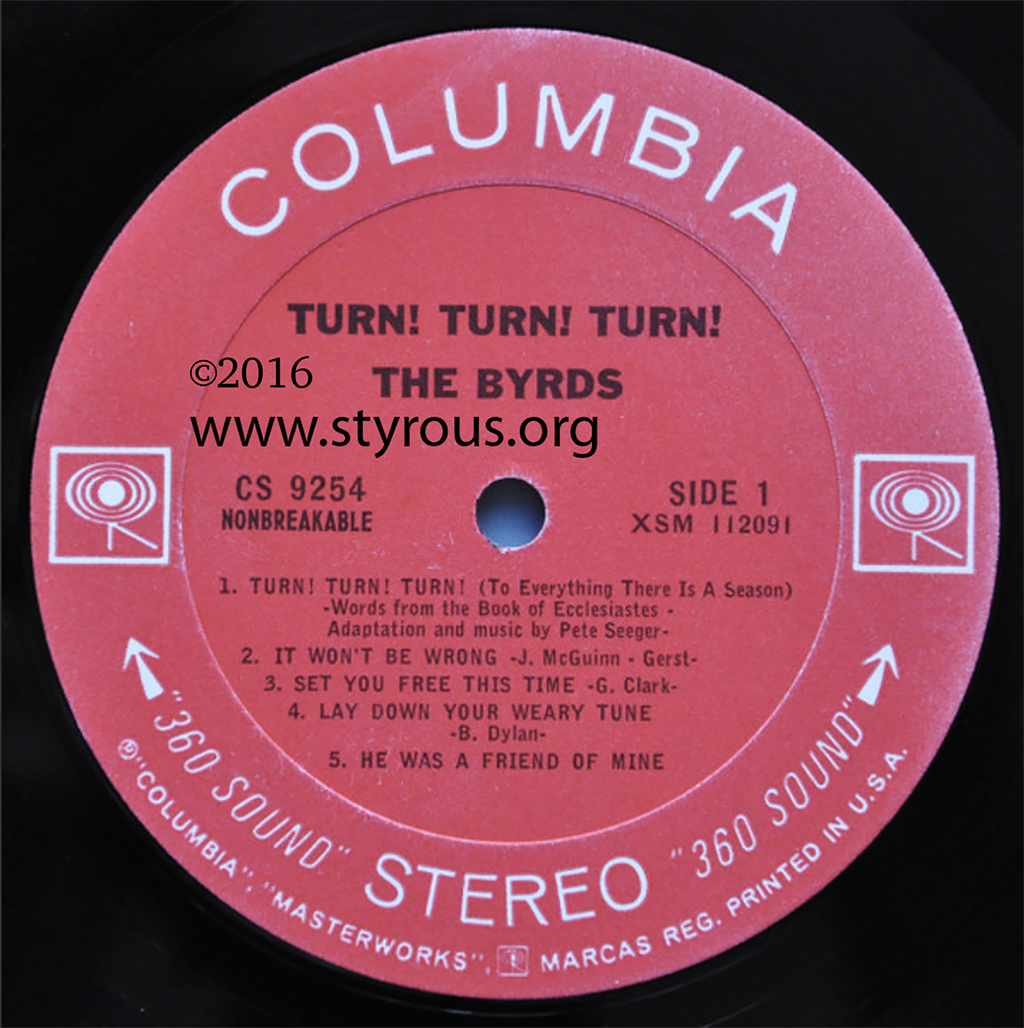
20,000 vinyl LPs 334: The Byrds ~ Turn! Turn! Turn, Oh, Susana

 ~  
vinyl LP front cover 
cover photo by Guy Webster 
cover design by Bob Cato 
photo of album cover by Styrous®


September 11 is a day with many historical references, the most infamous being the disastrous incident in New York City, in 2001. But another event happened over a hundred and fifty years earlier in 1847. The  Stephen Foster song, Oh! Susannah, was performed in public for the first time by a local quintet in PittsburghPennsylvania.          

I have always been intrigued by this song as a lot of the lyrics make no sense whatsoever! Samples: "It rain'd all night the day I left, The weather it was dry, The sun so hot I froze to death..." and so on. I remember as a kid thinking this was, "The cat's pajamas!" a phrase still in use at the time.   
 
And the name, Susana, has always been a fascination for me. The rhythmic syllables, the bouncy feeling of the consonants and vowels dancing around each other and, of course, when pronouncing it in the Castilian/Catalan tounge, the sensuous pursing of the lips to produce the sound "Su" (link below). VERY erotic! From my childhood, the name has always had a middle-eastern sound to my ears; then in 2000 when I was on Cyprus, the distant call of the Iman electrified me to the core when I heard it clearly ringing out above the raucous cacophony of the busy city streets. This totally cemented it in my mind as a mysterious, sensual, powerful and wonderful name!     

Anyway, I digress, back to the song itself! Foster was only 21 years old when he composed it in 1848. He later wrote, “the two fifty-dollar bills I received (for "Oh! Susanna") had the effect of starting me on my present vocation as a songwriter.” He wrote over two hundred songs, a lot of them dealing with the South although he only visited it once (link below). Oh! Susannah was a favorite of the ‘49ers during the California Gold Rush and others heading west during the mid-nineteenth century.    
 
The first version of it I knew was featured in the film, The Jazz Singer, with Al Jolson singing in black face. In 1942, Looney Tunes had Elmer Fudd singing a totally wacked-out version of it for the war effortConnie Francis covered it in 1961 on her Connie Sings Folksong Favorites album. The version The Byrds did in 1965 on their album, Turn! Turn! Turn!, is one of my all-time favorites. James Taylor did a really wonderful duet for guitar & vocal on his Sweet Baby James 1970 album (links below).           
 
The cover design was by Bob Cato who also did a cover for Blood, Sweat & Tears, Simon & Garfunkel and the graphics for the sound track recording of the 1933 film, King Kong which starred Fay Wray.          
 
 
vinyl LP back cover 
photo of album cover by Styrous® 
 
 
In 1940 the United States Postal Service issued a 1¢ commemorative stamp in Foster's honor for the Famous American Composers series.   
 
 
Stephen Foster 1¢ stamp - 1940
photo: Gwillhickers
 
 
There has been opposition to honors for him because of the racist aspect of the lyrics of his songs; but it was another era with different values.

 
Lyrics
 
 I came from Alabama,
⁠ Wid my banjo on my knee,
 
I'm gwyne to Louisiana, 
⁠My true love for to see; 

It rain'd all night the day I left, 
⁠The weather it was dry, 

The sun so hot I froze to death, 
⁠Susanna, don't you cry.

CHORUS.
⁠Oh! Susanna, 
⁠Oh don't you cry for me,
⁠ 
I've come from Alabama
⁠ Wid my banjo on my knee.

2
I jumped aboard de telegraph, 
⁠And trabbled down de riber, 

De lectric fluid magnified, 
⁠And killed five hundred nigger. 

De bullgine bust, de horse run off,
⁠ I realy thought I'd die;
 
I shut my eyes to hold my breath, 
⁠Susanna, don't you cry.
⁠ 
 
Cho: Oh! Susanna &c.

3
I had a dream de odder night
⁠ When ebery ting was still,
 
I thought I saw Susanna 
⁠A coming down de hill; 

The buck-wheat cake was in her mouth, 
⁠The tear was in her eye; 

Says I, "I'm coming from de south, 
⁠Susanna, don't you cry.
 
"
⁠Cho: Oh! Susanna &c.

4
I soon will be in New Orleans, 
⁠And den I'll look all round, 

And when I find Susanna,
⁠ I will fall upon de ground.

And if I do not find her, 
⁠Dis darkie'l surely die, 

And when I'm dead and buried, 
⁠Susanna, don't you cry.
⁠
 
Cho: Oh! Susanna &c.


Tracklist:
       
Side 1:
        
A1 - Turn! Turn! Turn! (To Everything There Is A Season),Adapted By, Music By – Pete Seeger - 3:34
A2 - It Won't Be Wrong, written by Gerst* - 1:58
A3 - Set You Free This Time - 2:49
A4 - Lay Down Your Weary Tune - 3:30
A5 - He Was A Friend Of Mine - 2:30
       
Side 2:
       
B1 - The World Turns All Around Her - 2:12
B2 - Satisfied Mind, written by J. Rhodes*, R. Hayes* - 2:21
B3 - If You're Gone - 2:45
B4 - The Times They Are A-Changin' - 2:17
B5 - Wait And See, written by D. Crosby* - 2:19
B6 - Oh! Susannah, arranged by J. McGuinn* - 3:00
       
Companies, etc.
       
    Printed By – Modern Album, Terre Haute, Indiana
    Published By – Melody Trails, Inc.
    Published By – Tickson Music Co.
    Published By – M. Witmark & Sons
    Published By – Peer International Corp.
       
Credits:
       
    Art Direction [Uncredited] – Bob Cato, John Berg
    Bass – Chris Hillman
    Drums – Mike Clark*
    Guitar, Leader – Jim McGuinn
    Liner Notes – Derek Taylor (2)
    Photography By [Cover Photo] – Guy Webster
    Producer – Terry Melcher
    Rhythm Guitar – Dave Crosby*
    Tambourine – Gene Clark
    Written-By – B. Dylan* (tracks: A4, B4), G. Clark* (tracks: A3, B1, B3), J. McGuinn* (tracks: A2, B5)
       
Notes:
       
Columbia Two-Eye Red label, "360 Sound Stereo" in white text.
NONBREAKABLE printed on labels.
Columbia Masterworks on label rim.
       
Barcode and Other Identifiers
        
    Matrix / Runout (Label matrix, side A): XSM 112091
    Matrix / Runout (Label matrix, side B): XSM 112092
    Matrix / Runout (Runout, side A, etched): XSM 112091 1D
    Matrix / Runout (Runout, side B, etched): XSM 112092 1C
    Matrix / Runout (Runout var 1, side A, etched): XSM 112091 1A O C
    Matrix / Runout (Runout var 1, side B, etched): XSM 112091 1B D O
    Rights Society (Tracks A1 to A3, A5 to B3, B5 and B6): BMI
    Rights Society (Tracks A4 and B4): ASCAP
    Other (Rear jacket fabricator identification): 3
 
The Byrds – Turn! Turn! Turn!
Label: Columbia – CS 9254
Format:    Vinyl, LP, Album, Stereo
Country: US
Released: Dec 6, 1965
Genre: Rock
Style: Folk Rock, Psychedelic Rock

         
Viewfinder links:        
         
Blood, Sweat & Tears               
The Byrds         
Bob Cato          
King Kong & Fay Wray           
Postal stamps        
Simon & Garfunkel          
        
Net links:        
Digital Music News ~ 
     The Original Lyrics to ‘Oh Susanna’ Are Brutally Racist       
        
        
YouTube links:        
         
2nd South Carolina String Band ~ Oh! Susanna                   
The Byrds ~ Oh, Susana         
Connie Francis ~ Oh, Susana        
Elmer Fudd - Oh, Susana               
Al Jolson ~ Oh, Susana         
PronounceNames.com ~ Susana        
Stephen Foster ~ OH! SUSANNA - Original 1848 Lyrics         
James Taylor ~ Oh, Susana          


Styrous® ~ September, 11, 2023