Showing posts with label Mel Brooks. Show all posts

June 28, 2026

Mel Brooks ~ Man of Many Dreams

 ~       


photo: HBO 
      
 
Today is the birthday of American actor, filmmaker, comedian, songwriter, and playwright Melvin James Brooks (né Kaminsky) better known as just plain Mel Brooks. But there is nothing plain about this guy! He has a career spanning over seven decades, he is known as a writer and director of a variety of successful broad farces and parodies. A recipient of numerous accolades, he is one of 28 entertainers to win the EGOT, which includes an Emmy, a Grammy, an Oscar, and a Tony. He received a Kennedy Center Honor in 2009, a Hollywood Walk of Fame star in 2010, the AFI Life Achievement Award in 2013, a British Film Institute Fellowship in 2015, a National Medal of Arts in 2016, a BAFTA Fellowship in 2017, and an Honorary Academy Award in 2024.     
 
Brooks was born on a tenement kitchen table on June 28, 1926, in Brownsville, Brooklyn to Katie (née Brookman) and Max Kaminsky. He grew up in Williamsburg, Brooklyn. His father's family were German Jews from Danzig (now Gdańsk, Poland). His mother was a Russian Jewish immigrant from Kiev, in the Pale of Settlement of the Russian Empire (now Ukraine). His father died of tuberculosis of the kidney at 34 when Brooks was two years old. He has said of his father's death, "There's an outrage there. I may be angry at God, or at the world, for that. And I'm sure a lot of my comedy is based on anger and hostility. Growing up in Williamsburg, I learned to clothe it in comedy to spare myself problems—like a punch in the face."            
 
He was a small, sickly boy, who often was bullied and teased by his classmates because of his size. At age nine, he saw Anything Goes with William Gaxton, Ethel Merman, and Victor Moore at the Alvin Theater. After the show, he told his uncle that he was not going to work in the garment district like everyone else, but instead wanted to go into show business.          
 
Brooks studied drums under jazz musician Buddy Rich, who had also grown up in Williamsburg and earned money as a musician from age 14. During his teens, he changed his name to Melvin Brooks, used his mother's maiden name Brookman, after being confused with trumpeter Max Kaminsky.     
 
In early 1944 in his senior year in high school, Brooks was recruited to take the Army General Classification Test, a Stanford–Binet-type IQ test. He received high scores and was sent to the Army Specialized Training Program at the Virginia Military Institute to be taught electrical engineering, horse riding, and saber fighting. In 1944, Brooks was drafted into the US Army. Twelve weeks later, when he turned 18, he officially joined the Army at Fort DixNew Jersey, induction center, and was sent to the Field Artillery Replacement Training Center at Fort Sill, Oklahoma, for basic and radio operator training. In December 1944, Brooks was transferred to the 1104th Engineer Combat Battalion as a combat engineer, participating in the Battle of the Bulge. Of his experience there, Brooks noted: 
"Along the roadside, you'd see bodies wrapped up in mattress covers and stacked in a ditch, and those would be Americans, that could be me. I sang all the time ... I never wanted to think about it ... Death is the enemy of everyone, and even though you hate Nazis, death is more of an enemy than a German soldier."   
Stationed in Saarbrücken and Baumholder, the battalion was responsible for clearing booby-trapped buildings and defusing land mines as the Allies advanced into Nazi Germany. Brooks was tasked with land-mine location; defusing was done by a specialist. Brooks has stated that when he heard Germans singing over loudspeakers, he responded by singing the American-Jewish singer Al Jolson hit "Toot, Toot, Tootsie (Goo' Bye!)" into a bullhorn.        
 
After the war, Brooks's mother secured him a job as a clerk at the Brooklyn Navy Yard, but Brooks "got into a taxi and ordered the driver to take him to the Catskills", where he started working in various Borscht Belt resorts and nightclubs in the Catskill Mountains as a drummer and pianist.  
       
In 1959, Brooks and Carl Reiner improvised and eventually developed the idea of the 2000-year-old man who had witnessed the crucifixion of Jesus Christ. They began performing the 2000 Year Old Man act on The Steve Allen Show. Their performances led to the release of the comedy album 2000 Years with Carl Reiner and Mel Brooks that sold over a million copies in 1961.[ It eventually became a comedy record album which ended up in my collection (link below).      
       
Brooks was involved in the creation of the Broadway musical All American, which debuted on Broadway in 1962. He wrote the play with lyrics by Lee Adams and music by Charles Strouse. It starred Ray Bolger as a southern science professor at a large university. During a press conference for All American, a reporter asked, "What are you going to do next?" and Brooks replied, "Springtime for Hitler," perhaps riffing on Springtime for Henry. For several years, Brooks toyed with a bizarre and unconventional idea about a musical comedy of Adolf Hitler. He explored the idea as a novel and a play before finally writing a script. He eventually found two producers to fund it, Joseph E. Levine and Sidney Glazier, and made his first feature film, The Producers (1968). The Producers was so brazen in its satire that major studios would not touch it, nor would many exhibitors. Brooks finally found an independent distributor who released it as an art film, a specialized attraction. At the 41st Academy Awards, Brooks won the Academy Award for Best Original Screenplay for the film over fellow writers Stanley Kubrick and John CassavetesThe Producers became a smash underground hit, first on the nationwide college circuit, then in revivals and on home video. It premiered to a limited audience in Pittsburgh, Pennsylvania, on November 22, 1967, before achieving a wide release in 1968.   
 
Brooks, along with his collaborator Thomas Meehan, later adapted it into a musical, which was hugely successful on Broadway and received an unprecedented 12 Tony awards. In 2000, Roger Ebert included The Producers in his canon of Great Movies, and remembered being in an elevator with Brooks and Anne Bancroft shortly after the movie was released: "A woman got on the elevator, recognized him and said, 'I have to tell you, Mr. Brooks, that your movie is vulgar.' Brooks smiled benevolently. 'Lady', he said, 'it rose below vulgarity.'"        


The Producers - 1968 
 
 
Viewfinder links:     
       
Anne Bancroft      
Ray Bolger       
Adolf Hitler         
Al Jolson       
Max Kaminsky        
Ethel Merman           
Buddy Rich        
Charles Strouse        


Net links:      


YouTubtre links:      
    
The 2000 Year Old Man 1967           
The 2000 Year Old Man album (11 mins., 46 secs.)            
Al Jolson ~ Toot, Toot, Tootsie (Goo' Bye!)      


William Gaxton articles/mentions


 ~     


date & photographer unknown 


Viewfinder links:        


Styrous® ~ Sunday, June 28, 2026   


Victor Moore articles/mentions


 ~     


date & photographer unknown 


Viewfinder links:        
 
Mel Brooks ~ Man of Many Dreams            


Styrous® ~ Sunday, June 28, 2026   


Charles Strouse articles/mentions

 ~     


date & photographer unknown 


Viewfinder links:        
 
Mel Brooks ~ Man of Many Dreams            


Styrous® ~ Sunday, June 28, 2026   


Max Kaminsky articles/mentions

 ~        


Max Kaminsky - 1947     
photo by William P. Gottlieb      


mentions:     
  
Mel Brooks ~ Man of Many Dreams           


Buddy Rich articles/mentions

 ~        


Buddy Rich - 1947     
photo by William P. Gottlieb      


mentions:     
  
Mel Brooks ~ Man of Many Dreams           


February 27, 2025

Gene Hackman articles/mentions

  ~      
Gene Hackman ~ Another Immortal gone    
     
     
mentions:     
Young Frankenstein     


date & photographer unknown


October 29, 2021

John Morris articles/mentions

 ~        


John Morris     
date & photographer unknown     


September 1, 2018

August 27, 2018

20,000 Vinyl LPs 146: The Odd Couple ~ Neil Simon

Art Direction – Christopher Whorf


Neil Simon died yesterday. He was an American playwright, screenwriter and author. He wrote more than 30 plays and nearly the same number of movie screenplays, mostly adaptations of his plays. Of all of them, my favorite was The Odd Couple (1965), for which he won a Tony Award. In 1968 the play was adapted into a film. The roles of misfits Felix Ungar and Oscar Madison were brilliantly cast with Jack Lemmon and Walter Matthau. What a fantastic team they made. 

The score for the film was written by Neal Hefti who wrote scores for many other films and television shows.      

Neil Simon was born on the fourth of July in 1927, in New York City. He began writing comedy scripts in the 50's for radio and some popular early television shows. Among them were the Sid Caesar Your Show of Shows from 1950 (where he worked alongside other young writers including Carl Reiner, Mel Brooks and Selma Diamond) and The Phil Silvers Show, which ran from 1955 to 1959 (link below).   

He wrote his first play,  Come Blow Your Horn, in 1961. It ran for 678 performances at the Brooks Atkinson Theatre.    

During 1966, Simon had four shows playing at Broadway theatres simultaneously: Sweet Charity, The Star-Spangled Girl, The Odd Couple and Barefoot in the Park.     

For most of his career Simon's work has received mixed reviews, with many critics admiring his comedy skills, much of it a blend of "humor and pathos". Other critics were less complimentary, noting that much of his dramatic structure was weak and sometimes relied too heavily on gags and one-liners. As a result, notes Kopince, "literary scholars had generally ignored Simon's early work, regarding him as a commercially successful playwright rather than a serious dramatist. Clive Barnes, theater critic for The New York Times, wrote that like his British counterpart Noël Coward, Simon was "destined to spend most of his career underestimated", but nonetheless very "popular". He received more combined Oscar and Tony nominations than any other writer.     

Simon died on August 26, 2018, after being on life-support while hospitalized for renal failure. He also had Alzheimer's disease. He was 91. The cause of death was complications with pneumonia, according to his publicist, Bill Evans. Simon died around 1 a.m. Sunday at New York-Presbyterian Hospital in New York City.       


Viewfinder links:       
       
Noël Coward         
Neal Hefti         
Jack Lemmon         
         
Net links:         
           
Neil Simon ~            
        Theatre    
        Screenplays   
        Television         
Steyn At Sea ~ 
          
YouTube links:         
          
The Odd Couple - movie trailer          
Remembering Playwright Neil Simon         
Johnny Carson ~ Neil Simon interview         
Charlie Rose ~ Neil Simon interview on "Rewrites" (1996)         


The Odd Couple soundtrack


Credits:       

    Arranged By, Conductor, Composed By – Neal Hefti
    Art Direction – Christopher Whorf
    Engineer – Bob Doherty
    Liner Notes – Howard W. Koch
    Producer – Tom Mack

Neal Hefti ‎– The Odd Couple (Music From The Original Motion Picture Score)Label: Dot Records ‎– DLP 25862, Dot Records ‎– DLP 25,862
Format: Vinyl, LP, Album, Stereo, Indianapolis
Country: US
Released: 1968
Genre: Non-Music, Pop, Stage & Screen
Style: Soundtrack, Dialogue, Easy Listening, Lounge


Styrous® ~ Monday, August 27, 2018        


December 27, 2017

Labyrinthitis ~ a dizzy proposition

~   
I have been diagnosed with a condition called labyrinthitis! What is that? Well, to start, it involves neither a Minotaur nor David Bowie.    


vinyl LP album cover
photo by Styrous®


Labyrinthitis is an inner ear disorder. The two vestibular nerves in the inner ear send information to the brain about spatial navigation and balance control. When one of these nerves becomes inflamed, it creates a condition known as labyrinthitis.    


Otitis media and interna are Latin names for inflammation of the ear chambers located behind the tympanic membrane (ear drum) and involve about 50% of all cases of acute vestibular disease. The middle ear is the region located directly behind the tympanic membrane (eardrum). It is made of the different bones and nerves responsible for the diffusion of the sound coming from the outer ear to the brain. The middle ear is connected to the nasal cavity by the Eustachian tube, an opening that enables the adjustment of the air pressure inside the middle ear. It is responsible for balance.  


Symptoms include dizziness, nausea, and loss of hearing. Vertigo, another symptom, is a type of dizziness marked by the sensation of moving, even though there's no motion. It can interfere with driving, working, and other activities. Medications and self-help techniques can lessen the severity of  vertigo.

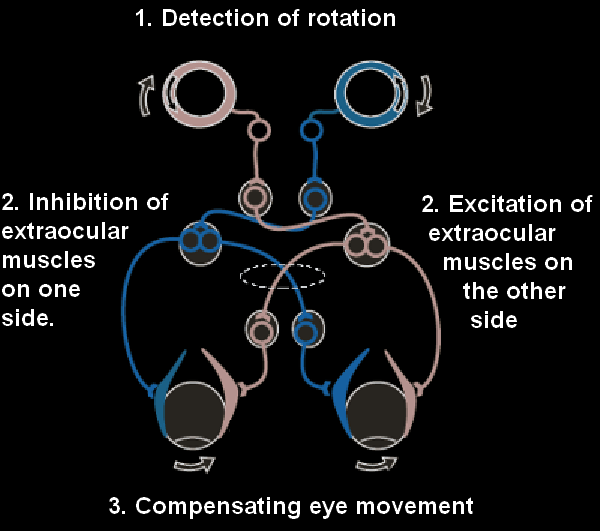
The vestibulo-ocular reflex is a reflex, where activation of the vestibular system causes eye movement. This reflex functions to stabilize images on the retinas (in yoked vision) during head movement by producing eye movements in the direction opposite to head movement, thus preserving the image on the center of the visual field(s).     


Push-pull system of the semicircular canals: for a horizontal head movement to the right, the result is a compensatory movement of the eyes.      

Several factors can cause this condition, including infections and viruses. Prompt treatment should be received for any ear infections, but there’s no known way to prevent labyrinthitis.     

The treatment for labyrinthitis usually involves using medications to control symptoms. Most people find relief from symptoms within one to three weeks and achieve full recovery in one to six months.


As long as the world is turning and spinning, 
we're gonna be dizzy and we're gonna make mistakes.
                        ~ Mel Brooks


Styrous® ~ Wednesday, December 27, 2017