~
Today is the birthday of silent film star,
Buster Keaton, born on October 4, 1895, into a
vaudeville family in
Piqua, Kansas.
His father was Joseph Hallie "Joe" Keaton who had a traveling show called the Mohawk Indian Medicine Company, which performed on stage and sold patent medicine on the side. When he was about 18 months old, Keaton fell down a long flight of stairs without injury, an
actor friend remarked, "Gee whiz, he's a regular
buster!" After that, Keaton's father began to use the nickname to refer to the youngster.
Buster began performing with his parents as The Three Keatons
when he was three years old. He first appeared on stage in 1899 in
Wilmington, Delaware.
The act was mainly a comedy sketch. His mother, Myra, played the saxophone on one
side of the stage, while Joe and Keaton performed center stage.
The Three Keatons
date & photographer unknown
Keaton
goaded his father by disobeying him, and the elder Keaton responded by
throwing him against the scenery, into the orchestra pit, or even into
the audience. A suitcase handle was sewn into Keaton's clothing to aid with the
constant tossing.
The act evolved as Keaton learned to take trick falls
safely; he was rarely injured or bruised on stage. This knockabout style
of comedy led to accusations of
child abuse,
and occasionally, arrest. However, Keaton was always able to show the
authorities that he had no bruises or broken bones. He was eventually
billed as "The Little Boy Who Can't Be Damaged", and the overall act as
"The Roughest Act That Was Ever in the History of the Stage".
Keaton said he had so much fun that he sometimes began laughing as his
father threw him across the stage. Noticing that this caused the
audience to laugh less, he adopted his famous deadpan expression when
performing
Keaton is best known for his silent film work in which his trademark was physical comedy accompanied by his stoic, deadpan expression that earned him the nickname "The Great Stone Face". Critic Roger Ebert
wrote of Keaton's "extraordinary period from 1920 to 1929" when he
"worked without interruption" as having made him "the greatest
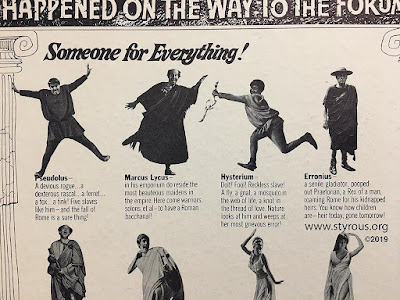
actor-director in the history of the movies". A Funny Thing Happened On The Way To The Forum was the final screen role for Buster Keaton.
The film plot takes place in the city of
Rome during the reign of
Emperor Nero,
Pseudolus is "the lyingest, cheatingest, sloppiest slave in all of
Rome", whose only wish is to buy his freedom from his master's parents,
the henpecked Senex and his overbearing wife, Domina.
In addition to an accomplished performer, he was a brilliant film maker, director and camera man. He said, "The first thing I did in the studio was to want to tear that camera to pieces. I had to know how that film got into the cutting room, what you did to it in there, how you projected it, how you finally got the picture together, how you made things match. The technical part of pictures is what interested me. Material was the last thing in the world I thought about. You only had to turn me loose on the set and I`d have material in two minutes, because I`d been doing it all my life."
Keaton's career declined when he signed with
Metro-Goldwyn-Mayer
and lost his artistic independence. His wife divorced him, and he
descended into alcoholism. He recovered in the 1940s, remarried, and
revived his career as an honored comic performer for the rest of his
life, earning an
Academy Honorary Award in 1959. Late in his career, he starred in the only cinema work by
Samuel Beckett, the silent and VERY surreal,
Film (
link below). Keaton had some great scenes in the 1965 film,
Beach Blanket Bingo which starred
Frankie Avalon and
Annette Funicello (
link below).
date & photographer unknown
Keaton loved television and he watched everything. Though he never mentioned it by name, among his favorite shows during the 1950s must have been the pioneering sitcom I Love Lucy, starring his friend and onetime MGM protégée Lucille Ball. When asked to name the best comedians of the up-and-coming generation he would often cite Ball as one of his “pets,” calling her timing “impeccable.”
Keaton had had a behind-the-scenes role in getting I Love Lucy on the air. In 1950, when CBS was trying to convince Ball to star in a sitcom based on her successful radio series My Favorite Husband, she agreed to sign on only if the show could costar her real-life husband, Cuban-American bandleader Desi Arnaz. The network balked at the idea of a domestic comedy centered around a couple of mixed race, so the two worked up a vaudeville routine to be filmed as an experimental pilot.
Keaton coached Ball in the big physical comedy scene, an act borrowed from the Spanish clown Pepito that involved Ball as a dimwitted but resourceful cellist auditioning for a spot in Arnaz’s orchestra. This pilot never aired at the time (and was lost until 1989, when it was discovered and aired on CBS as part of a Lucille Ball tribute special). But it was funny enough to convince CBS to give Ball and Arnaz their own prime-time series, which would run for 180 episodes and become perhaps the most influential of all early situation comedies. A pared-down version of the cello sketch found its way into a first-season episode, so although Keaton never guest-starred on I Love Lucy, he is nonetheless there as an influential presence.
Lucille Ball and Keaton - 1965 photo: Silver Screen Collection/Getty Images
On May 29, 1940, Keaton married
Eleanor Norris. She has been credited with salvaging his life and career. The marriage lasted until his death. Keaton died of
lung cancer on February 1, 1966, aged 70, in
Woodland Hills, Los Angeles.
Despite being diagnosed with cancer in January 1966, he was never told
he was terminally ill. Keaton thought that he was recovering from a
severe case of
bronchitis.
Confined to a hospital during his final days, he was restless and
paced the room endlessly, desiring to return home. In a British
television documentary about his career, his widow Eleanor told
producers from
Thames Television that Keaton was up out of bed and moving around, and even played cards with friends who came to visit the day before he died. He was buried at
Forest Lawn Memorial Park Cemetery in
Hollywood Hills,
California.
vinyl LP, record label details side 1 & 2
detail photos of record labels by Styrous®
Tracklist:
Side 1:
A1 - Tiba Solo - Into - Comedy Tonight
Vocals – Zero Mostel
Vocals
[Company] – Annette Andre, Buster Keaton, Helen Funai, Inga Neilsen,
Jack Gilford, Janet Webb, Jennifer Baker (2), Leon Greene, Lucienne
Bridou, Michael Crawford, Michael Hordern, Myrna White, Patricia Jessel,
Phil SIlvers, Susan Baker
3:27
A2 - Search For Mare's Sweat 0:39
A3 - Lovely
Vocals – Annette Andre, Michael Crawford
2:47
A4 - Tintinabula's Dance 0:58
A5 - Vibrata's Dance 0:45
A6 - Roman Emissary 0:35
A7 - Everybody Ought To Have A Maid
Vocals – Jack Gilford, Michael Hordern, Phil Silvers, Zero Mostel - 2:51
A8 - Riot At The Funeral 1:24
A9
- Domina Returns (Fanfare) - Into - My Bride, Vocals – Leon Greene,
Vocals [Company] – Annette Andre, Buster Keaton, Helen Funai, Inga
Neilsen, Jack Gilford, Janet Webb, Jennifer Baker (2), Lucienne Bridou,
Michael Crawford, Michael Hordern, Myrna White, Patricia Jessel, Phil
SIlvers, Susan Baker, Zero Mostel - 2:37
Side 2:
B1 - Erronious Returns - 0:27
B2 - Orgy Music... Roman Style - 1:57
B3 - Lovely (Reprise), Vocals – Jack Gilford, Zero Mostel - 2:16
B4 - In The Arena - 1:38
B5
- The Dirge, Vocals – Leon Greene, Vocals [Company] – Annette Andre,
Buster Keaton, Helen Funai, Inga Neilsen, Jack Gilford, Janet Webb,
Jennifer Baker (2), Lucienne Bridou, Michael Crawford, Michael Hordern,
Myrna White, Patricia Jessel, Phil SIlvers, Susan Baker, Zero Mostel -
3:40
B6 - The Rescue Of Philia - Into - The Chase - 5:57
B7 - Comedy Tonight And Playout - 3:28
Companies, etc.
Copyright © – United Artists Records, Inc.
Pressed By – Columbia Records Pressing Plant, Pitman
Mastered At – Customatrix
Credits:
Directed By [Music Direction], Music By [Incidental Music] – Ken Thorne
Engineer [Sound] – Eric Tomlinson
Music By, Lyrics By – Stephen Sondheim
Vocals [Domina] – Patricia Jessel
Vocals [Erronius] – Buster Keaton
Vocals [Fertilla] – Janet Webb
Vocals [Geminae] – Jennifer Baker (2), Susan Baker
Vocals [Gymnasia] – Inga Neilsen
Vocals [Hero] – Michael Crawford
Vocals [Hysterium] – Jack Gilford
Vocals [Lycus] – Phil Silvers
Vocals [Miles] – Leon Greene
Vocals [Panacea] – Lucienne Bridou
Vocals [Philia] – Annette Andre
Vocals [Pseudolus] – Zero Mostel
Vocals [Senex] – Michael Hordern
Vocals [Tintinabula] – Helen Funai
Vocals [Vibrata] – Myrna White
Notes:
Written by K. Thorne* (tracks: A1, A2, A4 to A6, A9 to B2, B4, B6), S. Sondheim* (tracks: A1, A3, A7 to A9, B3, B5 to B7)
Barcode and Other Identifiers
Matrix / Runout (Side A Label): UAL 4144 A
Matrix / Runout (Side B Label): UAL 4144 B
Matrix / Runout (Side A Runout Etched): UAL 4144A 1A
Matrix / Runout (Side A Runout Stamped): o B P 2
Matrix / Runout (Side B Runout Etched): UAL 4144 B 1A
Matrix / Runout (Side B Runout Stamped): o B I P 2
Stephen Sondheim – A Funny Thing Happened On The Way To The Forum (Original Motion Picture Soundtrack)
Label: United Artists Records – UAL 4144
Format: Vinyl, LP, Album, Mono
Country: US
Released: 1966
Genre: Stage & Screen
Style: Soundtrack
Viewfinder links:
Net links:
YouTube links:
Samuel Beckett ~ Film (1 hr. 4 Min.)
A Funny Thing Happened on the Way to the Forum -
"...stuntmen don't get you laughs,"
~ Buster Keaton
Styrous® ~ Wednesday, October 4, 2023


.jpg)


