photos by Styrous®
I started working in the late
1950's, a time when people had to dress up for work. Women still wore hats and
gloves. Men wore hats with business suits, white shirts and neckties as the office uniform. There was no such thing as, "
Casual Dress Day". I was into men's
fashion and ties are what I focused on especially (
they were the most affordable fashion item on a $125 a month salary).
My favorite neckties
were by Ernst. His ties were different: the ends were square, the quality of the manufacturing combined with the vast array of
textiles used to make them and the design eye that created them was sublime! WOW! It was a radically divergent visual effect from the point-ended ties that hadn't changed in probably thirty years. It was the modern age full of right angles, squares and rectangles; think CONTEMPORARY. I was totally in love with those ties and I eventually wound up with a small collection of them.
You probably have no idea who or
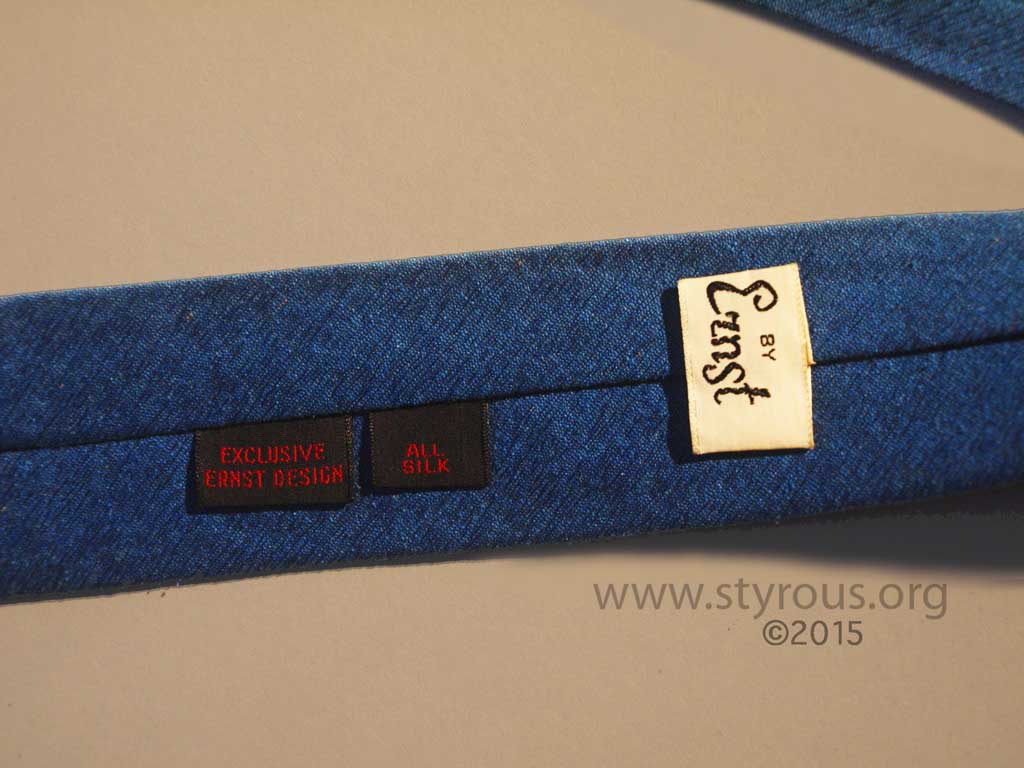
what Ernst was. Ok, I'll tell you but first I'll show you (
left & below).

I
have done research on Ernst (
Ernest J. Beall) and his ties and have come up with some interesting tales which follow the photos. But it's up to you which one you want to
believe.
One comes from the book, "
The Vanishing Vision - The Inside Story of Public Television" by James Day.
KQED Television was holding an all-night telethon (it's vague as to whether
it was in 1954 or 1958, an important point). People donated items to be
auctioned off and one of the items was a pair of lavender sheets used by
Kim Novak; it was donated by the Clift Hotel from a night she had
stayed there. Beall (Ernst) paid $250 for them; took them home and made
ties from them. The next day he then gave them back to the TV station
for the auction and the publicity from this launched Beall in his Ernst
career. I like this version, however, it might not fit with the trademark information at the end.
One of the stories comes from the
Daily Independent Journal. Issue Date: Saturday, July 31, 1965, Page: 35:
Ernst
was born Ernest J. Beall in the south in 1914. He served in WWII, then
returned home. But
not long after this, he left the south, apparently because he dared to
date a black girl, earning his family’s disapproval. Moving to Los
Angeles, he took a job at Capital Records, eventually becoming an
executive. Then, in the early 1950s, dissatisfied with the routine, he
chucked it all in and moved to San Francisco. In 1954, Beall J. Ernst
bought some material intended for women's suits, and made himself a
couple of neckties . . . unable to find neckties to his liking. Ernst
began to design and make his own. It began as a hobby, and today it is a
flourishing business.
Ernst,
a dedicated Marinite who has resided the past two years in a bachelor
home atop Haven Hill at Tiburon and who lived for six years prior to
that in San Anselmo, says it all started back in 1954. He was then a
Columbia records executive. For some time he had felt a dissatisfaction
with neckties then on the market, but had done nothing to remedy the
situation. Then, while shopping in the bargain basement of a department
store, he stumbled onto a fabric that struck him as fascinating. It was
women’s suiting material. But he bought a quarter of a yard of the goods
and, in his Los Gatos home, where he then lived, he began experimenting
with it. The result was “two and a half ties.” It was some time,
however, before Elrnst worked up enough nerve to wear one of his
homemade creations. Eventually, he did work up the courage. The result
was a flood of compliments from friends who wanted to know where he had
acquired the unusual neck pieces. Soon Beall Ernst was making regular
trips to bargain basements to acquire fabrics and working nights to turn
out ties to meet the requests of friends and business associates. And
thus began the story of “Ernst, the Tie Man.”
Another story comes from
Livejournal:
In 1952, Ernst leased an old brick warehouse South of Market Street and
threw himself into his work. His ties were immediately snapped up by
such local institutions as Gump’s, I. Magnin, The White House and the
City of Paris. They were seen on models in Esquire, Playboy and
Gentleman’s Quarterly.

Then,
one night as he slept, two men broke into his home. They tied him up
and locked him in a closet while they ransacked his house, stealing a
chest of jewelry, some $20,000 in cash, and eventually fleeing in
Ernst's brand new Jaguar. After nearly a day of confinement, Ernst
finally managed to call the police, even though he was still tied up
(dialing with his nose!). They eventually responded, but apparently
their investigations proved fruitless. The experience seems to have
deeply scarred Ernst. In 1970, he accepted a million-dollar offer by a
group of investors, and he bade farewell to the tie business.
At
this point, Ernst seems to have undergone some unknown and drastic
reversal of fortune. In 1978, the city directory shows that he was no
longer living in a house on Twin Peaks, but rather in an apartment in
the Tenderloin. Two years later, he was found dead, in Nevada,
apparently of natural causes, at the age of 64.
In
my research, I found the original Trademark for the name Ernst is dated
January 1, 1953. You can use this as a guide for the story you'd like
to believe.
~ ~ ~
I'm selling my small collection of Ernst neckties on eBay as I have done with other items of mine, in particular, my
reel-to-reel tape
collection.
Viewfinder link:
Styrous® ~ Tuesday, September, 22, 2015
~
.jpg)
.jpg)