Vinyl LP front cover
album cover photo by Gene Cook
photo of album cover by Styrous®
Today is the birthday of Lotte Lenya who was born on October 18 in 1898, 120 years ago. She was an Austrian singer, diseuse, and actress, who was based in the United States after the rise of National Socialism in Germany, when left-leaning artists were not in favor and although not Jewish, she left the country.
In the German-speaking and classical music world she is best remembered for her performances of the songs of her husband, Kurt Weill (link below), and in particular, The Threepenny Opera. There have been dozens of singers with far better voices than hers to interpret his music: Martha Schlamme in the fifties and sixties, Anne Sofie von Otter and Teresa Stratas in the seventies and eighties and currently Diana Krall. All of them with incredibly beautiful voices that elevated his music to the concert hall.

For me, The Threepenny Opera belongs to Lotte Lenya and it always will; I will always think of her as Jenny. No one has ever matched the pathos and desperation of the character as she did. Her voice kept it in the alleys and slums of the world where it was born and where it shines brightest.
This recordiing of The Threepenny Opera has English adaptation of book & lyrics by Marc Blitzstein and was released in 1954 but I did not discover it until the late fifties when I was in college. I fell in love with it and through my discovery of it, I found the world of Lotte Lenya & Kurt Weill (links below).
In the German-speaking and classical music world she is best remembered for her performances of the songs of her husband, Kurt Weill (link below), and in particular, The Threepenny Opera. There have been dozens of singers with far better voices than hers to interpret his music: Martha Schlamme in the fifties and sixties, Anne Sofie von Otter and Teresa Stratas in the seventies and eighties and currently Diana Krall. All of them with incredibly beautiful voices that elevated his music to the concert hall.

Kurt Weill & Lotte Lenya -1932
photographer unknown
For me, The Threepenny Opera belongs to Lotte Lenya and it always will; I will always think of her as Jenny. No one has ever matched the pathos and desperation of the character as she did. Her voice kept it in the alleys and slums of the world where it was born and where it shines brightest.
This recordiing of The Threepenny Opera has English adaptation of book & lyrics by Marc Blitzstein and was released in 1954 but I did not discover it until the late fifties when I was in college. I fell in love with it and through my discovery of it, I found the world of Lotte Lenya & Kurt Weill (links below).

Vinyl LP back cover detail
detail photo by Styrous®
The Three Penny Opera is a "play with music" by Bertolt Brecht, adapted from a translation by Elisabeth Hauptmann of the 18th-century English ballad opera, The Beggar's Opera, by John Gay, and four ballads by François Villon, with music by Kurt Weill.
Although there is debate as to how much, if any, Hauptmann might have
contributed to the text, Brecht is usually listed as sole author.
The role of Jenny in The Beggar's Opera, by John Gay, was based on an actual person, Jenny Diver, née Mary Young, who was was a notorious British pickpocket in the mid 1700's. She was executed on Wednesday, the 18th of March, 1741 (link below).
The role of Jenny in The Beggar's Opera, by John Gay, was based on an actual person, Jenny Diver, née Mary Young, who was was a notorious British pickpocket in the mid 1700's. She was executed on Wednesday, the 18th of March, 1741 (link below).
The Three Penny Opera was first performed at the Theater am Schiffbauerdamm in 1928 (link below) on a set designed by Caspar Neher.
Despite an initially poor reception, it became a great success, playing
400 times in the next two years. The performance was a springboard for
one of the best known interpreters of Brecht and Weill's work, Lotte Lenya, who was married to Weill.
The work was considered "Degenerate Art" by the Nazi Party; ironically it became a favourite of Berlin's "smart set" – Count Harry Kessler recorded in his diary meeting at the performance an ambassador and a director of the Dresdner Bank (and their wives), and concluded "One simply has to have been there."
Critics noticed that Brecht had included the four Villon songs translated by Ammer. Brecht responded by saying that he had "a fundamental laxity in questions of literary property."
By 1933, when Weill and Brecht were forced to leave Germany by the Nazi seizure of power, the play had been translated into 18 languages and performed more than 10,000 times on European stages.


The work was considered "Degenerate Art" by the Nazi Party; ironically it became a favourite of Berlin's "smart set" – Count Harry Kessler recorded in his diary meeting at the performance an ambassador and a director of the Dresdner Bank (and their wives), and concluded "One simply has to have been there."
Critics noticed that Brecht had included the four Villon songs translated by Ammer. Brecht responded by saying that he had "a fundamental laxity in questions of literary property."
By 1933, when Weill and Brecht were forced to leave Germany by the Nazi seizure of power, the play had been translated into 18 languages and performed more than 10,000 times on European stages.

Lotte Lenya & Kurt Weill - 1932
photo: Weill-Lenya Research Center
Kurt Weill Foundation for Music, New York

Vinyl LP back cover
photo by Styrous®
An interesting note about this recording is the role of Lucy Brown is performed by Beatrice Arthur of the 1970s sitcoms All in the Family (1971–72) and Maude (1972–78). She also played the role of Dorothy Zbornak in the sitcom The Golden Girls (1985–92).

Vinyl LP back cover detail
detail photo by Styrous®
In 1922 she was seen by her future husband, German composer Kurt Weill, during an audition for his first stage score Zaubernacht, a children's pantomime for solo soprano and chamber orchestra. She was cast but owing to her loyalty to her voice coach she declined the role. She accepted the part of Jenny in the first performance of The Threepenny Opera (Die Dreigroschenoper) in 1928, and the part became her breakthrough role. During the last years of the Weimar Republic, she was busy in film and theatre, and especially in Brecht-Weill plays. She made dozens of recordings of Weill's songs (link below).
In March 1933, she moved to Paris where she sang the leading part in the Brecht-Weill "sung ballet", The Seven Deadly Sins.
Lenya and Weill settled in New York City on September 10, 1935. During World War II, Lenya did a number of stage performances, recordings and radio performances for the troops, as well as the Voice of America. After a badly received part in her husband's musical The Firebrand of Florence in 1945 in New York, she withdrew from the stage.

Vinyl LP back cover detail
detail photo by Styrous®
In 1956 she won a Tony Award for her role as Jenny in the Marc Blitzstein English version of The Threepenny Opera, the only time an Off-Broadway
performance has been so honored. Lenya went on to record a number of
songs from her time in Berlin, as well as songs from the American stage. After many years, her voice had deepened with age and Sprechstimme
was used in some famous songs in the Brecht-Weill plays so Lenya
used it even more to compensate for the shortcomings of her voice.
In English-language cinema, she was nominated for an Academy Award for her role as a jaded aristocrat in The Roman Spring of Mrs. Stone (1961). She also played Rosa Klebb in the James Bond movie From Russia with Love (1963) which starred Sean Connery.
In 1962 she founded the Kurt Weill Foundation for Music (link below) chartered to preserve and perpetuate the legacies of Kurt Weill (1900-1950) and Lotte Lenya (1898-1981).
Lotte Lenya died in Manhattan of cancer in 1981, she was 83 years old. She is buried next to Kurt Weill at Mount Repose Cemetery in Haverstraw, New York.
In English-language cinema, she was nominated for an Academy Award for her role as a jaded aristocrat in The Roman Spring of Mrs. Stone (1961). She also played Rosa Klebb in the James Bond movie From Russia with Love (1963) which starred Sean Connery.
In 1962 she founded the Kurt Weill Foundation for Music (link below) chartered to preserve and perpetuate the legacies of Kurt Weill (1900-1950) and Lotte Lenya (1898-1981).
Lotte Lenya died in Manhattan of cancer in 1981, she was 83 years old. She is buried next to Kurt Weill at Mount Repose Cemetery in Haverstraw, New York.

Vinyl LP back cover detail
detail photo by Styrous®
Dozens of people have done covers of the most famous song from the opera, Die Moritat von Mackie Messer, also known as Mack the Knife or The Ballad of Mack the Knife. Some of the most famous singers were Bobby Darin, Frank Sinatra, Ella Fitzgerald, Tony Bennett, Marianne Faithfull, Nick Cave, Brian Setzer and the most famous version of the song, Louis Armstrong, who introduced it to American audiences (links below).
In 1956, Lenya was present in the studio when Armstrong recorded Mack the Knife. Armstrong improvised the line "Look out for Miss Lotte Lenya!" and added her name to the list of Mack's female conquests in the song.
In 1956, Lenya was present in the studio when Armstrong recorded Mack the Knife. Armstrong improvised the line "Look out for Miss Lotte Lenya!" and added her name to the list of Mack's female conquests in the song.

In 1994 there was a a video documentary, September Songs - The Music Of Kurt Weill. The performers in it were Elvis Costello, Lou Reed, David Johansen, Nick Cave, PJ Harvey, Teresa Stratas, Lotte Lenya, Betty Carter, William S. Burroughs, The Persuasions, and Stan Ridgway (video version only).
The songs featured in the video were released in a compilation album on CD in 1997. One of the cuts from this album is by Nick Cave who does a fantastic rendition of Mac the Knife (link below) from The Threepenny Opera.


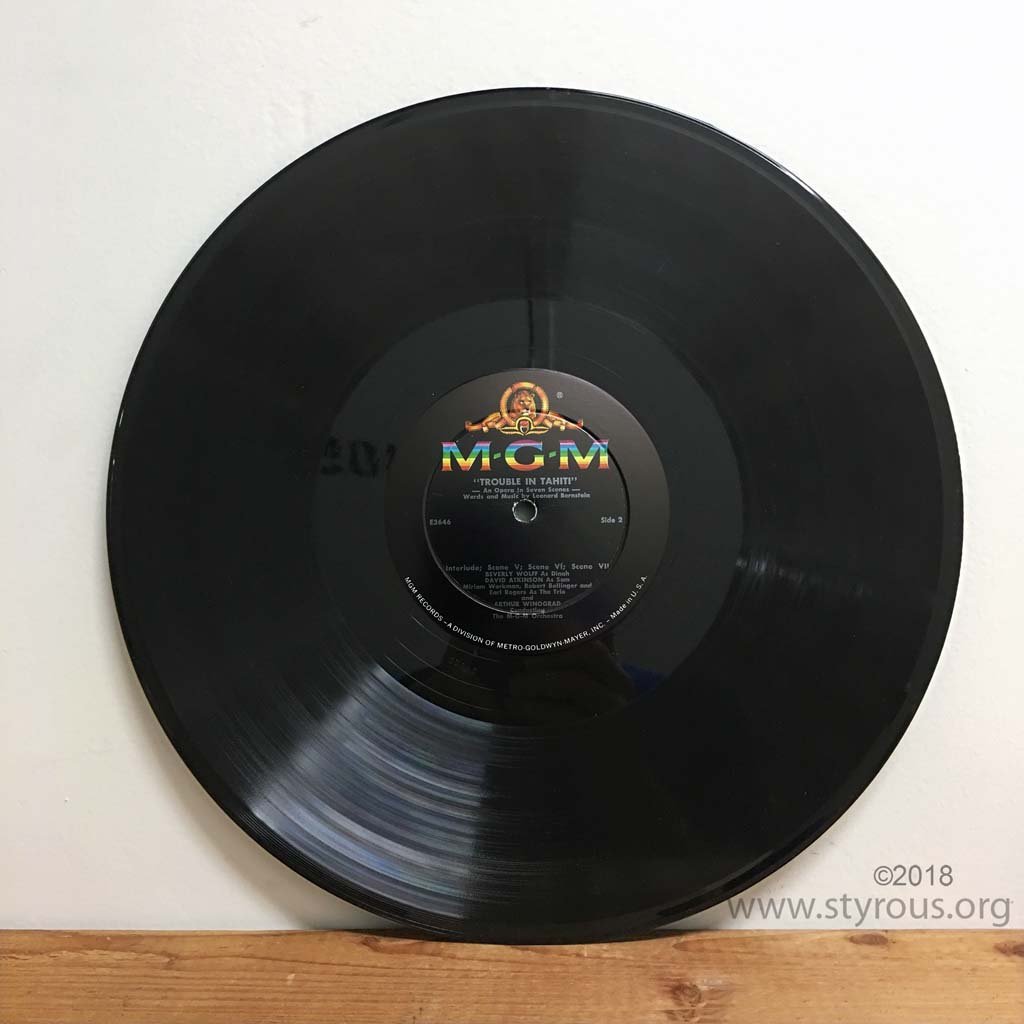
Vinyl LP label, side 2
photo by Styrous®
Tracklist:
Side 1:
A1.1 - Prologue (Spoken)
A1.2 - Overture
A1.3 - The Ballad Of Mack The Knife
A1.4 - Morning Anthem
A1.5 - Instead - Of - Song
A1.6 - Wedding Song
A1.7 - Pirate Jenny
A1.8 - Army Song
A1.9 - Love Song
A1.10 - Ballad Of Dependency
A1.11 - Melodrama And Polly's Song
A1.12 - Ballad Of The Easy Life
A1.13 - The World Is Mean
Side 2:
B1.1 - Barbara Song
B1.2 - Tango - Ballad
B1.3 - Jealousy Duet
B1.4 - How To Survive
B1.5 - Useless Song
B1.6 - Solomon Song
B1.7 - Call From The Grave
B1.8 - Death Message
B1.9 - Finale: The Mounted Messenger
Companies, etc.
Copyright (c) – Lowe's Inc.
Credits:
Banjo, Guitar – Ralph Colicchio
Clarinet – Charles Russo, Herbert Tishman
Conductor [Musical Director] – Samuel Matlowsky
Drums [Tympany], Percussion [Jercussion] – Stan Koor
Music By – Kurt Weill
Orchestra, Piano – The Threepenny Opera Orchestra*
Other [Introduction] – Gerald Price (tracks: A1.1)
Other [Production Staged By] – Carmen Capalbo
Photography By [Cover Photo] – Gene Cook
Text By [Original Text] – Bert Brecht*
Translated By [English Adaptation Of Lyrics] – Marc Blitzstein
Trombone – Elliot Philips
Trumpet – Bernard Ross, Harry Jenkins
Vocals [J. J. Peachum] – Martin Wolfson
Vocals [Streetsinger] – Gerald Price
Vocals, Performer [Jenny] – Lotte Lenya
Vocals, Performer [Lucy Brown] – Beatrice Arthur
Vocals, Performer [Macheath - Mack The Knife] – Scott Merrill
Vocals, Performer [Mrs. Peachum] – Charlotte Rae
Vocals, Performer [Polly Peachum] – Jo Sullivan (2)
Vocals, Performer [Tiger Brown] – George Tyne
Notes:
The complete score. (cover)
M-G-M RECORDS - A DIVISION OF © LOEW'S INCORPORATED. PRINTED IN U.S.A.
Made in U.S.A.
Barcode and Other Identifiers
Matrix / Runout (stamped, Side A): E3121 S1
Matrix / Runout (stamped, Side B): E3121 S2
Kurt Weill, Marc Blitzstein – The Threepenny Opera (Die Dreigroschenoper)
Label: MGM Records – E3121
Format: Vinyl, LP, Album
Country: US
Released: 1954
Genre: Folk, World, & Country, Stage & Screen
Style: Chanson, Score, Ballad, Musical
Viewfinder links:
Die Dreigoschenoper (Threepenny Opera)
Bertold Brecht
Bobby Darin
Ella Fitzgerald
Lotte Lenya
Frank Sinatra
Kurt Weill
Net links:
The Threepenny Opera
Lotte Lenya Audio Files
Lotte Lenya Discography
Lotte Lenya Filmography
Kurt Weill Foundation for Music
Kurt Weill Foundation for Music, Inc. ~ Lotte Lenya bio
Kurt Weill Foundation for Music, Inc. ~ Kurt Weill bio
Kurt Weill Compositions
Kurt Weill discography
Capital Punishment UK ~ Jenny Diver (Mary Young)
YouTube links:
The Threepenny Opera (complete, 53 minutes)
Lotte Lenya ~ Moritat (Mack the Knife)
Mack the Knife (1931 film)
Louis Armstrong - Mack the Knife
Nick Cave - Mack The Knife
Bobby Darin - Mack the Knife
Ella Fitzgerald - Mack the Knife
Frank Sinatra - Mack the Knife
Sting - The Ballad of Mack the Knife

date & photographer unknown
Styrous® ~ Thursday, October 18, 2018