Showing posts with label Gregory Peck. Show all posts

September 3, 2025

Alan Ladd & Veronica Lake ~ The Blue Dahlia

 ~      


Today is the birthday of movie actor Alan Ladd, who was an American actor and film producer. Ladd found success in film in the 1940s and early 1950s and was often paired with Veronica Lake in films noir, such as This Gun for Hire (1942), The Glass Key (1942), and The Blue Dahlia (1946).            


Ladd was born in Hot Springs, Arkansas, on September 3, 1913. On July 3, 1918, the five year-old Alan accidentally burned down the family home while playing with matches. In the early 1920s, Ladd's family moved to California. They lived in a migrant camp in Pasadena, California, at first and then moved to the San Fernando Valley. He enrolled in North Hollywood High School on February 18, 1930, became a high-school swimming and diving champion and participated in high-school dramatics in his senior year, including the role of Ko-Ko in The Mikado which was seen by a talent scout.      
 
He got regular professional acting work only when he turned to radio. Ladd had worked to develop a rich, deep voice ideal for that medium, and in 1936, he was signed by station KFWB as its sole radio actor. One night he was playing the roles of a father and son on radio when he was heard by an agent, Sue Carol. She was impressed and called the station to talk to the actors, and was told they were only one person.  She arranged to meet him, and impressed by his looks, she signed him and promoted her new client in films and on radio. Ladd's first notable part under Carol's management was the 1939 film Rulers of the Sea at $250 per week. He also received attention for a small part in Hitler – Beast of Berlin (1939). He had a small, uncredited part in Citizen Kane, playing a newspaper reporter toward the end of the film.         
 
Paramount knew it had a potential star and announced Ladd's next film, an adaptation of the Dashiell Hammett story, The Glass Key (1942) with Brian Donlevy and Veronica Lake.        


Ladd's cool, unsmiling, understated persona proved popular with wartime audiences, and he was voted by the Motion Picture Herald as one of the 10 "stars of tomorrow" for 1942. Paramount was delighted. The majority of stars were earmarked from wherever they came; if it seemed unlikely that public acceptance would come with one film, they were trained and built up: The incubation period was usually between two and five years. As far as Ladd was concerned, he was a small-part actor given a fat part faute de mieux, and after his second film for them, he had not merely hit the leading-men category, but had gone beyond it to films which were constructed around his personality. His salary was raised to $750 per week.         
 
He starred in China (1943) with Loretta Young for director John Farrow, with whom Ladd made a number of movies. Young did not like working with Ladd: "I found him petulant... I don't remember hearing him laugh, or ever seeing him laugh. Everything that concerned him was very serious... He had a certain screen personality... but as an actor... I never made any contact with him. He wouldn't look at me. He'd say "I love you...", and he'd be looking out there some place. Finally, I said "Alan, I'm he-ere!!"... I think he was very conscious of his looks. Alan would not look beyond a certain point in the camera because he didn't think he looked good."       
 
He enlisted for military service on January 19, 1943. While he was in the armed services, a number of films that had been announced for him were postponed and/or made with different actors but he was reportedly receiving 20,000 fan letters per week. The New York Times reported that "Ladd in the brief period of a year and with only four starring pictures to his credit... had built up a following unmatched in film history since Rudolph Valentino skyrocketed to fame." In December 1943, he was listed as the 15th-most popular star in the U.S.         
 
When Ladd returned from the army, Paramount announced a series of vehicles for him, including And Now Tomorrow and Two Years Before the Mast.       


In 1945 Paramount commissioned Raymond Chandler to write an original screenplay for him titled The Blue Dahlia, made relatively quickly in case the studio lost Ladd to the military once again.          
  
The Blue Dahlia was released to great acclaim (Chandler was nominated for an Oscar for the screenplay), quickly followed by Two Years Before the Mast. The two films were solid hits, each earning over $2 million in rentals in the U.S. and Canada; Two Years Before the Mast was a blockbuster, earning over $4 million and ranking among the top-10 most popular films of the year. Ladd's roles in This Gun for Hire, The Glass Key, and The Blue Dahlia, firmly established him as a no-nonsense tough guy in a popular genre of crime films later to become known as film noir.                 
 
In 1950, the Hollywood Women's Press Club voted Ladd the easiest male star to deal with in Hollywood. The following year, a poll from the Hollywood Foreign Press Association listed Ladd as the second-most popular male film star in the world, after Gregory Peck.        


When a former bomber pilot (Alan Ladd) comes home from the war, he finds his wife kissing her substitute boyfriend (Howard Da Silva), the owner of the Blue Dahlia nightclub. When she also confesses that her drunkenness caused their son's death, he walks out on her, but later she is found dead and he becomes the prime suspect.          


Viewfinder links:
          
Raymond Chandler           
Brian Donlevy           
Dashiell Hammett           
Alan Ladd           
Gregory Peck          
Howard da Silva.             
Rudolph Valentino           
Loretta Young           
        
Net links:


Video links:


Styrous® ~ Wednesday, September 3, 2025      


February 1, 2020

Lionel Richie articles/mentions

~    


Gregory Peck ~ Mr Suave      
USA For Africa ~ We Are The World      


Lionel Richie     
publicity photo     


January 6, 2018

Beemer Memory 19: A-2 leather flight jacket "Made in the USA"

photo by Styrous®
       
One of my favorite bike-riding jackets was this BLACK leather A-2 flight bomber jacket. The jacket is unusual as bomber jackets were always brown; I do have a brown one.    


photo by Styrous®


The Type A-2 leather flight jacket is an American military flight jacket originally invented and developed for and closely associated with World War II U.S. Army Air Forces pilots, navigators and bombardiers, who often decorated their jackets with squadron patches and elaborate artwork painted on the back. Sometimes casually referred to as a bomber jacket, its original designation was "Jacket, Pilot's (summer)", and its wartime usage was limited neither to pilots nor to bomber crews.    


The Type A-2 flying jacket was standardized by the U.S. Army Air Corps as the successor to the Type A-1 flying jacket adopted in 1927. The Type Designation Sheet lists the dates for Service Test as September 20, 1930, and Standardized (adopted as standard issue) on May 9, 1931. The military specification number for Type A-2 is 94-3040. The Drawing Number was given as 30-1415 in the original spec 94-3040 and is shown on A-2 jackets, but some documentation erroneously lists it as 31-1415.        

B-17 Flying Fortress Crew from 457th BG - 1943


photo by Styrous®


The U.S. Army Air Forces Class 13 Catalog listed the garment as "Jacket, Flying, Type A-2," with Spec. No. 94-3040. It describes the jacket's construction as "seal brown horsehide leather, knitted wristlets and waistband (skirt)."        


photo by Styrous®


Although the actual design would vary slightly depending on the manufacturer, and even among contracts within a single manufacturer, all A-2 jackets had several distinguishing characteristics: a snap-flap patch pocket on either side that does not have hand warmer compartments (hands in pockets were considered unfit for a military bearing), a shirt-style snap-down collar, shoulder straps (or Epaulets), knit cuffs and waistband, a back constructed from a single piece of leather to limit stress on the garment, and a lightweight silk or cotton inner lining with a leather hang strap (not a loop) and military spec tag attached just below the back collar. A-2's were lined with cotton per the original specification. A common misconception is that they were lined with silk.           


black A-2 bomber jacket interior lining
photo by Styrous®


A-2s were to be constructed of horsehide, which was either vegetable- or chrome-tanned. Some original A-2's were made from goatskin (as was the Navy G-1 jacket) and others from cowhide (which can be very difficult to tell from horse if tanned identically). All Spiewak and Doniger jackets are of goat, as are many Cable, Dubow, Bronco, Perry, and Rough Wear examples.        


black A-2 bomber jacket cuff detail
detail photo by Styrous®


Wartime-issued A-2 jackets appear in a wide range of color tones and hues, although all are based on two distinct colors: Seal (dark brown to almost black) and Russet (pale red-brown to medium brown). Most seal jackets were russets re-dyed during the war to cover scuffing and discoloration, although some contracts, like the Aero Leather 21996, were dyed seal right from the start. Original knit cuffing typically matched the leather or came close, but exceptions exist, such as Aero Leather's eye-catching rust-red cuffing on seal brown hide.        


black A-2 bomber jacket front detail
detail photo by Styrous®


The A-2 was one of the early articles of clothing designed expressly to use a zipper. Zippers were made of steel or brass, and some were nickel plated. Known zipper suppliers were Talon, Crown, Conmar, and Kwik, with Talon providing the majority of zippers used in wartime A-2 construction. Until about 1940, Talon zippers with riveted or grommeted metal bottoms were used.         


black A-2 bomber jacket front detail
detail photo by Styrous®


Unlike modern, loose-fitting jackets, the original A-2 looks to us today a rather trim-fitting jacket. Period photos and films reveal a jacket which could be worn fitted and sharp looking or a bit baggy and loose in the body. It was designed to fit the thinner male of the time.                 


black A-2 bomber jacket cuff detail
detail photo by Styrous®


Original wartime issued A-2 jackets are rare but not unavailable. Tens of thousands were issued from 1931 through 1944 (the vast majority in 1942-43), and some old stock jackets may have been issued even into the late 1940s long after Type A-2 was discontinued as standard AAF equipment. The value of such originals range widely depending on condition, known history, patches and artwork, and even size. Most originals used a sizing system considerably smaller than today's comparable sizes, with only 2-4 inches (100 mm) of "slack" over the tagged chest size. In other words, an original size 42 might be closer to a modern 40 or even a 38, depending on the manufacturer. Original World War II era jackets sell at auction for between $800 and $5,000, with wearable examples generally running $1,000 and up.              


Bud Tordoff & ground crew 
in front of his P-51, Upupa epops - 1944 - 45


The A-2 bomber jacket in the movies & on TV 

A-2 jackets can be seen in many movies, as they came to represent the American fighting man. Seeing legendary actors such as Gregory Peck and John Wayne on the big screen wearing A-2's only reinforced their popularity.


By the 1950s the A-2 was moving into the role of the motorcycle jacket, which would soon evolve into its own distinct style. The jacket worn by Henry Winkler in the role of "Fonzie" in the TV show Happy Days was a variation of the A-2 jacket.  


In the 1960s and 1970s the A-2 reappeared in a new crop of big budget World War II films such as The Great Escape and Patton, as well as being the wardrobe of choice for Bob Crane's character of Colonel Hogan in the popular TV series Hogan's Heroes. This same jacket, manufactured by the studio's costume department, would later be worn by Frank Sinatra in the film Von Ryan's Express. Dwight Schultz' character H. M. Murdock on 1980s TV show The A-Team wore an A-2 Jacket with a tiger printed on the back along with the words 'DA NANG 1970'. His character wore the jacket throughout the show's 5 seasons. Also, in the anime Hetalia: Axis Powers, the character America is most always seen wearing an A-2 jacket with the number '50' on the back in white. Arnold Schwarzenegger also appeared wearing the A-2 with a police badge in his new 2013 movie The Last Stand.


I don't know the brand of the jacket I have but the label inside clearly states it was, "Made in USA" 

"Made in USA" 
photo by Styrous®


The A-2 bomber jacket is warm, cozy and for sale on eBay.  
       
       
Viewfinder links:      
      
Beemer Memories          
Gregory Peck articles/mentions      
John Wayne article/mentions      


New links:      


Flying is learning how to throw yourself at the ground and miss!
                           ~ Douglas Adams


Styrous® ~ Saturday, January 6, 2018   


September 15, 2017

Richard Nixon articles/mentions


 ~       


Richard Nixon - 1937       
photo: UPI     


mentions:      
 
The 1968 Exhibit        
All of Us or None           
Father's Day 2026 ~ Dad's egg cup                         


Richard Nixon - 1973            
Getty Images                  


Ronald Reagan articles/mentions

~        
   
Ella Fitzgerald ~ Queen of Jazz  
Gregory Peck ~ Mr Suave      
Go With Love (Dionne Warwick)      


photographer unknown


September 9, 2017

Lauren Bacall articles/mentions

~       
       
Gregory Peck ~ Mr Suave        
Chuy Reyes ~ Rumba de Cuba      


Lauren Bacall     
photographer unknown     


August 1, 2017

July 30, 2017

July 27, 2017

20,000 Vinyl LPs 99: Miklós Rózsa ~ Spellbound by 10"

10" vinyl LP album, cover detail
detail photo by Styrous®


Miklós Rózsa (Hungarian: [ˈmikloːʃ ˈroːʒɒ]; died on this day, Thursday, July 27, in 1995. He was a Hungarian composer trained in Germany (1925–1931), and active in France (1931–1935), England (1935–1940), and the United States (1940–1995), with extensive sojourns in Italy from 1953.   

10" vinyl LP album, back cover detail 
album photo by Ned Scott
detail photo by Styrous®


Rózsa is best known for his nearly one hundred film scores, with Spellbound one of the top; however, he maintained an allegiance to absolute concert music throughout what he called his "double life."   


 10" vinyl LP album cover detail
detail photo by Styrous®
 

The 1945 Alfred Hitchcock mystery/suspense film, Spellbound, dealt with the new field of psychoanalysis and the inner workings of the human mind. It opens with a quote from the 1599 Julius Caesar (play), by William Shakespeare, "The Fault... is Not in Our Stars, But in Ourselves..." and announces that it wishes to highlight the virtues of psychoanalysis in banishing mental illness and restoring reason.   


10"vinyl LP album cover detail 
detail photo by Styrous®


The film stars Ingrid Bergman, Gregory Peck, Michael Chekhov and Leo G. Carroll. It is an adaptation by Angus MacPhail and Ben Hecht of the novel The House of Dr. Edwardes (1927) by Hilary Saint George Saunders and John Palmer.  

10" vinyl LP album cover 
   Artwork by Gunall
detail photo by Styrous®
 
There was major contention between director Alfred Hitchcock and producer David O. Selznick. Selznick wanted Hitchcock to make a movie based upon Selznick's own positive experience with psychoanalysis.  Selznick brought in his therapist, May Romm M.D., who was credited in the film as a technical adviser. Romm and Hitchcock clashed frequently. Further contention was caused by the hiring of surrealist artist Salvador Dalí to conceive certain scenes in the film's key dream sequence. However, the sequence conceived and designed by Dalí and Hitchcock, once translated to film, proved to be too lengthy and too complicated, so the vast majority of what was filmed was cut from the film during editing. About two minutes of the dream sequence appear in the final film, but Ingrid Bergman said that the sequence had been almost 20 minutes long before it was cut by Selznick. The cut footage apparently no longer exists, although some production stills have survived in the Selznick archives. Eventually Selznick hired William Cameron Menzies, who had worked on Gone With the Wind, to oversee the set designs and to direct the sequence. Hitchcock himself had very little to do with its actual filming.  


dream sequence based on designs
(as Salvador Dali) 
movie still


Selznick originally wanted the brilliant Bernard Herrmann, but when Herrmann turned it down, Rózsa was hired and won the Academy Award for his score. Although Rózsa considered Spellbound to contain some of his best work, he said "Alfred Hitchcock didn't like the music — said it got in the way of his direction. I never saw him since."   


Miklós Rózsa ~ Spellbound
 10" vinyl LP album back cover 
album photo by Ned Scott
photo of album cover by Styrous®
 
 
During the film's protracted post-production, considerable disagreement arose about the music, exacerbated by a lack of communication between producer, director, and composer. Rózsa scored another film, The Lost Weekend, before Spellbound was released, and he again used the theremin in that score. This led to allegations that he had recycled music from Selznick's film in the Paramount production. Meanwhile, Selznick's assistant tampered with the Spellbound scoring by replacing some of Rózsa's material with earlier music by Franz Waxman and Roy Webb.     


 10" vinyl LP album cover detail
detail photo by Styrous®


The film orchestral score by Miklós Rózsa is notable for its pioneering use of the theremin, performed by Dr. Samuel Hoffmann. The score features one of the earliest uses of the theremin. The sound of the instrument, which had been invented in 1928, would become associated indelibly with science fiction thanks to its use in films like The Day The Earth Stood Still. But the instrument originally got its start in Hollywood (it had been used in the scores to some Russian films like the 1931, Odna) thanks to the score for Spellbound. It was played by Dr. Samuel Hoffman, a medical doctor who had a sideline as one of the most important practicioners of the instrument, later playing on the scores for The Thing From Another World, It Came From Outer Space, The 5000 Fingers Of Dr. T and The Ten Commandments.     

Leonard Slatkin did a stellar performance of the Spellbound Concerto with the BBC Orchestra, Simon Mulligan on Piano, and Celia Sheen playing the theremin (link below). It's over 12 minutes but worth every second! It's fantastic!      


 10" vinyl LP album cover detail
detail photo by Styrous®


In a nutshell, Ingrid Bergman (link below) stars as Dr. Constance Petersen, a psychoanalyst, and Gregory Peck (link below) plays Dr. Anthony Edwardes who has come to replace the director, (Leo G. Carroll), of  Green Manors, a mental hospital, who is being forced into retirement. However, Petersen (Bergman) suspects Edwardes (Peck) is an imposter and the plot thickens. 


 10" vinyl LP album back cover detail
album photo by Ned Scott
detail photo by Styrous®

Miklós Rózsa was born on the 18th of April, 1907, in Budapest to Jewish parents. He achieved early success in Europe with his orchestral Theme, Variations, and Finale (Op. 13) of 1933 and became prominent in the film industry from such early scores as The Four Feathers (1939) and The Thief of Bagdad (1940). The latter project brought him to America when production was transferred from wartime Britain, and Rózsa remained in the United States, becoming an American citizen in 1946. His notable Hollywood career earned him considerable fame, including Academy Awards for Spellbound (1945), A Double Life (1947), and Ben-Hur (1959), while his concert works were championed by such major artists as Jascha Heifetz, Gregor Piatigorsky, and János Starker.


 10" vinyl LP album back cover detail
album photo by Ned Scott
detail photo by Styrous®


Rózsa was introduced to classical and folk music by his mother, Regina Berkovits, a pianist who had studied with pupils of Franz Liszt, and his father, Gyula, a well-to-do industrialist and landowner who loved Hungarian folk music. Rózsa's maternal uncle Lajos Berkovits, violinist with the Budapest Opera, presented young Miklós with his first instrument at the age of five.

He enrolled at the University of Leipzig in 1925, ostensibly to study chemistry at the behest of his father. Determined to become a composer, he transferred to the Leipzig Conservatory the following year; there, he studied composition with Hermann Grabner, a former student of Max Reger. He also studied choral music with (and later assisted) Karl Straube at the Thomaskirche, where Johann Sebastian Bach had been organist.        


Miklós Rózsa ~ Spellbound
 10" vinyl LP album back cover detail
detail photo by Styrous®


Rózsa's first two published works, the String Trio, Op. 1, and the Piano Quintet, Op. 2, were issued in Leipzig by Breitkopf & Härtel. In 1929 he received his diplomas cum laude. For a time he remained in Leipzig as Grabner's assistant, but at the suggestion of the French organist and composer Marcel Dupré, he moved to Paris in 1932.    

The Trio is beautiful and flows just by virtue of the strings. The quintet is as hard and disjointed as the Trio is soft and almost dreamy; they make a nice pair (links below).   

Rózsa was introduced to film music in 1934 by the Swiss composer Arthur Honegger. Following a concert which featured their respective compositions, Honegger mentioned that he supplemented his income as a composer of film scores, including the film Les Misérables (1934). Rózsa went to see it and was greatly impressed by the opportunities the film medium offered, and thought, "A HA!"    


Miklós Rózsa ~ Spellbound
 10" vinyl LP album back cover detail
detail photo by Styrous®

His first film score was for Knight Without Armour (1937), produced by fellow Hungarian, Alexander Korda. After his next score, for Thunder in the City (1937), he joined the staff of the Korda London Films, and scored the studio's epic The Four Feathers (1939).        

In 1939, Rózsa travelled with Korda to Hollywood to complete the work on The Thief of Bagdad (1940) The film earned him his first Academy Award nomination. A further two followed with Lydia (1940) and Sundown (1941). In 1943, he received his fourth nomination for the Korda film, Jungle Book (1942).      


Miklós Rózsa ~ Spellbound
 10" vinyl LP album back cover detail
detail photo by Styrous®


Rózsa earned another Oscar nomination for scoring The Killers (1946) which introduced Burt Lancaster to film audiences. Part of the famed theme for the Dragnet radio and TV show duplicated part of Rozsa's The Killers main theme; Rózsa sued for damages, and subsequently was given co-credit for the Dragnet theme.    


 10" vinyl LP label, side 1
detail photo by Styrous®


His popular film scores during the 1970s included his last two Billy Wilder collaborations The Private Life of Sherlock Holmes (1970) and Fedora (1978), the Ray Harryhausen fantasy sequel The Golden Voyage of Sinbad (1973), the latter-day film noir Last Embrace starring Roy Scheider, and the time-travel fantasy film Time After Time (1979) for which Rózsa won a Science Fiction Film Award, saying in his televised acceptance speech that owith f all the film scores he had ever composed, it was the one he had worked on the hardest.     


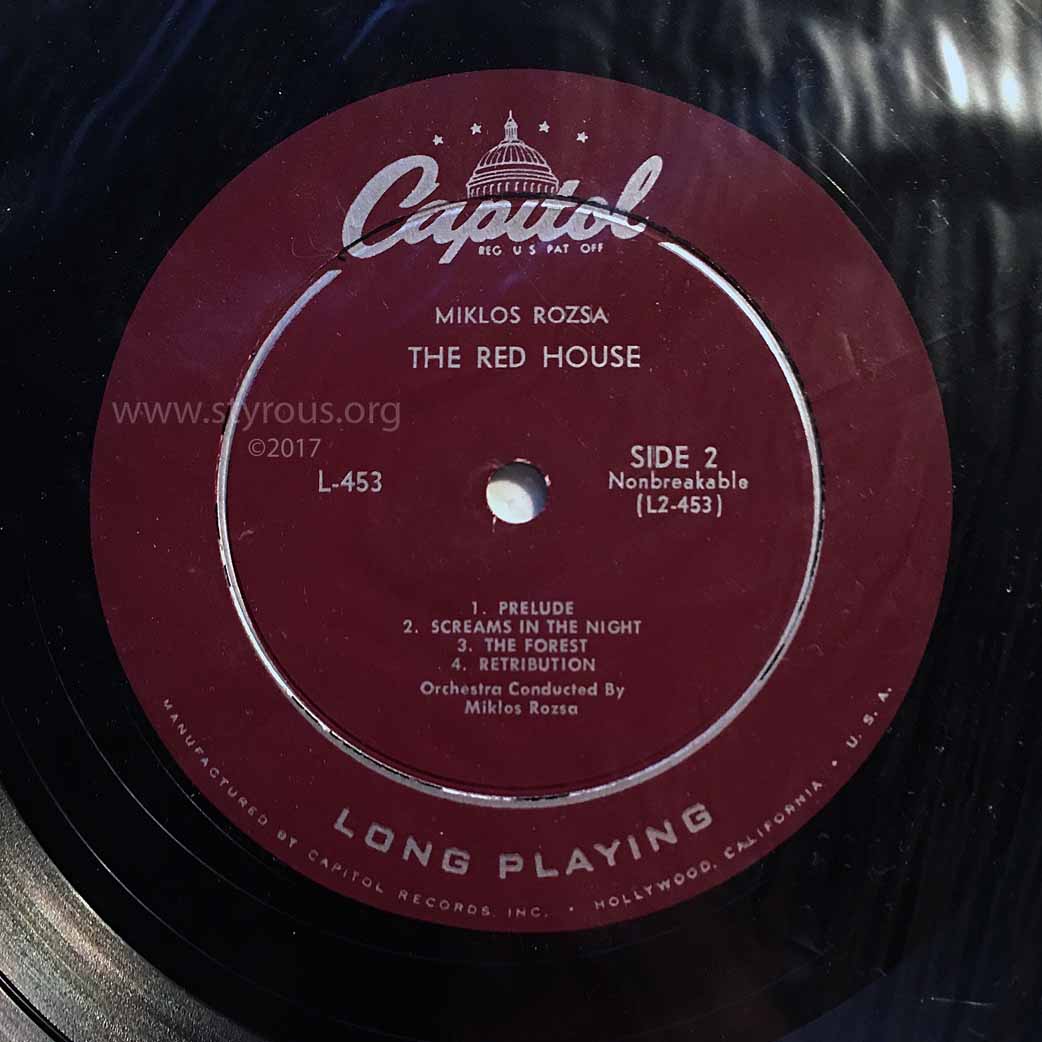
 10" vinyl LP label, side 2
detail photo by Styrous®


Miklós Rózsa died at the Good Samaritan Hospital in  Los Angeles, California, on Thursday, the 27th of July, 1995. He was 88 years old.     
  

Tracklist:

Side 1:

A1     Spellbound Concerto - 12:19 

Side 2:

          The Red House    
B1     Prelude - 3:15  
B2     Screams In The Night - 2:54  
B3     The Forest - 3:37  
B4     Retribution - 3:33  

Credits:

    Artwork – Gunall*
    Salvador Dalí dream sequence based on designs by (as Salvador Dali).     
    Conductor – Erich Kloss (tracks: A1), Miklós Rózsa (tracks: Miklos Rozsa)
    Orchestra – Frankenland State Orchestra Of Nürnberg* (tracks: A1)

Notes:

Dark red label with silver print.

Miklós Rózsa* ‎– Spellbound Concerto -- The Red House
Label: Capitol Records ‎– L-453
Format: Vinyl, LP, 10", Album
Country: US
Released: 1953
Genre: Stage & Screen
Style: Score


Viewfinder links:    
            
Gregory Peck ~ Mr Suave       
Ingrid Bergman ~ The shy lion          
          
Net links:    
           
Spellbound:
             Plot                 
             Cast               
New York Times Spellbound review              
Rózsa film scoring career       
New York Times Rózsa obit            
     
            
YouTube links:    
            
Miklos Rozsa: Spellbound -     
         Spellbound (1945) (complete movie)   
                Main Theme      
                Official Trailer      
                Salvador Dali Dream Sequence        
                Skiing Breakthrough   
Leonard Slatkin ~ Spellbound Concerto (time: 12' 12")     

Miklos Rozsa        
              Theme, Variations, and Finale (Op. 13)     
              String Trio, Op. 1     
              Piano Quintet in F Minor, Op. 2    


The Fault... is Not in Our Stars,
But in Ourselves...

                      — William Shakespeare


Styrous® ~ Thursday, July 27, 2017