Showing posts with label 10" vinyl LP. Show all posts

February 2, 2026

20,000 vinyl LPs 406: Stan Getz ~ Just Jazz Volume 13 10" LP

 ~  
Stan Getz  ~ Just Jazz, Vol. 13
10" vinyl LP front cover 
photo of album cover by Styrous®


American jazz saxophonist, Stan Getz was born Stanley Gayetski on February 2, 1927, in Philadelphia, Pennsylvania; his father was from England and his mother was born in Philadelphia. His paternal grandparents Harris and Beckie Gayetski were originally from Kyiv, Ukraine, but had emigrated to escape the anti-Jewish pogroms to Whitechapel, in the East End of London.     


The 10' vinyl LP, Just Jazz, Vol. 13, was recorded at the Civic Auditorium, Pasadena, CA, on June 23, 1947. It captured some great sounds from Red Norvo and Willie Smith both on vibraphones, Oscar Moore on guitar and Louis Bellson on drums.        
      
Body and Soul, written by Johnny Green, is a wonderful strip song! I used it for some of the girls I worked with on Broadway (link below). It starts of with a languid piano into then is joined by the Getz saxophone which evolved into the most wonderful flutters and vibrations that accent the erotic body movements performed.        


Stan Getz  ~ Just Jazz, Vol. 13
vinyl LP label, side 1 
photo by Styrous®


Stan Getz  ~ Just Jazz, Vol. 13
vinyl LP label, side 2 
photo by Styrous®
   
Tracklist:
       
Side 1:
        
        Body And Soul    
        I Got Rhythm    
       
Side 2:
       
        How High The Moon
       
Notes:
       
Recorded at the Civic Auditorium, Pasadena, CA, June 23, 1947


Viewfinder links:        
        
Another World         
Louis Bellson              
Stan Getz        
Johnny Green            
Oscar Moore             
Red Norvo                  
              
Willie Smith        
        
Net links:        


YouTube links:        
        
Body & Soul         
How High The Moon        


Styrous® ~ Monday, February 2, 2026        


December 6, 2023

20,000 vinyl LPs 342: Agnes Moorehead ~ Sorry, Wrong Number 10" vinyl LP

 ~  
10" vinyl LP front cover detail 
detail photo of front cover by Styrous®


Today is the birthday of American actress, Agnes Moorehead who was born on the 6th of December in 1900, in Clinton, Massachusetts,        


10" vinyl LP front cover detail 
detail photo of front cover by Styrous®
 
 
Sorry, Wrong Number was written by Lucille Fletcher. She once explained in an interview, Sorry, Wrong Number was partially inspired by an incident from someone else's life. When she went down to the corner drug store for medicine, she struck up a conversation with her pharmacist, a longtime friend. She raised the ire of an elderly woman who had apparently been waiting first. The woman interrupted and approached the druggist, complaining about poor service and demanding to "know who this interloper is!", referring to Fletcher. Fletcher, finding the woman's shrill voice and demeanor particularly irritating, went home with the intention of writing a script based around a character with those traits who becomes embroiled in a precarious situation.     


10" vinyl LP front cover
photo of front cover by Styrous®
 
 
The plot is as follows: On an average evening in the apartment where she lives alone, the bedridden Leona Stevenson picks up the phone to make a call. But the telephone operator connects her call incorrectly. It’s not a friend on the other end of the line — it’s two men plotting a murder. The intended victim? Stevenson herself.

“The entire show is based around the hysteria of the main character,” says Steve Darnall, editor of Nostalgia Digest. We’re stuck with the increasingly frantic Stevenson as she tries to stay alive. But, ultimately, she fails. That’s what makes Sorry, Wrong Number so unusual, Darnall says. “It was one of the first times that someone had had the audacity to go on this national network and present a story in which the killers get away.”       
 
 
10" vinyl LP back cover
photo by Styrous®
 
 
The radio drama premiered in 1943 and became one of the most legendary radio plays of all time. Agnes Moorehead created the role in the first performance and again in several later radio productions. Barbara Stanwyck starred in the 1948 film version and, in 1952, performed the original radio play over the airwaves. A 1959 version produced for the CBS radio series Suspense received a 1960 Edgar Award for Best Radio Drama.


10" vinyl LP back cover details
detail photos by Styrous®


Tracklist:
       
Side 1:
        
Sorry, Wrong Number - 8:05
       
Side 2:
       
Sorry, Wrong Number - 8:07
       
Companies, etc.
       
    Copyright © – Decca Records, Inc.
       
Credits:
       
    Edited By, Producer, Directed By William Spier
    Written By Lucille Fletcher
       
Notes:
       
Copyright 1952, DECCA RECORDS, INC.

Printed in U.S.A.

With supporting cast and sound effects.

Track durations are not listed.

Originally released as two disc "78rpm Album" in 1947
Sorry, Wrong Number (Lucille Fletcher's Celebrated Radio Thriller)
       
Barcode and Other Identifiers
       
    Matrix / Runout (A side label): MG 2669
    Matrix / Runout (B side label): MG 2670 ★
    Matrix / Runout (A side runout machine stamped): MG2669T1
    Matrix / Runout (B side runout machine stamped): MG2670T1
         
Viewfinder links:        
         
Lucille Fletcher            
Agnes Moorehead        
        
Net links:        
    
btboces ~ Sorry, Wrong Number By Lucille Fletcher        
DPS ~ Sorry, Wrong Number                 
Studio 360 ~ Sorry, Wrong Number        
Why the Book Wins ~ Sorry Wrong Number Agnes Moorehead              
        
YouTube links:        
        
Agnes Moorehead ~ Sorry, Wrong Number        


Styrous® ~ Sunday, July 19, 2020       


September 8, 2017

20,000 Vinyl LPs 108: Chuy Reyes ~ Rumba de Cuba @ 10"


10" vinyl LP album book cover 
2nd re-issue - date unknown
photo by Styrous®


I was organizing my vinyl LP space with Lon Clark (link below) yesterday and came across this delightful 1949 gem. Chuy Reyes ~ Rumba de Cuba, was a 10" vinyl LP in a book album similar to The Nutcracker and The Pentateuch of the Cosmogony (links below). This format was common in the 40's and early 50's. Unfortunately, the record itself disappeared years before I bought it. All I have is the album but the graphics were too good to pass up.     


10" vinyl LP album book cover  interior
2nd re-issue - date unknown
photo by Styrous®


It was a mono recording, of course, and my version is a re-issue (date unknown). There was also a 45 rpm version of the album issued.    


original issue - 1949

1st re-issue - date unknown


10" vinyl LP album cover interior 
photo by Styrous®

Chuy Reyes was born in Mexico but I could not find the date. He and his Hollywood Mocambo Orchestra was the club band at the Mocambo Night Club from the time it opened on January 3, 1941. 

The mocambos (from mocambo, literally Huts) were village-sized communities mainly of runaway slaves in colonial Brazil, during the Portuguese rule. They were also called, ladeiras, magotes, or quilombos.     

Mocambos were exile communities established by fugitive Brazilian slaves between the 18th and 19th century. The purpose of these settlements was to protect the slaves from the Portuguese opposition, thanks to their hidden location, which was difficult to find for the punitive military expeditions. Mocambos were a threat to the economy and the social fabric of the slave regime, because the parasitic economy of these communities was mostly composed of theft, extortion and raiding. Though the minority of communities lived off agriculture and arms trade. Mocambos were not controlled by the government and because of the high percentage of Brazilian slaves, which incorporated one third of the total population, the number and the importance of Mocambos was continually increasing. For this reason Mocambos inhabitants were executed by punitive military expeditions and the children born in the Mocambos became property of the leaders of the exterminating expeditions.         
 
       
 The Mocambo

The Mocambo - 1941 


The Mocambo was located in West Hollywood, California, at 8588 Sunset Boulevard on the Sunset Strip and was owned by Charlie Morrison and Felix Young.      

The Mocambo - 1957 


Among the celebrities who frequented the Mocambo were Clark Gable and Carole Lombard, Humphrey Bogart and Lauren Bacall, Errol Flynn, Charlie Chaplin, Elizabeth Taylor, Judy Garland, Henry Fonda, Lana Turner, Ava Gardner, Bob Hope, James Cagney, Sophia Loren, Janet Leigh and Tony Curtis, Natalie Wood and Robert Wagner, Grace Kelly, Debbie Reynolds and Eddie Fisher, Howard Hughes, Kay Francis, Marlene Dietrich, Theda Bara, Tyrone Power, Jayne Mansfield, John Wayne, Ben Blue, Ann Sothern, and Louis B. Mayer. Myrna Loy and Arthur Hornblow, Jr. celebrated their divorce there.        


The Mocambo - 1947
photographer unknown


photographer unknown


Mocambo, 1951
 photographer unknown


Mocambo - 1955 
photographer unknown 


Mocambo nightclub - 1948
photographer unknown 


The Mocambo wouldn’t allow Ella Fitzgerald to sing there, because of the color of her skin. One day Marilyn Monroe, by then a superstar, paid a visit to Charlie Morrison, the owner of the club. She made Charlie an offer: if he booked Ella, she promised she would be there, front and center, every single night of Ella’s show. Morrison agreed, because there was no star bigger than Monroe at the time (imagine the publicity!), and Ella suddenly found herself on that stage.       

photographer unknown


The club's main stage was replicated on the TV series I Love Lucy as the "Tropicana" Club. Lucille Ball and Desi Arnaz were frequent guests at the Mocambo and were close friends of Morrison.


Lobby ~ Mocambo nightclub
photographer unknown


Chuy Reyes And His Hollywood Mocambo Orchestra ‎– 
Rumba De Cuba


Tracklist:

Side 1:

A1 = Baracoa, Vocals – Tony Martinez (9), written by Traditional
   
A2 = Almendra, Vocals – Tony Gari, written by Abelardo Valdes*
   
A3 = Boteando, Vocals – Tony Martinez (9), written by King-Martinez
   
A4 = La Yuca, Vocals – Tony Martinez (9), written by Traditional
   
Side 2:

B1 = La Ultima Noche, Vocals – Tony Martinez (9), written by Bobby Collazo
   
B2  Blen! Blen! Blen!, Vocals – Tony Gari, written by Pozot-Cugat
   
B3 = Negra Leono, Vocals – Tony Gari, written by Antonio Fernandez
   
B4 = Hokey Joe, Vocals – Tony Martinez (9), written by Swan-Ricardo

   
Chuy Reyes And His Hollywood Mocambo Orchestra* ‎– Rumba De Cuba
Label: Capitol Records ‎– H152, Capitol Records ‎– H-152
Format: Vinyl, 10", 33 ⅓ RPM, Mono
Country: US
Original release: 1949
Re-issue: unknown
Genre: Latin
Style: Rumba


Viewfinder links:               
    
“Just the cover, ma’am!”            
Lon Clark          
Dave Greenslade ~ The Pentateuch of the Cosmogony      
        
Net links:              
             
Martin Turnbull ~ Mocambo: The Nightclub’s Nightclub                        
Night at the Mocambo ~ Marilyn Monroe & Ella Fitzgerald  
              
YouTube links:              
             
Baracoa              
Almendra           
Boteando             
La Yuca              
La Ultima Noche             
Blen! Blen! Blen!
Negra Leono       
Hokey Joe       


Styrous® ~ Friday, September 8, 2017    


July 27, 2017

20,000 Vinyl LPs 99: Miklós Rózsa ~ Spellbound by 10"

10" vinyl LP album, cover detail
detail photo by Styrous®


Miklós Rózsa (Hungarian: [ˈmikloːʃ ˈroːʒɒ]; died on this day, Thursday, July 27, in 1995. He was a Hungarian composer trained in Germany (1925–1931), and active in France (1931–1935), England (1935–1940), and the United States (1940–1995), with extensive sojourns in Italy from 1953.   

10" vinyl LP album, back cover detail 
album photo by Ned Scott
detail photo by Styrous®


Rózsa is best known for his nearly one hundred film scores, with Spellbound one of the top; however, he maintained an allegiance to absolute concert music throughout what he called his "double life."   


 10" vinyl LP album cover detail
detail photo by Styrous®
 

The 1945 Alfred Hitchcock mystery/suspense film, Spellbound, dealt with the new field of psychoanalysis and the inner workings of the human mind. It opens with a quote from the 1599 Julius Caesar (play), by William Shakespeare, "The Fault... is Not in Our Stars, But in Ourselves..." and announces that it wishes to highlight the virtues of psychoanalysis in banishing mental illness and restoring reason.   


10"vinyl LP album cover detail 
detail photo by Styrous®


The film stars Ingrid Bergman, Gregory Peck, Michael Chekhov and Leo G. Carroll. It is an adaptation by Angus MacPhail and Ben Hecht of the novel The House of Dr. Edwardes (1927) by Hilary Saint George Saunders and John Palmer.  

10" vinyl LP album cover 
   Artwork by Gunall
detail photo by Styrous®
 
There was major contention between director Alfred Hitchcock and producer David O. Selznick. Selznick wanted Hitchcock to make a movie based upon Selznick's own positive experience with psychoanalysis.  Selznick brought in his therapist, May Romm M.D., who was credited in the film as a technical adviser. Romm and Hitchcock clashed frequently. Further contention was caused by the hiring of surrealist artist Salvador Dalí to conceive certain scenes in the film's key dream sequence. However, the sequence conceived and designed by Dalí and Hitchcock, once translated to film, proved to be too lengthy and too complicated, so the vast majority of what was filmed was cut from the film during editing. About two minutes of the dream sequence appear in the final film, but Ingrid Bergman said that the sequence had been almost 20 minutes long before it was cut by Selznick. The cut footage apparently no longer exists, although some production stills have survived in the Selznick archives. Eventually Selznick hired William Cameron Menzies, who had worked on Gone With the Wind, to oversee the set designs and to direct the sequence. Hitchcock himself had very little to do with its actual filming.  


dream sequence based on designs
(as Salvador Dali) 
movie still


Selznick originally wanted the brilliant Bernard Herrmann, but when Herrmann turned it down, Rózsa was hired and won the Academy Award for his score. Although Rózsa considered Spellbound to contain some of his best work, he said "Alfred Hitchcock didn't like the music — said it got in the way of his direction. I never saw him since."   


Miklós Rózsa ~ Spellbound
 10" vinyl LP album back cover 
album photo by Ned Scott
photo of album cover by Styrous®
 
 
During the film's protracted post-production, considerable disagreement arose about the music, exacerbated by a lack of communication between producer, director, and composer. Rózsa scored another film, The Lost Weekend, before Spellbound was released, and he again used the theremin in that score. This led to allegations that he had recycled music from Selznick's film in the Paramount production. Meanwhile, Selznick's assistant tampered with the Spellbound scoring by replacing some of Rózsa's material with earlier music by Franz Waxman and Roy Webb.     


 10" vinyl LP album cover detail
detail photo by Styrous®


The film orchestral score by Miklós Rózsa is notable for its pioneering use of the theremin, performed by Dr. Samuel Hoffmann. The score features one of the earliest uses of the theremin. The sound of the instrument, which had been invented in 1928, would become associated indelibly with science fiction thanks to its use in films like The Day The Earth Stood Still. But the instrument originally got its start in Hollywood (it had been used in the scores to some Russian films like the 1931, Odna) thanks to the score for Spellbound. It was played by Dr. Samuel Hoffman, a medical doctor who had a sideline as one of the most important practicioners of the instrument, later playing on the scores for The Thing From Another World, It Came From Outer Space, The 5000 Fingers Of Dr. T and The Ten Commandments.     

Leonard Slatkin did a stellar performance of the Spellbound Concerto with the BBC Orchestra, Simon Mulligan on Piano, and Celia Sheen playing the theremin (link below). It's over 12 minutes but worth every second! It's fantastic!      


 10" vinyl LP album cover detail
detail photo by Styrous®


In a nutshell, Ingrid Bergman (link below) stars as Dr. Constance Petersen, a psychoanalyst, and Gregory Peck (link below) plays Dr. Anthony Edwardes who has come to replace the director, (Leo G. Carroll), of  Green Manors, a mental hospital, who is being forced into retirement. However, Petersen (Bergman) suspects Edwardes (Peck) is an imposter and the plot thickens. 


 10" vinyl LP album back cover detail
album photo by Ned Scott
detail photo by Styrous®

Miklós Rózsa was born on the 18th of April, 1907, in Budapest to Jewish parents. He achieved early success in Europe with his orchestral Theme, Variations, and Finale (Op. 13) of 1933 and became prominent in the film industry from such early scores as The Four Feathers (1939) and The Thief of Bagdad (1940). The latter project brought him to America when production was transferred from wartime Britain, and Rózsa remained in the United States, becoming an American citizen in 1946. His notable Hollywood career earned him considerable fame, including Academy Awards for Spellbound (1945), A Double Life (1947), and Ben-Hur (1959), while his concert works were championed by such major artists as Jascha Heifetz, Gregor Piatigorsky, and János Starker.


 10" vinyl LP album back cover detail
album photo by Ned Scott
detail photo by Styrous®


Rózsa was introduced to classical and folk music by his mother, Regina Berkovits, a pianist who had studied with pupils of Franz Liszt, and his father, Gyula, a well-to-do industrialist and landowner who loved Hungarian folk music. Rózsa's maternal uncle Lajos Berkovits, violinist with the Budapest Opera, presented young Miklós with his first instrument at the age of five.

He enrolled at the University of Leipzig in 1925, ostensibly to study chemistry at the behest of his father. Determined to become a composer, he transferred to the Leipzig Conservatory the following year; there, he studied composition with Hermann Grabner, a former student of Max Reger. He also studied choral music with (and later assisted) Karl Straube at the Thomaskirche, where Johann Sebastian Bach had been organist.        


Miklós Rózsa ~ Spellbound
 10" vinyl LP album back cover detail
detail photo by Styrous®


Rózsa's first two published works, the String Trio, Op. 1, and the Piano Quintet, Op. 2, were issued in Leipzig by Breitkopf & Härtel. In 1929 he received his diplomas cum laude. For a time he remained in Leipzig as Grabner's assistant, but at the suggestion of the French organist and composer Marcel Dupré, he moved to Paris in 1932.    

The Trio is beautiful and flows just by virtue of the strings. The quintet is as hard and disjointed as the Trio is soft and almost dreamy; they make a nice pair (links below).   

Rózsa was introduced to film music in 1934 by the Swiss composer Arthur Honegger. Following a concert which featured their respective compositions, Honegger mentioned that he supplemented his income as a composer of film scores, including the film Les Misérables (1934). Rózsa went to see it and was greatly impressed by the opportunities the film medium offered, and thought, "A HA!"    


Miklós Rózsa ~ Spellbound
 10" vinyl LP album back cover detail
detail photo by Styrous®

His first film score was for Knight Without Armour (1937), produced by fellow Hungarian, Alexander Korda. After his next score, for Thunder in the City (1937), he joined the staff of the Korda London Films, and scored the studio's epic The Four Feathers (1939).        

In 1939, Rózsa travelled with Korda to Hollywood to complete the work on The Thief of Bagdad (1940) The film earned him his first Academy Award nomination. A further two followed with Lydia (1940) and Sundown (1941). In 1943, he received his fourth nomination for the Korda film, Jungle Book (1942).      


Miklós Rózsa ~ Spellbound
 10" vinyl LP album back cover detail
detail photo by Styrous®


Rózsa earned another Oscar nomination for scoring The Killers (1946) which introduced Burt Lancaster to film audiences. Part of the famed theme for the Dragnet radio and TV show duplicated part of Rozsa's The Killers main theme; Rózsa sued for damages, and subsequently was given co-credit for the Dragnet theme.    


 10" vinyl LP label, side 1
detail photo by Styrous®


His popular film scores during the 1970s included his last two Billy Wilder collaborations The Private Life of Sherlock Holmes (1970) and Fedora (1978), the Ray Harryhausen fantasy sequel The Golden Voyage of Sinbad (1973), the latter-day film noir Last Embrace starring Roy Scheider, and the time-travel fantasy film Time After Time (1979) for which Rózsa won a Science Fiction Film Award, saying in his televised acceptance speech that owith f all the film scores he had ever composed, it was the one he had worked on the hardest.     


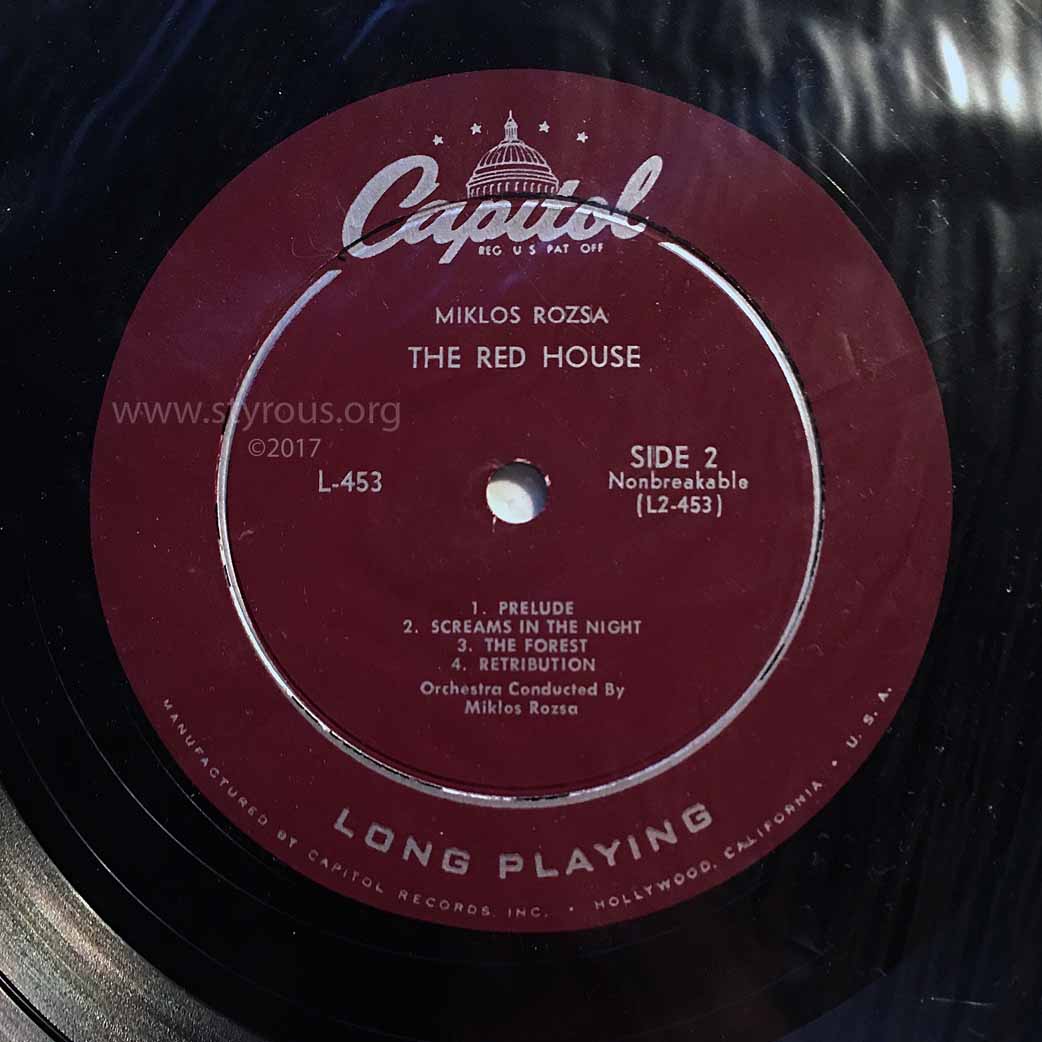
 10" vinyl LP label, side 2
detail photo by Styrous®


Miklós Rózsa died at the Good Samaritan Hospital in  Los Angeles, California, on Thursday, the 27th of July, 1995. He was 88 years old.     
  

Tracklist:

Side 1:

A1     Spellbound Concerto - 12:19 

Side 2:

          The Red House    
B1     Prelude - 3:15  
B2     Screams In The Night - 2:54  
B3     The Forest - 3:37  
B4     Retribution - 3:33  

Credits:

    Artwork – Gunall*
    Salvador Dalí dream sequence based on designs by (as Salvador Dali).     
    Conductor – Erich Kloss (tracks: A1), Miklós Rózsa (tracks: Miklos Rozsa)
    Orchestra – Frankenland State Orchestra Of Nürnberg* (tracks: A1)

Notes:

Dark red label with silver print.

Miklós Rózsa* ‎– Spellbound Concerto -- The Red House
Label: Capitol Records ‎– L-453
Format: Vinyl, LP, 10", Album
Country: US
Released: 1953
Genre: Stage & Screen
Style: Score


Viewfinder links:    
            
Gregory Peck ~ Mr Suave       
Ingrid Bergman ~ The shy lion          
          
Net links:    
           
Spellbound:
             Plot                 
             Cast               
New York Times Spellbound review              
Rózsa film scoring career       
New York Times Rózsa obit            
     
            
YouTube links:    
            
Miklos Rozsa: Spellbound -     
         Spellbound (1945) (complete movie)   
                Main Theme      
                Official Trailer      
                Salvador Dali Dream Sequence        
                Skiing Breakthrough   
Leonard Slatkin ~ Spellbound Concerto (time: 12' 12")     

Miklos Rozsa        
              Theme, Variations, and Finale (Op. 13)     
              String Trio, Op. 1     
              Piano Quintet in F Minor, Op. 2    


The Fault... is Not in Our Stars,
But in Ourselves...

                      — William Shakespeare


Styrous® ~ Thursday, July 27, 2017