Showing posts with label Michael Riesman. Show all posts

December 7, 2020

1,000,001 CDs 18: Gavin Bryars With Tom Waits ‎~ Jesus' Blood Never Failed Me Yet

~      

Two things happened on a December 7th; the bombing of Pearl Harbor in Honolulu, Hawaii, in 1941 and the birth of Tom Waits in Pomona, California in 1949. Both changed my life forever and we would never see the world the same way again.          
           
I first became aware of Waits when I was dancing on Broadway at the hungry i in San Francisco (link below). Janice, one of the girls who danced there, loved his songs and used them regularly. Then one night he actually came into the club; Janice was in heaven and I got to meet him. He is an easy going, down-to-earth guy and I liked him a lot.    

In 1971, Gavin Bryars composed a work based on a loop of an unknown homeless man in a Lambeth church in London, England, in 1975, singing a brief improvised stanza. The loop was the singer's recollection of the chorus of a Gospel hymn, by James M Black, published in 1911.      


 Lambeth church - 1975
homeless man - London
Photograph: Evening Standard/Getty Images
 
 
Bryars made a loop of 13 bars; he was by that time teaching at Leicester Polytechnic and was able to make use of a small sound studio there. To preserve the delicate original, he recorded it on to a second machine, leaving the loop running while he went to fetch a coffee. When he returned, he found that the painting students in the various rooms around the studio had fallen silent and were listening sombrely to the old man’s voice. Someone was weeping in a corner. It’s an effect that audiences have been experiencing ever since.        
 
Recognizing that his piano was in tune with the singer, began to work on harmonization. He made a simple chordal arrangement, which in later versions has developed into a rich ensemble sound with strings and brass, weighted to the low end of the harmonic scale. There have been several versions of the work from 1972 to 2019. This is the 1993 version and the CD has Tom Waits singing the hymn.  
              
Bryars was deeply interested in using “found material”. He spent significant time away from composition, studying the work of Marcel Duchamp, whose “readymades” are key works of high modernism, and he had already experimented with found material in the 1969 indeterminate piece The Sinking of the Titanic (link below).        


CD front & back 
Design – David Lau 
cover photos by Nick White 
photo of CD cover by Styrous®


The piece was first recorded for use in a documentary which chronicles street life in and around Elephant and Castle and Waterloo, in London. When later listening to the recordings, Bryars noticed the clip was in tune with his piano and that it conveniently looped into 13 bars. For the first LP recording, he was limited to a duration of 25 minutes; later he completed a 60-minute version of the piece for cassette tape; and with the advent of the CD, this is a 74-minute version.       


This is a very strange recording in so many ways, which is not unusual for neither Bryars nor Waits. I have a favorite track on any album; I don't on this one because although there are six tracks, the music runs from one track to the next. The tape loop of the homeless man (called The Tramp) plays with orchestral variations on the first four tracks but Waits doesn't actually come in until the fifth track when he accompanies the tape loop of "The Tramp". Waits then takes over on the sixth track which is VERY quiet and dreamy but his whiskey-and-cigarette flavored voice is unmistakable.       


Gavin Bryars is an English composer and double bassist. He has worked in jazz, free improvisation, minimalism, historicism, avant-garde, and experimental music.           


Tom Waits is an American singer, songwriter, musician, composer, and actor. His lyrics often focus on the underbelly of society and are delivered in his trademark deep, gravelly voice. He worked primarily in jazz during the 1970s, but his music since the 1980s has reflected greater influence from blues, rock, vaudeville, and experimental genres.        


Jesus' Blood Never Failed Me Yet was shortlisted for the 1993 Mercury Prize, an annual music prize awarded for the best album released in the United Kingdom by a British or Irish act created by Jon Webster. The prize when to Suede for their self-titled album.   


Tracklist:

1 - Tramp With Orchestra I (String Quartet) - 27:05
2 - Tramp With Orchestra II (Low Strings) - 15:16
3 - Tramp With Orchestra III (No Strings) - 4:48
4 - Tramp With Orchestra IV (Full Strings) 6:06
5 - Tramp And Tom Waits With Full Orchestra - 19:38
6 - Coda: Tom Waits With High Strings - 1:47

Companies, etc.

    Phonographic Copyright (p) – Point Music
    Copyright (c) – GB Records (2)
    Copyright (c) – Mnemonic Records
    Copyright (c) – Point Music-
    Produced For – Euphorbia Productions Ltd.
    Produced For – Philips Classics Productions
    Manufactured By – PolyGram Classics & Jazz
    Marketed By – PolyGram Classics & Jazz
    Made By – UML
    Recorded At – Prairie Sun Recording Studios
    Engineered At – The Looking Glass Studios
    Mixed At – The Looking Glass Studios
    Produced At – Dave Hunt Studio
    Produced At – Cedar
    Published By – Island Records Inc.

Credits:

    Alto Vocals [Chorus] – Elsa Higby, Katie Geissinger, Margo Grib*
    Art Direction – Margery Greenspan
    Baritone Vocals [Chorus] – Gregory Purnhagen, Jeffrey Kensmoe*, Peter Stewart (2)
    Bassoon [Orchestra] – Kim Laskowski
    Cello [Hampton String Quartet] – John Reed (3)
    Cello [Orchestra] – Beverly Lauridsen, Clay Ruede, Jeanne LeBlanc, Jesse Levy, Mark Shuman, Semyon Fridman
    Clarinet [Orchestra] – Allen Blustine, Steven Hartman
    Composed By [Music] – Gavin Bryars
    Conductor, Producer – Michael Riesman
    Contrabassoon [Orchestra] – Jeffrey Marchand
    Design – David Lau (2)
    Double Bass [Bass] [Orchestra] – Barbara Wilson (2), Homer Mensch, John Beal
    Engineer, Mixed By – Chris Ekers, Dante DeSole
    Executive-Producer – Kurt Munkacsi, Philip Glass, Rory Johnston
    Flute [Orchestra] – Michael Parloff
    French Horn [Orchestra] – Ann Yarborough*, Ron Sell, Sharon Moe, Tony Miranda
    Guitar [Orchestra] – Brian Koonin
    Harp [Orchestra] – Karen Lindquist, Nina Kellman
    Oboe [Orchestra] – Dorothy Darlington
    Organ [Orchestra] – Michael Riesman
    Percussion [Orchestra] – Frank Cassara
    Photography By [Cover Photo] – Nick White (4)
    Photography By [Photos (Inlay Card & Inside) Except Tom Waits] – Alastair Thain
    Recorded By [Tom Waits' Vocals] – Mark "Mooka" Rennick*
    Soprano Vocals [Chorus] – Kristin Norderval, Lisa Bielawa, Marion Beckenstein, Michele Eaton
    Tenor Vocals [Chorus] – Eric Lamp*, Jeffrey Johnson, John Koch
    Trombone [Orchestra] – James Pugh*, Keith O'Quinn
    Trumpet [Orchestra] – Neil Balm, Wilmer Wise
    Tuba [Orchestra] – Alan Ralph*
    Viola [Hampton String Quartet] – Richard Maximoff
    Viola [Orchestra] – Alfred Brown, Juliet Haffner, Olivia Koppel*, Paul Peabody
    Violin [1st] [Hampton String Quartet] – Regis Iandiorio
    Violin [2nd] [Hampton String Quartet] – Richard Henrickson
    Violin [Orchestra] – Dale Stuckenbruck, David Nadien, Donna Tecco, Elena Barere, Eriko Sato-Oei*, Jan Mullen, Jean Ingraham, Laura Seaton, Matthew Raimondi, Max Ellen, Mayuki Fukuhara, Nancy McAlhany, Richard Sortomme, Sanford Allen
    Vocals [Additional] – Tom Waits

Notes:

Original version © 1971 Gavin Bryars.
Current version © 1993 Mnemonic/(MCPS/PRS).
℗ © 1993 Point Music / a joint venture of Euphorbia Productions, Ltd. and Philips Classics Productions.

Manufactured and marketed by PolyGram Classics and jazz, a division of PolyGram Records, Inc., New York, NY.
Printed in the U.S.A.

Engineered and mixed at The Looking Glass Studios, NYC.
Tom Waits' vocals recorded at Prairie Sun Recording, Cotatti, CA.
Pre-Production/Tape Preparation: Dave Hunt Studio, London; Cedar Audio, Cambridge; Nick Gilpin, Autograph.

Tom Waits appears courtesy of Island Records, Inc.

Total Time - 74:43

Barcode and Other Identifiers

    Barcode (Scanned): 028943882323
    Barcode (Text): 0 289-438823-2 3Tom Waits
    Matrix / Runout (Burned on Master): 438 823-2 02@
    Matrix / Runout (Pressed on Stamper - Variant 1): E
    Matrix / Runout (Pressed on Stamper - Variant 2): D
    Label Code: LC 6042
    Rights Society: MCPS/PRS
    Other: PG 925
    Other: PTH
    Matrix / Runout (Pressed on Stamper - Variant 3): G

Gavin Bryars With Tom Waits ‎– Jesus' Blood Never Failed Me Yet
Label: Point Music ‎– 438 823-2
Format: CD, Album, Reissue
Country: US
Released: 
Genre: Electronic, Classical
Style: Abstract, Contemporary, Minimal          


Viewfinder links:        
         
Samuel Becket        
Gavin Bryars        
Philip Glass         
Hungry i articles        
Kurt Munkacsi        
      
Net links:        
         
The Cross-Eyed Pianist ~ A mesmerising musical experience     
The Guardian ~ Anthem for the homeless         
Opuszine ~ Jesus’ Blood Never Failed Me Yet        
Pitchfork ~ Jesus' Blood Never Failed Me Yet        
Gramophone ~ Jesus' Blood Never Failed Me Yet                 
      
YouTube links:        
        
Jesus' Blood Never Failed Me Yet (1 hr., 14 mins., 43 sec.)       
Jesus' Blood Never Failed Me Yet (edit w/Tom Waits)       
Jesus' Blood Never Failed Me Yet (interview)       


“ . . . the tears of the world are a constant quality. 
For each one who begins to weep, 
someone somewhere else stops.”
            ~ Samuel Beckett
 
 
Tom Waits (front), Gavin Bryars (rear) 


Styrous® ~ Monday, December 7, 2020     


Michael Riesman artiocles/mentions

    ~  
     
     
Bryars & Waits ~ Jesus' Blood Never Failed Me Yet      
Philip Glass ~ Mishima     


date & photographer unknown


October 3, 2020

1,000,001 CDs 17: Philip Glass ‎– La Belle Et La Bête

 ~
Gregory Purnhagen (bass/baritone), far left, and Hai-Ting Chinn (mezzo-soprano), far right 
perform with the Philip Glass ensemble during a screening of La Belle Et La Bête
 

It was fifteen years ago last month, in September of 2005, that Tom & I attended a performance like one I'd never seen before or since at the Metro in Oakland. 


It was a staging by the Oakland Opera Theater of the operatic fantasy, La Belle et la Bête, written by Philip Glass (link below).         
      
The show actually started outside on the sidewalk with a tent that served as a cafe in front of the Metro. The audience drifted into the theater and took their seats. I'd shot a performance by earRotator the year before (link below).    


Metro, Oakland
photographer unknown


I discovered that almost the entire space was taken up by the set for the opera. There was little room for the audience which was VERY small.          

The cast was Lisa Marie Bolin, Roger McCracken and Angela Dean Baham, as well as acrobats, contortionists, stilt walkers and a pole climber.        


CD front cover 
cover image: still from La Belle et la Bête
photo of CD by Styrous®


sticker  on CD front cover
photo by Styrous®
 
    
La Belle et la Bête (The Beauty and the Beast) is an opera for ensemble and film, composed in 1994 by Philip Glass based on a libretto in French by the composer according to the script of the film by Jean Cocteau released in 1946.         

Glass had the idea of removing the original soundtrack from Cocteau's film, including the voices of the actors, and replacing it with his own music and the voices of the singers. In order to perfectly match the singing with the movements of the actors' lips on the screen, he transcribed all the lines and meticulously located them so that the music perfectly matched the image. Glass thus timed each word of the film's dialogues by electronic tracking of the film and placed them mathematically in the score, then synchronized music and film using a computer which, in charge of sorting the delays and advances of the spoken and sung words, recalculated the digital signals of the audio tape on the film's digital circuit. The result of this collaboration has been posted to YouTube (link below).        


CD case interior w/disc1
photo Styrous®


La Belle et la Bête (The Beauty and the Beast) is an opera for ensemble and film, composed in 1994 by Philip Glass based on a libretto in French by the composer according to the script of the film by Jean Cocteau released in 1946. This is the second part of a trilogy in homage to the French poet after Orphée (1993) and before Les Enfants Terribles (1996). The world premiere of the work took place on 4 June 1994 in Seville, with Michael Riesman conducting.        


CD case interior w/disc 2
photo Styrous®


A stage production requires three different levels: the film projected on a large screen, the singers on a stage in front of the screen and the musicians. It takes both precision and synchronisation on the part of the orchestra and the singers. For this, director Charles Otte had the idea of presenting the singers turning their backs to the audience when they are not singing, thus being able to follow their cinematographic doubles on the screen.           


La Belle et la Bête  is written for the Philip Glass Ensemble, to which strings and percussion are added; the orchestra therefore includes a flute and a piccolo flute, a clarinet and a bass clarinet, a soprano saxophone and viola, two trombones and a bass trombone, a harp, two synthesizers, strings and a percussionist.       


Tracklist:

1-01     Ouverture - 3:31
1-02     Les Sœurs - 3:47
1-03     La Demande En Mariage D'Avenant - 3:37
1-04     Le Voyage Du Père - 5:22
1-05     La Belle Et La Bête - 7:39
1-06     Le Retour Du Père - 2:18
1-07     La Belle Va Au Château - 8:12
1-08     Le Dîner - 3:43
1-09     Les Tourments De La Bête - 4:50
2-01     Promenade Dans Le Jardin - 10:10
2-02     La Saisie Des Meubles - 1:33
2-03     La Confiance De La Bête En La Belle - 4:59
2-04     Belle Retourne Chez Son Père - 1:57
2-05     Belle Raconte Son Histoire - 3:54
2-06     Le Plan - 3:32
2-07     La Passion D'Avenant - 4:06
2-08     Le Magnifique Apparaît - 3:10
2-09     Le Miroir - 4:26
2-10     Le Pavillon - 3:44
2-11     La Métamorphose - 4:10

Companies, etc.

    Phonographic Copyright (p) – Nonesuch Records
    Copyright (c) – Nonesuch Records
    Phonographic Copyright (p) – WEA International Inc.
    Copyright (c) – WEA International Inc.
    Produced For – Euphorbia Productions Ltd.
    Recorded At – The Looking Glass Studios
    Mixed At – The Looking Glass Studios
    Made By – WEA Manufacturing Inc.
    Pressed By – Specialty Records Corporation

Credits:

    Alto Saxophone, Soprano Saxophone – Richard Peck
    Baritone Vocals – Gregory Purnhagen, John Kuether, Zheng Zhou
    Bassoon – Charles McCracken*
    Cello – Beverly Lauridsen, Semyon Fridman, Seymour Barab
    Conductor, Directed By [Music Director], Keyboards, Mixed By – Michael Riesman
    Engineer – Anne Pope, Rich Costey
    Engineer [Assistant] – Amanda Riesman, Dave Porter, James Law, Leonardo Heiblum
    Flute, Piccolo Flute, Soprano Saxophone, Bass Clarinet – Andrew Sterman
    French Horn – Sharon Moe
    Keyboards – Eleanor Sandresky, Philip Glass
    Liner Notes [Interview] – Jonathan Cott
    Mezzo-soprano Vocals – Janice Felty
    Other [French Language Consulant] – Lisa M. Glaeser
    Other [Vocal Coach] – Alan Johnson
    Performer – The Philip Glass Ensemble
    Producer – Kurt Munkacsi
    Producer [Theatrical Production] – Jedediah Wheeler
    Soprano Saxophone, Flute – Jon Gibson (2)
    Soprano Vocals – Ana Maria Martinez, Hallie Neill
    Synthesizer [Programming Assistance] – John Witte, MacDonald Quayle*
    Synthesizer [Sound Design] – Michael Riesman
    Trombone [Tenor] – James Pugh*
    Tuba, Bass Trombone – Alan Raph
    Viola – Alfred Brown, John Dexter (3), Stephanie Fricker*
    Violin – Jan Mullen, Jenny Koo, Karen Karlsrud, Linda Quan, Regis Iandiorio, Sanford Allen, Sergiu Schwartz, Tim Baker*

Notes:

An opera for ensemble and film. Music by Philip Glass. Based on the film by Jean Cocteau.
Produced for Euphorbia Productions Ltd., New York.
Recorded and mixed at The Looking Glass Studios, New York.
Music preparation: Lisa Bielawa, Peter Foley, Ken Willians.
Production coordinator: Sharon Ainsberg. Production assistants: Warren Fischer, Leonardo Heiblum, Amanda Riesman. Intern: Svjetlana Bukvic.
Graphic design: John Gall.
Photographs on La Belle Et La Bête, a film by Jean Cocteau, by G. R. Aldo.

Packaged in a double CD case that is housed in a cardboard slip case and accompanied by a 146 page booklet with opera text in English, French & German.

℗ & © 1995 Nonesuch Records for the United States and
℗ & © 1995 WEA International Inc. for the world outside the United States
Barcode and Other Identifiers

    Barcode (Scanned): 075597934724
    Barcode (Text): 0 7559-79347-2 4
    Matrix / Runout (Disc 1): [Specialty 'S' Logo] 2 79347-2.1 SRC##01 M1S1
    Matrix / Runout (Disc 2): [Specialty 'S' Logo] 2 79347-2.2 SRC**01 M1S1

Philip Glass ‎– La Belle Et La Bête
Label: Nonesuch ‎– 79347-2
Format: 2 × CD
Country: US
Released: 07 Apr 1995
Genre: Electronic
Style: Modern Classical, Minimal


Viewfinder link:     
      
Jean Cocteau      
Philip Glass     
Jean Marais     
Tom White           
    
Net links:     
      
East Bay Times ~ Oakland show not ordinary opera    
LA Times ~ Philip Glass transforms opera, film with La Belle et la Bête   
Oakland Metro     
    
YouTube links:     
       
Jean Cocteau & Philip Glass ~ La Belle et la Bete 
Philip Glass ~   
     La Belle et la Bête (documentary)     
     La Belle et La Bete  (instrumental remix) (22:13)     


Styrous® ~ Saturday, October 3, 2020     


July 10, 2017

20,000 Vinyl LPs 96: Carl Orff ~ Carmina Burana á la Manzarek

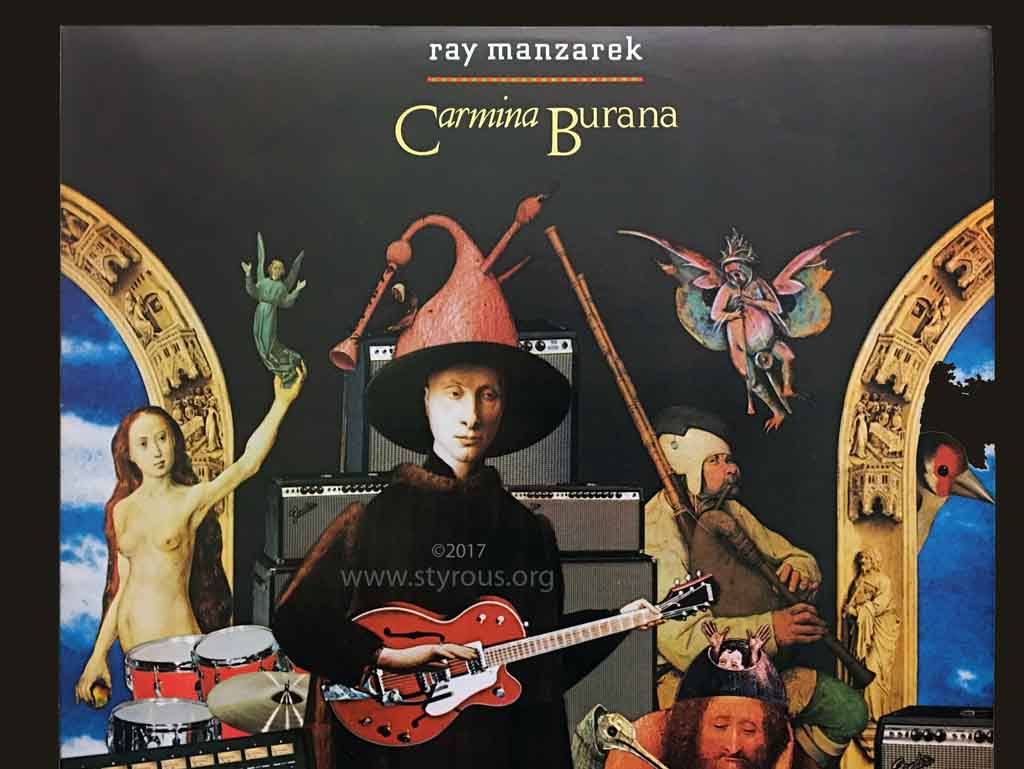
vinyl LP, front cover detail
    Artwork [Design] by Lynn Robb
    Artwork [Illustration] by Hieronymus Bosch
detail photo by Styrous®

Today, July 10th, is the birthday of Carl Heinrich Maria Orff (German: [ˈkaɐ̯l ˈɔɐ̯f]). He was a German composer, best known for his cantata Carmina Burana which was based on a medieval collection of poems. I discovered Carmina when I was in college in the late 50's. It has been one of my favorite works of serious music ever since then.

In 1803 a scroll of medieval poems was discovered in the German province of Bavaria among the debris of the secularized monastery of Benedikt-Beuren ("BURANA").  

These poems, written primarily in Latin, were determined to be the work of renegade monks and wandering poets of the 13th Century. Their words captured a lost world of rebels and dropouts of the medieval clergy; hard lovers, drinkers, on the move, celebrating existence rather than living the meditative, celibate, cloistered life of the monastery.
    
Carmina Burana is based on 24 poems from the medieval collection Carmina Burana. Its full Latin title is Carmina Burana: Cantiones profanæ cantoribus et choris cantandæ comitantibus instrumentis atque imaginibus magicis ("Songs of Beuern: Secular songs for singers and choruses to be sung together with instruments and magic images").    

fol. 1r with the Wheel of Fortune 


In 1935 Carl Orff re-discovered the poems. Impressed with their meaning and rhythm he composed a cantata, Carmina Burana, utilizing the centuries old verses. He transformed the writings into invocations and profane chants accompanied by numerous instruments and magical representations.

These songs ("CARMINA") were divided into three primary sections: Springtime - the life force renewed; In the Tavern - drinking and gambling; The Court of Love - passion, sensuality. The sections are pervaded and framed by the Wheel of Fortune ("O Fortuna") perpetually turning, perpetually governing the course of man's existence.       
 
photographer unknown 

In 1983, Ray Manzarek grabbed Carmina by the throat, shook it up and spit out one of the most stellar transcriptions of it EVER! Attracted to the spiritual power of Carmina Burana, he chose to interpret the piece in a contemporary framework. This presentation intends to create enchanted pictures; to conjure up the ecstasy expressed by the lyrics, an enhanced intense feeling for life akin to the passions and revelry of the wandering poets of so long ago.    


Carl Orff ~ Carmina Burana
Ray Manzarek
vinyl LP, front cover
    Artwork [Design] by Lynn Robb
    Artwork [Illustration] by Hieronymus Bosch
photo of album cover by Styrous®


Carmina Burana is part of Trionfi, a musical triptych that also includes Catulli Carmina and Trionfo di Afrodite. For more information, there is a version of Carmina conducted by Eugene Ormandy on the Viewfinder (link below).   

But this is in no way a traditional rendition of the work, far from it. Ray Manzarek has taken the work from the traditional version to the heights of hard rock and beyond.  


vinyl LP, back cover
 album photo by Larry Williams
photo by Styrous®


This is the third solo album by Ray Manzarek; It was produced by Kurt Munkacsi and Philip Glass. In addition to being a renowned Western-classical-music producer, having worked with many avant-garde composers such as Charlemagne Palestine, Munkacsi has been the person primarily responsible for the sound of Philip Glass's recorded work.         


vinyl LP, back cover detail
detail photo by Styrous®


The cover art features a photo-montage of illustrations by Hieronymus Bosch (spelled on original release as Hieronymus Beach) and modern items like guitar, drums, reel-to-reel and keyboards. Cover design by Lynn Robb.       


vinyl LP, front cover detail
    Artwork [Design] by Lynn Robb
    Artwork [Illustration] by Hieronymus Bosch
detail photo by Styrous®


There isn't a single track from the album I don't like but as usual, I have a favorite. In this case it is The Roasted Swan (link below). It is slow and dreamy with a languid, mournful but intensely beautiful sax, played by Jack Kripl, replacing the tenor in the original orchestral work. It suddenly erupts into a timpani-pounding, hard-rock beat accompanied by an all-male chorus and organ that  builds into a whopper of an ending!  


vinyl LP, back cover  detail
album photo by Larry Williams
detail photo by Styrous®


The Face of Spring is a marvelous song. It starts off with a fast, tinkly piano intro, that erupts into a very slow but determined, hard rock beat which is joined by the chorus in three quarter time. It is vigorous and dreamy while it rocks out from time to time until near the end when it erupts once more into a faster tempo that ends abruptly.  


vinyl LP, back cover  detail
album photo by Larry Williams
detail photo by Styrous®


Boiling Rage (Estuans Interius) is just that. It is the complete opposite of The Face of Spring. It is fast, bouncy with full chorus in hard rock conjunction with the group.       


In 1934, Orff encountered the 1847 edition of the Carmina Burana by Johann Andreas Schmeller, the original text dating mostly from the 11th or 12th century, including some from the 13th century. Michel Hofmann (de), then a young law student and Latin and Greek enthusiast, assisted Orff in the selection and organization of 24 of these poems into a libretto, mostly in Latin verse, with a small amount of Middle High German and Old Provençal. The selection covers a wide range of topics, as familiar in the 13th century as they are in the 21st century: the fickleness of fortune and wealth, the ephemeral nature of life, the joy of the return of Spring, and the pleasures and perils of drinking, gluttony, gambling and lust.         

vinyl LP, back cover  detail
detail photo by Styrous®


Orff was born in Munich on 10 July 1895. His family was Bavarian and was active in the Army of the German Empire. His paternal grandfather was a Jew who converted to Catholicism.   

In addition to his career as a composer, Orff developed an influential approach toward music education for children. In 1924 Dorothee Günther (de) and Orff founded the Günther School for gymnastics, music, and dance in Munich. Orff was there as the head of a department from 1925 until the end of his life, and he worked with musical beginners. There he developed his theories of music education, having constant contact with children. In 1930, Orff published a manual titled Schulwerk, in which he shares his method of conducting. Before writing Carmina Burana, he also edited 17th-century operas.   

In the mid-1920s, Orff began to formulate a concept he called elementare Musik, or elemental music, which was based on the unity of the arts symbolized by the ancient Greek Muses, and involved tone, dance, poetry, image, design, and theatrical gesture. Like many other composers of the time, he was influenced by the Russian-French émigré Igor Stravinsky. He also began adapting musical works of earlier eras for contemporary theatrical presentation.    


Ray Manzarek
side one 
vinyl LP, back cover detail
detail photo by Styrous®


Ray Manzarek
side two 
vinyl LP, back cover detail
detail photo by Styrous®


Carmina Burana was hugely popular in Nazi Germany after its premiere in Frankfurt in 1937. Given Orff's previous lack of commercial success, the monetary factor of acclaim for Carmina Burana was significant to him. But the composition, with its unfamiliar rhythms, was also denounced with racist taunts.      

Orff's assertion that he had been anti-Nazi during the war was accepted by the American denazification authorities, who changed his previous category of "gray unacceptable" to "gray acceptable", enabling him to continue to compose for public presentation, and to enjoy the royalties that the popularity of Carmina Burana had earned for him.       


vinyl LP, side one
photo by Styrous®


vinyl LP, side two
photo by Styrous®


There is a lyric sheet enclosed . . . .


Raymond Daniel "Ray" Manzarek, Jr. (né Manczarek; February 12, 1939 – May 20, 2013) was an American musician, singer, producer, film director, and author, best known as a member of The Doors from 1965 to 1973, which he co-founded with singer and lyricist Jim Morrison.      

Orff was an observant and active Roman Catholic. He died of cancer in Munich in 1982 at the age of 86. He had lived through four epochs: the German Empire, the Weimar Republic, Nazi Germany and the post World War II West German Bundesrepublik. Orff was buried in the Baroque church of the beer-brewing Benedictine priory of Andechs, south of Munich.


Tracklist:

Side 1:

    Destiny: Ruler Of The World

1 - The Wheel Of Fortune (O Fortuna) - 3:06
2 - The Wounds Of Fate (Fortune Plango) - 3:44

    Springtime

3 - The Face Of Spring (Veris Leta Facies) - 4:16
4 - Sunrise (Omnia Sol Temperat) - 2:14
5 - Welcome (Ecce Gratum) - 2:46
6 - The Dance (Tanz) - 2:25
7 - Sweetest Boy (Dulcissime)- 0:34
8 - If The Whole World Was Mine (Were Diu Werlt) - 0:50

Side 2:

    In The Tavern

9 - Boiling Rage (Estuans Interius) - 3:14
10 - The Roasted Swan (Olim Lacus) - 2:11
11 - In The Tavern (In Taberna) - 2:33

    The Court Of Love

12 - Love Flies Everywhere (Amor Volat) - 2:08
13 - A Young Girl (Stetit Puella) - 2:54
14 - Come, My Beauty (Veni Veni Venias) - 2:36
15 - The Lovers (Blanziflor Et Helena) - 1:16

    Destiny: Ruler Of The World

16 - The Wheel Of Fortune (O Fortuna) - 3:09

Credits:

    Arranged By – Ray Manzarek
    Arranged By [Orchestrations], Conductor – Michael Riesman
    Artwork By [Design] – Lynn Robb
    Artwork By [Illustration] – Hieronymus Bosch
    Bass – Doug Hodges
    Composed By – Carl Orff
    Drums – Larry Anderson (2)
    Engineer [2nd] – Clay Rose, Gene Wooley
    Guitar – Ted Hall (2)
    Mastered By – Bob Ludwig
    Mixed By – Joe Chiccarelli
    Piano, Organ, Keyboards [Misc.] – Ray Manzarek
    Producer – Kurt Munkacsi, Philip Glass
    Recorded By – John Beverly Jones
    Saxophone, Flute – Jack Kripl
    Synthesizer – Adam Holzman, Michael Riesman

Personnel:

  • Ray Manzarek - Piano, Organ, Keyboards, arrangements
  • Michael Riesman - Synthesizers, Orchestrations, conductor
  • Larry Anderson - Drums
  • Ted Hall - Guitar
  • Doug Hodges - Bass
  • Adam Holzman - Synthesizers
  • Jack Kripl - Saxophones, Flutes
Principal Singers:
  • Catherine Aks
  • Ma Premm Alimo
  • Bruce Fifer
  • Maryann Hart
  • Cindy Heuues
  • Michael Hume
  • Elliot Levine
  • Dora Ohrenstein
  • Patrick Tomano
  • Imball Wheeler
Notes:

Issued with 4-Page Insert with Lyrics + Credits.

Latin Lyrics: © 1937 by B. Schott's Soehne, copyright renewed.
English Adaptation: © 1938 B. Schott's Soehne by Permission Of European American Music Distributors Corp. Sole U.S. agent for B. Schott's Soehne.
Lyrics used by permission.

Lyric sheet enclosed.

Ray Manzarek ‎– Carmina Burana
Label: A&M Records ‎– SP-4945
Format: Vinyl, LP, Album
Country: US
Released: 1983
Genre: Electronic, Rock
Style: Folk Rock, Modern Classical, Abstract, Art Rock


Net links:                         
              
Ray Manzarek Discography
Ray Manzarek website      
       
        
Viewfinder links:        
         
Eugene Ormandy ~ Carmina Burana        


YouTube links:    
          
Carmina Burana:      
     Ray Manzarek - Carmina Burana (Full Album)        
     Ray Manzarek - The Wheel of Fortune (O Fortuna)       
     Ray Manzarek - The Wounds of Fate (Fortune Plango Vulnera) 
     Eugene Ormandy ~ The Roasted Swan (Olim Lacus)    
     Ray Manzarek - The Roasted Swan (Olim Lacus)        
     Ray Manzarek - The Face of Spring (Veris Leta Facies)    
     Ray Manzarek ~ Boiling Rage (Estuans Interius)    
     Ray Manzarek - In the Tavern (In Taberna)                
     Ray Manzarek - A Young Girl (Stetit Puella)   
     Ray Manzarek - Come, My Beauty (Veni Veni Venias)   
     Ray Manzarek - Love Flies Everywhere (Amor Volat)  
     Ray Manzarek - Dance (Tanz)  
     Ray Manzarek ~ Carmina Burana 1983 video excerpts   
     Ray Manzarek ~ Sunrise (Omnia Sol Temperat)     
Tempus est Iocundum "Codex Buranus, 179"              


Carl would have been ecstatic about the album! 
Happy Birthday! 


Styrous® ~ Monday, July 10, 2017