Showing posts with label Michael Rennie. Show all posts
Showing posts with label Michael Rennie. Show all posts
March 14, 2024


Gort articles/mentions

August 27, 2021
Stanley Kubrick articles/mentions
 ~
~ mentions:
Meat Loaf ~ Bat Out of Hell
Michael Rennie ~ Klaatu barada nikto!
Michael Rennie ~ Klaatu barada nikto!
Stanley Kubrick - 1949
self-portrait
August 25, 2021
Michael Rennie ~ Klaatu barada nikto!
~

movie poster
I
have many songs, pieces of music or whatever, that I will always remember
the moment, situation or place I was when I heard it; a case in point
is the theremin;
ok, it's not a song but it fits in there. The first time I heard the
sound of the instrument I was 11 years old and had discovered Sci-Fi in books and films several years earlier. As far as films go, I
was used to the funky stuff, Buster Crabbe as Flash Gordon, the VERY low budget Man From Planet X, etc.,
so, from the moment the The Day the Earth Stood Still opened with the electrifying (pun intended) music score by
Bernard Herrmann with the quivering, other-worldly sound of the theremin, which sent shivers up and down my spine (it still does), I was
transfixed in my seat! The film score by Herrmann
is sensational; it is in my pantheon of the top ten film scores of all
time. I think it with the excellent production values are what makes Day the Earth
the Grandfather of the modern Sci-Fi film age.
The next technological/sonic breakthroughs would happen again 17 years later with the Stanley Kubrick film 2001: A Space Odyssey . . .

. . . then 35 years later with Star Wars.

Today, August 25, is the birthday of Michael Rennie who starred as Klaatu, the alien from the flying saucer in The Day the Earth Stood Still.

Michael Rennie was a 6' 4" tall British film, television and stage actor, born in 1909, in Idle near Bradford, West Riding of West Yorkshire, England. He appeared in more than fifty films but is best remembered for his starring role as the space visitor Klaatu in the 1951 Sci-Fi film, The Day the Earth Stood Still.
He attracted the interest of a casting director at Gaumont British
who took him on as an extra. Rennie said this was a deliberate strategy
so he could learn how films were made. Head of production Michael Balcon
said Rennie was taken on "because he was good-looking and athletic. He
knew nothing of acting, but was given a contract to play small parts
and to work as stand-in for players such as Robert Young and John Loder.
Rennie's first screen acting was an uncredited bit part in the Alfred Hitchcock film Secret Agent (1936), standing in for Robert Young. Balcon says he saw Rennie act in a scene in East Meets West
(1936) and fired him immediately afterwards. Balcon wrote "I had seen
the rushes of that day's filming and had at once decided that Rennie was
far too inexperienced to justify big screen parts."
Rennie worked mostly in Yorkshire, eventually becoming a star with the
York Repertory Company. Among his roles were as Professor Henry Higgins
in Pygmalion, a play by George Bernard Shaw, which was later made into the 1956 musical My Fair Lady .
During
World War II, Rennie began to receive offers for film roles but
continued repertory work honing his craft. He enlisted in the RAF Volunteer Reserve
on 27 May 1941. "There has been a pause in Rennie's film career", wrote
Balcon in 1942. "But there will be parts awaiting him when the war is
over"
With the end of the war in Europe in May 1945, Rennie was given his first film break, when cast alongside Margaret Lockwood, then at the peak of her popularity, in the musical I'll Be Your Sweetheart (1945), directed by Val Guest.
The movie was not a big hit but Rennie received excellent notices, including a review from the US trade paper Variety
who said his performance made the film "noteworthy" and that he was . . .
". . . likely Hollywood material... the best bet in the way of a new male star to have come out of a British studio in many years. Rennie not only has a lot on the ball as a straight lead, he knows the value of visual tricks. Femmes will go for him in a big way."
He followed this with The Wicked Lady in 1945. Rennie was the fifth lead
but it was a good part and
an excellent project to be associated with – the year's biggest
box-office hit, subsequently being listed ninth on a list of top ten
highest-grossing British films of all time.
Rennie's prestige was raised when he was given a single prominent scene as a commander of Roman centurions in the Gabriel Pascal production of Caesar and Cleopatra by George Bernard Shaw (also 1945), starring Vivien Leigh and Claude Rains.
Rennie was now established as a leading actor. One report called him
"the bobbysoxers' dark idol... Gainsborough's 1945 discovery." He was
mobbed by female fans on a personal appearance tour.
In 1950, he was one of several English actors cast in the 20th Century Fox medieval adventure story The Black Rose starring Tyrone Power and Orson Welles. Rennie was specifically cast as the 13th-century King Edward I, whose 6' 2" (1.88 m) frame gave origin to his historical nickname "Longshanks".
After Claude Rains turned down the role, Rennie received top billing in his next film, The Day the Earth Stood Still, the first postwar, large-budget, "A" science-fiction
film. It was a serious, high-minded exploration of mid-20th century
suspicion and paranoia, combined with a philosophical overview of
humanity's coming place in the larger universe. Rennie said director
Robert Wise told him to do the role "with dignity but not with
superiority". (The story was later dramatised in 1954 on Lux Radio Theatre, with Rennie and Billy Gray recreating their original film roles. Seven years later, on 3 March 1962, when The Day the Earth Stood Still made its television premiere on the NBC Saturday Night at the Movies, Rennie appeared in a two-minute introductory prologue before the start of the film.)
He appeared in the film Seven Cities of Gold in 1955 with Richard Egan and Anthony Quinn, and with them again in Demetrius and the Gladiators (link below). His film career only went up from there.

Michael Rennie - 1958
photo: CBS Television
During a visit to his mother's home in Harrogate, Yorkshire, following the death of his brother, Rennie died suddenly of an aortic aneurysm almost two months before his 62nd birthday.
Viewfinder links:
Net links:
The Day the Earth Stood Still ~
Klaatu barada nikto! (interpretation)


July 29, 2020
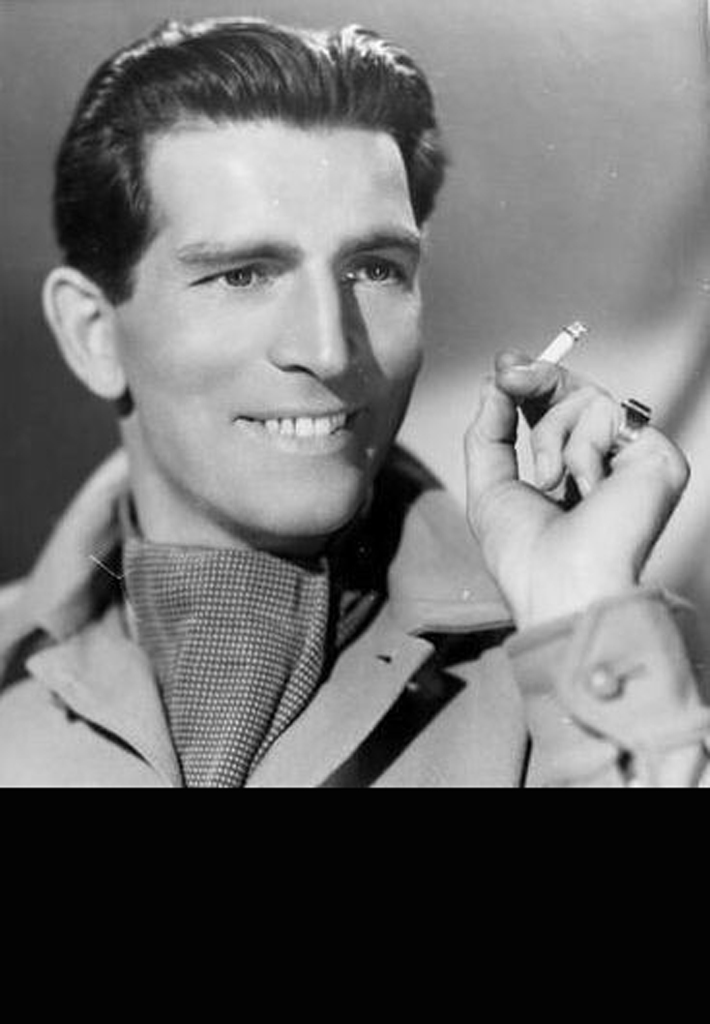
Richard Egan articles/mentions

Richard Egan & Demetrius and the Gladiators
mentions:
Michael Rennie ~ Klaatu barada nikto!
Richard Egan - 1949
publicity photo
June 29, 2019
20,000 Vinyl LPs 188: Bernard Herrmann ~ The Day the Earth Stood Still

Bernard Herrmann was born in New York City on June 29, 1911, under the name, Max Herman. There are maybe 10 film score composers that I think are the greatest, Nino Rota, Ennio Morricone, Jerry Goldsmith, etc., but at the very apex of the greats are Rota and Herrmann.
Herrmann is known for his collaborations with director Alfred Hitchcock, most famously North by Northwest, The Man Who Knew Too Much, and Vertigo; his scores are brilliant. He also composed scores for many other films, including Citizen Kane for Orson Welles, The Ghost and Mrs. Muir, Cape Fear, Fahrenheit 451 for François Truffaut, and Taxi Driver for Martin Scorsese. He worked extensively in radio drama (composing for Orson Welles), composed the scores for several fantasy films by Ray Harryhausen and many TV programs, including the Rod Serling Twilight Zone series, and Have Gun – Will Travel. At the top of these film scores is the one that has never been matched for sheer terror and suspense, Psycho (link below).
However, at the very top of this amazing pinnacle is what I consider his absolute best score, The Day the Earth Stood Still.


movie poster
After seeing the film who will ever forget the themes he composed for the soundtrack with his signature use of the theremin? However, he did not rely entirely on a theremin or synthesizers; his use of the piano on Radar is brilliant (link below). This recording of four of his film scores includes The Day the Earth Stood Still.

The Day the Earth Stood Still ~ LaserDisc front cover
art direction: Glenn Ross
illustration: Richard Krieger
photo of album cover by Styrous®
photo of album cover by Styrous®
Then there is, "Klaatu Barada Nikto"; seems to me it's one of THE most well-known film lines EVER delivered (link below)!

front cover detail
art direction: Glenn Ross
art direction: Glenn Ross
illustration: Richard Krieger
detail photo of album cover by Styrous®
And last, but certainly NOT least, there are the spectacular special effects! You could say they were ahead of their time, however, even by today's high-tech standards, they are stunning!!!!

front cover detail
art direction: Glenn Ross
art direction: Glenn Ross
illustration: Richard Krieger
detail photo of album cover by Styrous®
One of the special effects was the robot "bodyguard", Gort, that spews forth laser-like death rays when danger threatens Klaatu, the extraterrestrial (back then they were called aliens) portrayed by Michael Rennie. What an amazing creature! It is the very best rendition of a robot EVER created which has never been surpassed.


Gort was portrayed by seven-foot, seven-inch (231 cm)-tall actor Lock Martin
wearing a thick foam-rubber suit designed and built by Addison Hehr.
Two suits were created, fastened alternately from the front or back so
that the robot would appear seamless from any angle in the completed
scenes.

The Day the Earth Stood Still ~ LaserDisc back cover
photo by Styrous®
The Day the Earth Stood Still was directed by Robert Wise, who edited Citizen Kane in 1941 and The Magnificent Ambersons in 1942 for director Orson Welles before going on
to direct such major 1960s musicals as West Side Story in 1961 and The Sound of Music in 1965.
The Day the Earth Stood Still was based on the
story Farewell to the Master by Harry Bates (link below), which was first published in the October 1940 issue of Astounding Science Fiction.
As with most films Day follows the story line of the book somewhat, with some major changes, it diverges radically in that in the book the major character is Cliff Sutherland, a free-lance picture reporter. Klaatu is killed right off the bat and the robot is "Gnut" and green.
Also, at the end, when Gnut is implored by Sutherland to tell his masters that the death of Klaatu was an accident, Gnut replies, "You misunderstand, I am the master!"
As with most films Day follows the story line of the book somewhat, with some major changes, it diverges radically in that in the book the major character is Cliff Sutherland, a free-lance picture reporter. Klaatu is killed right off the bat and the robot is "Gnut" and green.
Also, at the end, when Gnut is implored by Sutherland to tell his masters that the death of Klaatu was an accident, Gnut replies, "You misunderstand, I am the master!"

detail photo by Styrous®
The Lux Radio Theater performed a dramatization of the script with Michael Rennie and Jean Peters on January 4, 1954 (link below).

detail photo by Styrous®
In 1973 a Canadian progressive rock group, formed by John Woloschuk and Dee Long, named themselves Klaatu after the extraterrestrial, in the film The Day the Earth Stood Still. The band released the singles Anus Of Uranus / Sub-Rosa Subway and Dr. Marvello. More on them in a future article.

The band struggled to get radio recognition. By 1975 Davies, along with producer Terry Brown, managed to land the band a deal with Capitol Records in the US and worldwide. Then, on February 17, 1977, a feature headlined ‘Could Klaatu Be Beatles? Mystery Is A Magical Tour’, written by Steve Smith, he asked, "Why did the album sound so much like the Fab Four? “It struck me almost immediately,” he says. “The track Sub-Rosa Subway is completely Beatlish.”

date & photographer unknown
The band struggled to get radio recognition. By 1975 Davies, along with producer Terry Brown, managed to land the band a deal with Capitol Records in the US and worldwide. Then, on February 17, 1977, a feature headlined ‘Could Klaatu Be Beatles? Mystery Is A Magical Tour’, written by Steve Smith, he asked, "Why did the album sound so much like the Fab Four? “It struck me almost immediately,” he says. “The track Sub-Rosa Subway is completely Beatlish.”

detail photo by Styrous®
The Day the Earth Stood Still has been selected for preservation in the United States National Film Registry and is ranked in the top 50 on the Time Out highly regarded list of the 100 Best Sci Fi Movies.
detail photo by Styrous®
The Day the Earth Stood Still has aged better than almost all of its peers. The ideal of a society based on the predication of universal peace with a
benevolent police state is a dream yet to be realized, if ever. The special effects are still effective, and the
eerie Bernard Herrmann score sets the mood perfectly. Decades later, it
remains a thought-provoking, worthwhile parable.

detail photo by Styrous®

photo by Styrous®

photo by Styrous®

photo by Styrous®

photo by Styrous®
Net links:
AFI ~ The Day the Earth Stood Still
Cast & Crew
1950's science fiction films
Classic Film & TV Café (review)
My Meaninigful Movies ~ The Day the Earth Stood Still
Farewell to the Master PDF
YouTube links:
The Day the Earth Stood Still ~
Klaatu Comes in Peace
AFI ~ The Day the Earth Stood Still
Cast & Crew
1950's science fiction films
Classic Film & TV Café (review)
My Meaninigful Movies ~ The Day the Earth Stood Still
Farewell to the Master PDF
YouTube links:
The Day the Earth Stood Still ~
Klaatu Comes in Peace
Gort Appears
Klaatu Barada Nikto
Klaatu's Speech
The Choice Is Ours
The Day The Earth Stood Still movie trailer
Lux Radio Theater ~ The Day the Earth Stood Still (1 hr.)
Bernard Herrmann ~
The Day the Earth Stood Still Suite (11 min. 37 sec.)
Radar

Klaatu Barada Nikto
Klaatu's Speech
The Choice Is Ours
The Day The Earth Stood Still movie trailer
Lux Radio Theater ~ The Day the Earth Stood Still (1 hr.)
Bernard Herrmann ~
The Day the Earth Stood Still Suite (11 min. 37 sec.)
Radar

Subscribe to:
Posts (Atom)