Showing posts with label Flash Gordon. Show all posts

February 27, 2022

Hollywood Bound ~ Gene Autry, Flash Gordon & other Wonders

 ~      

 
A friend recently showed me a book he had just purchased entitled, Hollywood Bound by Peter Doggett, an English music journalist, author and magazine editor. The book had movie stills from films that had bondage themes of one type or another. As I had seen many of the films featured in the book, it brought back many memories.          

In the forties when I was about 8 years old, there was a movie theater called The State on 4th & Market, where Ross ("Dress for Less") is now located.   
 
 
The State Theater - ca 1950 
photographer unknown
 
 
On Saturdays The State had matinees for kids that cost 9¢ to get in. I lived in Visitacion Valley on Geneva Ave. in the outer Mission and my mother would give me a quarter to go to the 9 am showing. It cost 5¢ for the bus each way which left me 6¢. I would buy a candy bar which cost 5¢. That left me 1¢ which I saved and on the fifth Saturday I could buy TWO candy bars!         

During the Saturday matinee they had a double feature (two FULL length movies), usually "B" films that are now cult films, some featured in Hollywood Bound, or Hopalong Cassidy played by William Boyd . . .
             
 
Hopalong Cassidy Enters movie poster
 
 
. . . The Three Stooges usually with a great cast as in this one with Gale Storm, Louis Jordan, Will Osborne and Phil Regan an American actor and singer who later served time for bribery in a real estate scandal . . .        
 
 
Swing Parade of 1946 movie poster 
 
           
. . . coming attractions, a news reel (TV was newly invented & very few people had one, a bazillon cartoons and a serial, usually with cowboys (such as The Phantom Empire with Gene Autry), etc.!!!!!
 
 
movie poster


The last Saturday I went, they showed a serial with Buster Crabbe (it was his birthday earlier this month) as Flash Gordon. It was my first viewing of a Sci-Fi film; even though it had pretty cheesy effects (e.g. the space ship), gaudy sets and bad acting (link below), from an 8 year old kid's point of view it was terrific. I remember being COMPLETELY transfixed and I had to see it again. Now, with all that stuff they showed, the entire program probably lasted three or four hours and I sat through THREE showings! I didn't get home until around 9 that evening; that's 12 hours I was gone. My mother was out of her wits by then, I caught holy hell and was never allowed to go to the movie matinee again. 
 
But it was worth it!!!           

Flash Gordon was always in trouble of one kind or another and in chapter 6, Emperor Ming (delightfully portrayed by Charles Middleton) . . . 


. . . was the culprit mentioned in the book, Hollywood Bound and shown on YouTube (link below).           


Hollywood Bound has many other photographs in it that are absolutely wonderful, some romantic, some erotic and some hilarious! But I'll leave that for another blog entry.         


Viewfinder links:
           
Gene Autry          
Buster Crabbe          
Louis Jordan           
Will Osborne           
Gale Storm          
The Three Stooges          
         
YouTube links:
          
Flash Gordon (space ship) serial clip                      


Flash on, Gordon!


Styrous® ~ Sunday, February 27, 2022 


Will Osborne articles/mentions

 ~        


Will Osborne - 1930 


August 25, 2021

Michael Rennie ~ Klaatu barada nikto!

 ~      
movie poster


I have many songs, pieces of music or whatever, that I will always remember the moment, situation or place I was when I heard it; a case in point is the theremin; ok, it's not a song but it fits in there. The first time I heard the sound of the instrument I was 11 years old and had discovered Sci-Fi in books and films several years earlier. As far as films go, I was used to the funky stuff, Buster Crabbe as Flash Gordon, the VERY low budget Man From Planet X, etc., so, from the moment the The Day the Earth Stood Still opened with the electrifying (pun intended) music score by Bernard Herrmann with the quivering, other-worldly sound of the theremin, which sent shivers up and down my spine (it still does), I was transfixed in my seat! The film score by Herrmann is sensational; it is in my pantheon of the top ten film scores of all time. I think it with the excellent production values are what makes Day the Earth the Grandfather of the modern Sci-Fi film age.     
 
The next technological/sonic breakthroughs would happen again 17 years later with the Stanley Kubrick film 2001: A Space Odyssey . . .         


. . . then 35 years later with Star Wars.     


Today, August 25, is the birthday of Michael Rennie who starred as Klaatu, the alien from the flying saucer in The Day the Earth Stood Still. 


Michael Rennie was a 6' 4" tall British film, television and stage actor, born in 1909, in Idle near Bradford, West Riding of West Yorkshire, England. He appeared in more than fifty films but is best remembered for his starring role as the space visitor Klaatu in the 1951 Sci-Fi film, The Day the Earth Stood Still.                  

He attracted the interest of a casting director at Gaumont British who took him on as an extra. Rennie said this was a deliberate strategy so he could learn how films were made. Head of production Michael Balcon said Rennie was taken on "because he was good-looking and athletic. He knew nothing of acting, but was given a contract to play small parts and to work as stand-in for players such as Robert Young and John Loder.     
          
Rennie's first screen acting was an uncredited bit part in the Alfred Hitchcock film Secret Agent (1936), standing in for Robert Young. Balcon says he saw Rennie act in a scene in East Meets West (1936) and fired him immediately afterwards. Balcon wrote "I had seen the rushes of that day's filming and had at once decided that Rennie was far too inexperienced to justify big screen parts."          
          
Rennie worked mostly in Yorkshire, eventually becoming a star with the York Repertory Company. Among his roles were as Professor Henry Higgins in Pygmalion, a play by George Bernard Shaw, which was later made into the 1956 musical My Fair Lady .           
          
During World War II, Rennie began to receive offers for film roles but continued repertory work honing his craft. He enlisted in the RAF Volunteer Reserve on 27 May 1941. "There has been a pause in Rennie's film career", wrote Balcon in 1942. "But there will be parts awaiting him when the war is over"         
 
With the end of the war in Europe in May 1945, Rennie was given his first film break, when cast alongside Margaret Lockwood, then at the peak of her popularity, in the musical I'll Be Your Sweetheart (1945), directed by Val Guest.        
 
The movie was not a big hit but Rennie received excellent notices, including a review from the US trade paper Variety who said his performance made the film "noteworthy" and that he was . . . 
". . . likely Hollywood material... the best bet in the way of a new male star to have come out of a British studio in many years. Rennie not only has a lot on the ball as a straight lead, he knows the value of visual tricks. Femmes will go for him in a big way."        
He followed this with The Wicked Lady in 1945. Rennie was the fifth lead but it was a good part and an excellent project to be associated with – the year's biggest box-office hit, subsequently being listed ninth on a list of top ten highest-grossing British films of all time.           
 
Rennie's prestige was raised when he was given a single prominent scene as a commander of Roman centurions in the Gabriel Pascal production of Caesar and Cleopatra by George Bernard Shaw (also 1945), starring Vivien Leigh and Claude Rains. Rennie was now established as a leading actor. One report called him "the bobbysoxers' dark idol... Gainsborough's 1945 discovery." He was mobbed by female fans on a personal appearance tour.        
 
In 1950, he was one of several English actors cast in the 20th Century Fox medieval adventure story The Black Rose starring Tyrone Power and Orson Welles. Rennie was specifically cast as the 13th-century King Edward I, whose 6' 2" (1.88 m) frame gave origin to his historical nickname "Longshanks".    

After Claude Rains turned down the role, Rennie received top billing in his next film, The Day the Earth Stood Still, the first postwar, large-budget, "A" science-fiction film. It was a serious, high-minded exploration of mid-20th century suspicion and paranoia, combined with a philosophical overview of humanity's coming place in the larger universe. Rennie said director Robert Wise told him to do the role "with dignity but not with superiority". (The story was later dramatised in 1954 on Lux Radio Theatre, with Rennie and Billy Gray recreating their original film roles. Seven years later, on 3 March 1962, when The Day the Earth Stood Still made its television premiere on the NBC Saturday Night at the Movies, Rennie appeared in a two-minute introductory prologue before the start of the film.)              
 
He appeared in the film Seven Cities of Gold in 1955 with Richard Egan and Anthony Quinn, and with them again in Demetrius and the Gladiators (link below). His film career only went up from there.    


During a visit to his mother's home in Harrogate, Yorkshire, following the death of his brother, Rennie died suddenly of an aortic aneurysm almost two months before his 62nd birthday.    


Viewfinder links:
           
Buster Crabbe       
Demetrius and the Gladiators                  
Richard Egan        
Bernard Herrmann           
Alfred Hitchcock          
Stanley Kubrick          
Lux Radio Theater           
Tyrone Power         
Anthony Quinn        
Claude Rains         
George Bernard Shaw         
All things Star Wars          
Orson Welles          
          
Net links:
           
The Day the Earth Stood Still ~           
       Cast    
       Klaatu barada nikto! (interpretation)   
Complete filmography          


YouTube links:
           
      The Day the Earth Stood Still  (1951) main title sequence       
      The Arrival of the Saucer             
      Klaatu appears      
      Gort appears     
      The Day The Earth Stands Still       
      Klaatu's warning     
      The Day The Earth Stood Still (1951) film review  


Styrous® ~ Wednesday, August 25, 2021 


May 25, 2017

20,000 Vinyl LPs 88: Star Wars @ 40


detail photo by Styrous®

It's hard to believe it was 40 years ago today, May 25, 1977, that the film and the soundtrack for Star Wars were simultaneously released. And, as they say, the rest is history.  There is a link to my impressions about that momentous event below.  


photo by Styrous®


I had no knowledge of what I was about to see other than the movie trailer playing at the time (link below). Because I only had a tiny, 13" Sonny, rabbit ears with bad reception and tinny sound as the TV was not connected to a sound system, I was not prepared for what was to come.    


photo by Styrous®

My album is the original 1977 release of the soundtrack, entitled Star Wars - Original Soundtrack. It includes a 24" x 36" fold-out poster of a painting by science fiction artist John Berkey, depicting the final battle over the Death Star from the film's end.    


photo by Styrous®


To me, the film score for Star Wars by John Williams is the best one he ever composed. Great examples are The Dune Sea Of Tatooine episode, the quirky and delightful music from the  Cantina scene, the Princess Lea Theme and many others (links below).     


photo by Styrous®


On the recommendation of his friend Steven Spielberg, Lucas hired composer John Williams. Williams had worked with Spielberg on the film Jaws, for which he won an Academy Award. Lucas felt that the film would portray visually foreign worlds, but that the musical score would give the audience an emotional familiarity; he wanted a grand musical sound for Star Wars, with leitmotifs to provide distinction. Therefore, he assembled his favorite orchestral pieces for the soundtrack, until Williams convinced him that an original score would be unique and more unified. However, a few of Williams' pieces were influenced by the tracks given to him by Lucas: the Main Title Theme was inspired by the theme from the 1942 film Kings Row, scored by Erich Wolfgang Korngold; and the track Dune Sea of Tatooine drew from the soundtrack of Bicycle Thieves, scored by Alessandro Cicognini.   


photo by Styrous®


The score for Star Wars was recorded over eight sessions at Anvil Studios in Denham, England on March 5, 8–12, 15 and 16, 1977. The score was performed by the London Symphony Orchestra with Williams conducting. The score was orchestrated by Herbert W. Spencer, who also orchestrated The Empire Strikes Back and Return of the Jedi. The score was recorded by engineer Eric Tomlinson and edited by Kenneth Wannberg, and the scoring sessions were produced by Star Wars director George Lucas and supervised by Lionel Newman, head of 20th Century Fox's music department.

The 20th Century Fox's second logo was used from 1953 to 1987. This version was designed by Pacific Title artist Rocky Longo, and was originally created for the new CinemaScope process.   


20th Century Records also released The Story of Star Wars that same year, a narrated audio drama adaptation of the film utilizing some of its original music, dialogue, and sound effects (this recording will be a future article).   


photo by Styrous®


The album includes some of the best notes ever; one page has a synopsis of the film, Williams and LSO bios, etc, and another a detailed, track by track breakdown of how the music program was put together.

notes, bios, etc. 


tracks info


The giant color, fold out poster which depicts the Rebel Alliance dogfighting the Empire near and along the Death Star. This John Berkey illustration, featuring the frenzied dogfight, was published as a free poster inserted into the first pressings of the Star Wars vinyl LP soundtrack album and measures 22" x 33".   

Star Wars poster
illustration by John Berkey
photo by Styrous®


Star Wars was released theatrically in the United States on May 25, 1977. It earned $461 million in the U.S. and $314 million overseas, totaling $775 million. It surpassed Jaws (1975) to become the highest-grossing film of all time until the release of E.T. the Extra-Terrestrial (1982). When adjusted for inflation, Star Wars is the second-highest-grossing film in North America, and the third-highest-grossing film in the world. It received ten Academy Award nominations (including Best Picture), winning seven. It was among the first films to be selected as part of the U.S. Library of Congress National Film Registry as being "culturally, historically, or aesthetically significant". At the time, it was the most recent film on the registry and the only one chosen from the 1970s. Its soundtrack was added to the U.S. National Recording Registry in 2004. Today, it is often regarded as one of the best films of all time, as well as one of the most important films in the history of motion pictures.        


Star Wars
vinyl LP, side 1
photo by Styrous®


Star Wars
vinyl LP label, side 1
photo by Styrous®


The film's success led to two critically and commercially successful sequels, The Empire Strikes Back (1980) and Return of the Jedi (1983). The film was originally released in 1977 with the title "Star Wars". The subtitles Episode IV and A New Hope were only added to the opening crawl in subsequent re-releases. Star Wars ~ A New Hope was reissued multiple times  incorporating many changes including modified computer-generated effects, altered dialogue, re-edited shots, remixed soundtracks, and added scenes.        


Star Wars
vinyl LP, side 2
photo by Styrous®


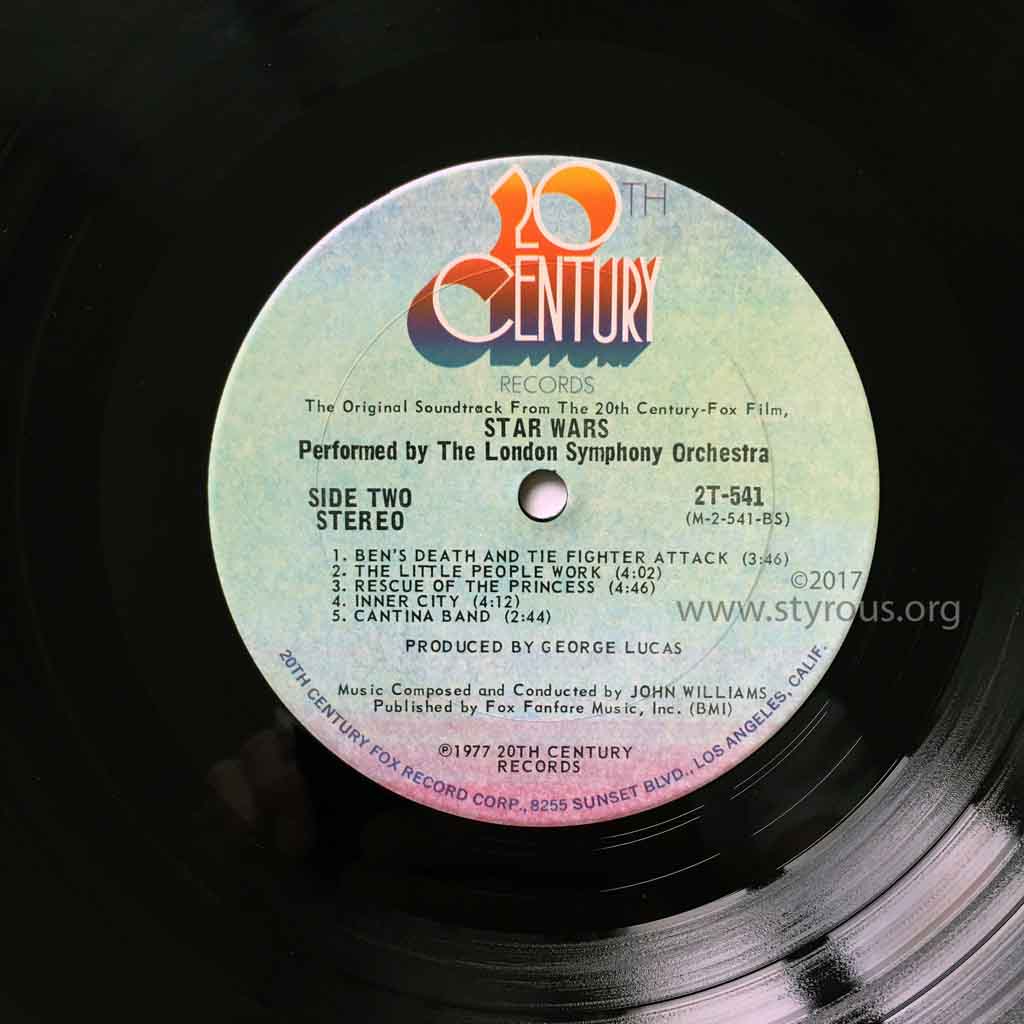
Star Wars
vinyl LP label, side 2
photo by Styrous®


According to Lucas, different concepts of the film were inspired by numerous sources, such as Beowulf and King Arthur for the origins of myth and religion. Lucas originally intended to rely heavily on the 1930s Flash Gordon film serials; however, he resorted to the 1958 Akira Kurosawa film, The Hidden Fortress, and the book by Joseph Campbell, The Hero with a Thousand Faces, because of copyright issues with Flash Gordon. Star Wars features several parallels to Flash Gordon, such as the conflict between Rebels and Imperial Forces, the wipes between scenes, the fusion of futuristic technology and traditional mythology, and the famous opening crawl that begins each film. The film has also been compared to The Wizard of Oz.        


Star Wars
vinyl LP, side 3
photo by Styrous®


Star Wars
vinyl LP label, side 3
photo by Styrous®


Lucas described a "used future" concept to the production designers in which all devices, ships, and buildings looked aged and dirty. Instead of following the traditional sleekness and futuristic architecture of science fiction films that came before, the Star Wars sets were designed to look inhabited and used. Barry said that the director "wants to make it look like it's shot on location on your average everyday Death Star or Mos Eisley Spaceport or local cantina." Lucas believed "what is required for true credibility is a used future", opposing the interpretation of "future in most futurist movies" that "always looks new and clean and shiny." Christian supported Lucas's vision, saying "All science fiction before was very plastic and stupid uniforms and Flash Gordon stuff. Nothing was new. George was going right against that."            


Star Wars
vinyl LP, side 4
photo by Styrous®


Star Wars
vinyl LP label, side 4
photo by Styrous®


During the chaos of production and post-production, the team made decisions about character voicing and sound effects. Sound designer Ben Burtt had created a library of sounds that Lucas referred to as an "organic soundtrack". Blaster sounds were a modified recording of a steel cable, under tension, being struck. The lightsaber sound effect was developed by Burtt as a combination of the hum of idling interlock motors in aged movie projectors and interference caused by a television set on a shieldless microphone. Burtt discovered the latter accidentally as he was looking for a buzzing, sparking sound to add to the projector-motor hum. For Chewbacca's growls, Burtt recorded and combined sounds made by dogs, bears, lions, tigers, and walruses to create phrases and sentences. Lucas and Burtt created the robotic voice of R2-D2 by filtering their voices through an electronic synthesizer. Darth Vader's breathing was achieved by Burtt breathing through the mask of a scuba regulator implanted with a microphone.


Star Wars movie poster


Tracklist:   

Side One:    

A1     Main Title     5:20
A2     Imperial Attack     6:10
A3     Princess Leia's Theme     4:18
A4     The Desert And The Robot Auction     2:51

Side Two:    

B1     Ben's Death And TIE Fighter Attack     3:46
B2     The Little People Work     4:02
B3     Rescue Of The Princess     4:46
B4     Inner City     4:12
B5     Cantina Band     2:44

Side Three:    

C1     The Land Of The Sand People     2:50
C2     Mouse Robot And Blasting Off     4:01
C3     The Return Home     2:46
C4     The Walls Converge     4:37
C5     The Princess Appears     4:04

Side Four:    

D1     The Last Battle     12:05
D2     The Throne Room And End Title     5:28

Companies, etc.   

    Recorded At – Anvil Recording Studios
    Remixed At – The Burbank Studios
    Mastered At – The Mastering Lab
    Published By – Fox Fanfare Music, Inc.
    Phonographic Copyright (p) – 20th Century Records
    Copyright (c) – Twentieth Century Fox Film Corporation
    Pressed By – Columbia Records Pressing Plant, Terre Haute

Credits:   

    Bass – A. Griffiths*, B. Mollinson*, G. Neal, G. Newson*, J. Cooper*, P. Dimitroff*
    Bassoon – P. Francis*, R. Bourton*
    Cello – C. Gillinson*, D. Powrie*, D. Cummings*, F. Saunders*, J. Long*, K. Glossop*, K. Law*, M. Meulien*, R. Adams*, T. Storer*
    Clarinet – J. Brymer*, R. Moore*, R. Jowitt*
    Composed By, Conductor – John Williams (4)
    Engineer [Recording] – Eric Tomlinson
    Flute – F. Nolan*, L. Sanders*, R. Taylor*
    Harp – J. Marson*, R. Scheffel-Stein*
    Horns – A. Chidell*, D. Cripps*, G. Warren*, J. Brown*, J. Quaife*, J. Butterworth*, J. Rooke*, S. Reading
    Liner Notes – Charles Lippincott
    Oboe – A. Camden*, R. Lord*
    Orchestra – The London Symphony Orchestra
    Percussion – M. Frye*, R. Northcott*
    Piano, Celesta – M. Round, R. Noble*
    Producer – George Lucas
    Remix – John Neal
    Timpani – K-H. Goedicke*
    Trombone – D. Wick*, E. Crees*, F. Mathison*
    Trumpet – M. Murphy*, N. Archibald*, R. Izen*, W. Lang*
    Tuba – J. Fletcher*, S. Wick*
    Viola – A. Taylor*, B. Clarke*, D. Hume*, E. Cuthbertson*, M. Mitchell*, P. Hooley*, P. Vermont*, P. Norriss*, W. Krasnik*, W. Sumpton*
    Violin – B. Thomas, B. Gaulton*, C. Reuben*, D. Llewellyn*, D. Williams*, D. Gaines*, D. Stewart*, G. Creese*, I. Arditti*, J. Steadman*, M. Weber*, N. Freeman, N. Watson*, N. Taweel*, R. Studt*, R. Clark*, R. Retallick*, R. Brightman*, S. Artis*, S. Castle*, S. Colter*, T. Morton*, T. Cook*, T. Swift*, W. Hill*, W. Brown*

Notes:  

Recorded over eight sessions at Anvil Studios in Denham, England on March 5, 8-12, 15-16, 1977
Remixed at The Burbank Studios, Burbank, California

Published by Fox Fanfare Music, Inc. (BMI)
© 20th Century-Fox Film Corporation

Has an insert with the list of each instrument and its performer and a color fold-out poster.
Also comes with 16-page color booklet describing characters and behind the scenes info, and poster of fighters over the Death Star.        

Release is Auto-Coupled - sides are organized for use with an auto-changing player.
Record 1: Sides A and D
Record 2: Sides B and C
Barcode and Other Identifiers

    Rights Society: BMI
    Matrix / Runout (Side A Label): M-2-541-AS
    Matrix / Runout (Side B Label): M-2-541-BS
    Matrix / Runout (Side C Label): M-2-541-CS
    Matrix / Runout (Side D Label): M-2-541-DS
    Matrix / Runout (Side A Etchings [Variant 1]): M-2-541-AS-3
    Matrix / Runout (Side B Etchings [Variant 1]): M-2-541-BS-1C
    Matrix / Runout (Side C Etchings [Variant 1]): M-2-541-CS-4
    Matrix / Runout (Side D Etchings [Variant 1]): M-2-541-DS
    Matrix / Runout (Side A Etchings [Variant 2]): M-2-541-AS-7 TI
    Matrix / Runout (Side B Etchings [Variant 2]): M-2-541-BS-5 TI
    Matrix / Runout (Side C Etchings [Variant 2]): M-2-541-CS-8 TI
    Matrix / Runout (Side D Etchings [Variant 2]): M-2-541-DS-4 TI
    Matrix / Runout (Side A & B Mastering Facility Stamp): TML-M
    Matrix / Runout (Side C & D Mastering Facility Stamp): TML-S

John Williams, The London Symphony Orchestra ‎– Star Wars
Label: 20th Century Records ‎– 2T-541
Format: 2 × Vinyl, LP, Album, Gatefold
Country: US
Released: May 25, 1977
Genre: Classical, Stage & Screen
Style: Soundtrack, Modern Classical, Contemporary, Score


Viewfinder links:
           
Star Wars            
Episode VII ~ The Force Awakens in 3D (or am I cross-eyed yet?)            
All things Star Wars                
Carrie Fisher ~ Forever Princess Lea            
       
Net links:        
         
Star Wars: Episode IV - A New Hope Official Site        
John Williams website             
Star Wars: Episode IV Cast          
Star Wars: Episode IV Plot
         
YouTube links:        
      
Star Wars ~ Original Trailer (1977)            
Star Wars - Opening Scene            
       
Star Wars music       
       Main Title     
       The Dune Sea Of Tatooine                       
       Cantina song       
       Princess Leia's Theme      
        
Kings Row ~ Main Title          
Bicycle Thieves          


The list of best film scores, by the American Film Institute, ranks the Star Wars soundtrack at number one. 


Styrous® ~ Thursday, May 25, 2017     

~


~