this is a continuation of the OMD, Dazzle Ships album
(link below)
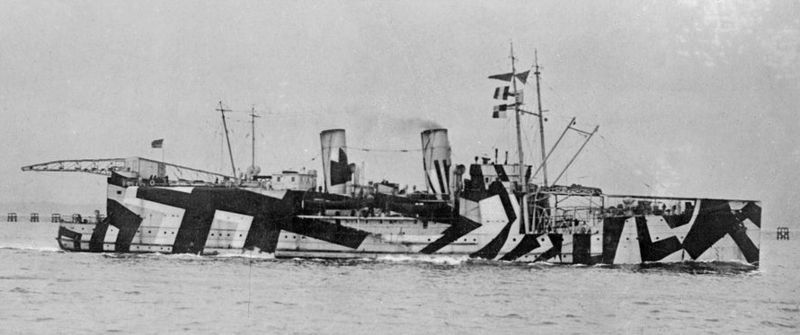
SS West Mahomet in
dazzle camouflage - 1918
Dazzle camouflage, also known as razzle dazzle (in the U.S.) or dazzle painting, was a family of
ship camouflage used extensively in
World War I, and to a lesser extent in
World War II and afterwards. Credited to the British
marine artist Norman Wilkinson,
it consisted of complex patterns of geometric shapes in
contrasting colours, interrupting and intersecting each other.
The 1919 painting,
Dazzle-ships in Drydock at Liverpool, by
Edward Wadsworth was the inspriation for the album,
Dazzle Ships, by
Orchestral Manoeuvres in the Dark (OMD), released in 1983 (
link below).
In 1914, an embryologist named
John Graham Kerr approached
Winston Churchill and proposed a new way to camouflage Britain’s ships. Taking
his inspiration from animals like the
zebra and
giraffe, he suggested
that instead of trying to conceal their ships, they make them so
glaringly conspicuous that it would be nearly impossible to target them.
Unlike other forms of
camouflage, the intention of dazzle is not to
conceal
but to make it difficult to estimate a target's range, speed, and
heading. Wilkinson explained in 1919 that he had intended dazzle
primarily to mislead the enemy about a ship's course and so to take up a
poor firing position.
Front view of Siboney - May 1918
The
trick was in the paint, which formed
optical illusions along the hulls
of the ships. The goal was to make it so disjointed, so visually
confusing, that rangefinders wouldn’t be able to get a fix on the ship’s
location, size, and speed. The rangefinders used to pinpoint enemy
ships at the time worked by creating two half-images of a target; when
the operator maneuvered the half-images into a single, unbroken image,
he could calculate the ship’s distance, allowing them to calibrate the
guns for an accurate shot.
But if you looked at a ship with dazzle
camouflage, the two half-images still ended up looking like a mismatch,
even when they were perfectly aligned. With their patterns of zigzags,
spirals, and complex geometric shapes, the ships didn’t look like ships
anymore; all the distinguishing features normally used to identify a
ship’s orientation—mainly the stern and the bow—were lost in the
illusion.
HMS Argus displaying a coat of dazzle camouflage - 1918
The Admiralty made it a point to use a different paint scheme on every
single ship so the enemy couldn’t learn to use the patterns to identify
specific classes of ship. As a result, it was hard to tell what worked
and what didn’t. There was no standard; one ship could be painted bright
blue with red spirals, and another might be painted with intersecting
black and white bars. If one of those went down, it could have been
because of the colors, or the pattern, or just because the enemy got
lucky. There were too many factors involved to fairly evaluate it.
Every ship was given a different pattern. The Admiralty called in a
creative army of artists, sculptors, and designers to create each
design. While some were just crazy jumbles of lines and shapes, others
were full-on optical illusions, creating such effects as making the
center of the ship appear higher than either side.
Dazzle has been compared to the contemporary Vorticist art that was partly inspired by Cubism. Though the style grew out of Cubism, it is more closely related to
Futurism in its embrace of dynamism, the machine age and all things
modern (cf.
Cubo-Futurism).
However, Vorticism diverged from Futurism in the way it tried to
capture movement in an image. In a Vorticist painting modern life is
shown as an array of bold lines and harsh colours drawing the viewer's
eye into the centre of the canvas.
The Mud Bath, 1914
The name
Vorticism was given to the movement by
Ezra Pound in 1913,
although
Wyndham Lewis, usually seen as the central figure in the movement, had
been producing paintings in the same style for a year or so previously.
The movement was announced in 1914 in the first issue of BLAST, which contained its manifesto and the movement's rejection of landscape and nudes in favour of a geometric style tending towards abstraction. It became the
literary magazine
of that art movement in Britain but only two editions were published:
the first on July 2, 1914 (dated 20 June 1914). The first edition contained many illustrations in the Vorticist style by
Jacob Epstein, Lewis and others.
Italian futurist Filippo Tommaso Marinetti gave a series of lectures at the
Lyceum Club, in
London in 1910, aimed at galvanizing support across Europe for the new Italian
avant-garde.
In his presentation he addressed his audience
as "victims of .... traditionalism and its medieval trappings," which
electrified the assembled avant-garde. Within two years, an exhibition
of futurist art at the
Sackville Gallery,
in
London, brought futurism squarely into the popular imagination, and the
press began to use the term to refer to any forward-looking trends in
modern art.
The second (and last) edition of
BLAST, by
Wyndham Lewis and friends, included an article by
Henri Gaudier-Brzeska; it was written and submitted from the trenches of
WWI.

BLAST second edtision - July 1915
Depiction of how Norman Wilkinson intended dazzle camouflage to cause the enemy to take up poor firing positions.
Eyepiece image of a warship
in a naval rangefinder, image halves not yet adjusted for range. The
target's masts are especially useful for rangefinding, so Kerr proposed
disrupting these with white bands.
Claimed effectiveness: Artist's conception of a U-boat commander's periscope view of a merchant ship in dazzle camouflage (left) and the same ship uncamouflaged (right), Encyclopædia Britannica, 1922. The conspicuous markings obscure the ship's heading.
dazzle camouflage (left), uncamouflaged (right)
December 31, 1921
Polish destroyer ORP Wicher (sunk September 3, 1939)
Diagram of the camouflage pattern of the S.S. Alban produced for the U.S. Navy by Thomas Hart Benton, 1918.
camouflage pattern diagram
by Thomas Hart Benton - 1918
American ships in dazzle camouflage
Viewfinder link: