~
Arthur Honegger (
French: [aʁtyʁ ɔnɛɡɛːʁ]; was a
Swiss composer, who was widely known as a train enthusiast, and once notably said:
"I have always loved locomotives passionately. For me they are living
creatures and I love them as others love women or horses." His
"mouvement symphonique"
Pacific 231 (a depiction of a steam locomotive) gained him early notoriety in 1923.
He insisted that he wrote it as an exercise in building momentum while the tempo of the piece slows. It is post-
impressionism bordering on
modern music with it's
dissonance and harsh
harmonics. His orchestral piece,
Pacific 231, is his most frequently performed work.
The orchestration consists of 2
flutes,
piccolo flute, 2
oboes,
English horn, 2
clarinets,
bass clarinet, 2
bassoons,
contrabassoon – 4
French horns, 3
trumpets, 3
trombones,
tuba, –
4 percussionists (
tenor drum,
cymbal,
bass drum,
tam tam) –
strings.
He originally titled it
Mouvement Symphonique, only giving it the name
Pacific 231, which is a class of
steam locomotive designated in
Whyte notation as a
4-6-2,
with four pilot wheels, six driving wheels, and two trailing wheels
(the French, who count axles rather than wheels when describing
locomotives, call this arrangement 2-3-1) after the work was finished.
A 1949 French award-winning film,
Pacific 231, directed by
Jean Mitry, used the orchestral work as the sound track for a tribute to the
steam locomotive, and included close-up footage of driving wheels,
running gear and railroad operations, mostly taken at speed, and
cut/choreographed to the music (
link below).
It would be interesting to pair
Pacific 231 with the images of locomotive-fixated photographer,
William S. (Simrell) Young.
It is also interesting to compare
Pacific 231 with the
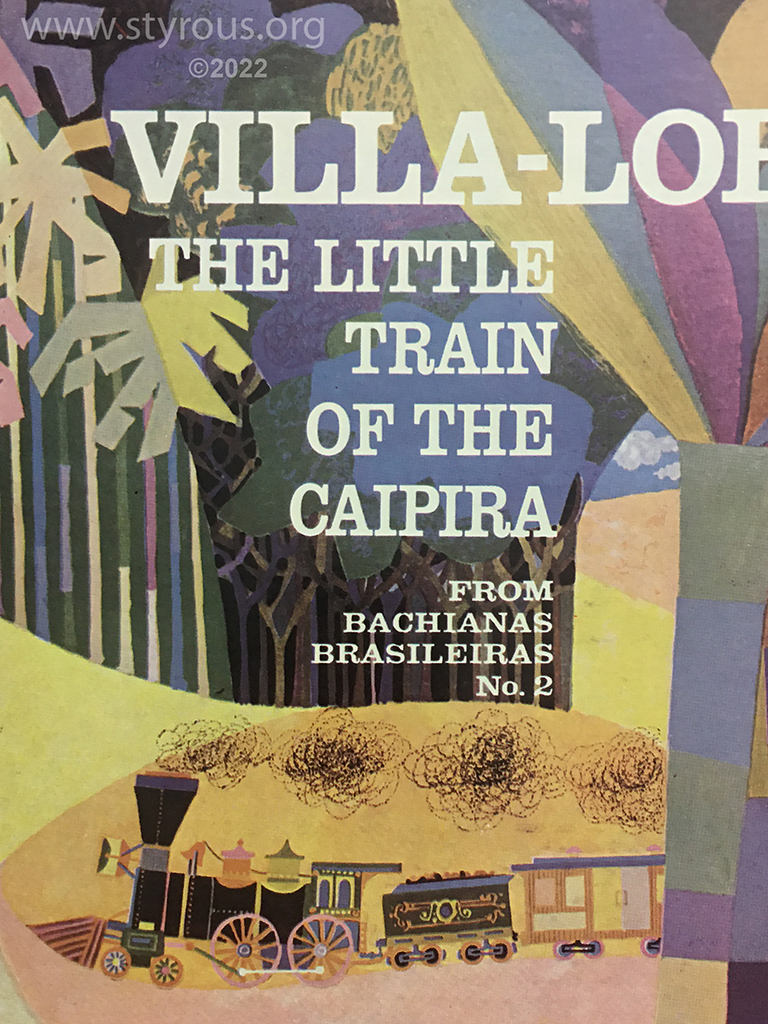
Villa-Lobos piece of music based on a locomotive,
The Little Train of the Caipira, (
YouTube link below) from his
Bachianas brasileiras No. 2. Where Honegger's piece is harsh, brash and agressive,
The Little Train is gentle like a sensual
samba
(Villa-Lobos WAS from Brazil, after all) with occaional blasts to let
you know it's a train we're talkin' about. Maybe it's the
Northern European vs. the
Latin-American temperment that is demonstrated by the two works.
His "dramatic psalm"
Le Roi David (
King David),
made him a star in the music world in the early 1920s; it is still in the choral repertoire. Between World War I and World
War II, Honegger was very prolific. He composed nine ballets and three vocal stage works, among many other works.
He composed the music for the
Abel Gance epic 1927
silent film,
Napoléon. I saw
Napoléon with full orchestra accompaniment in Oakland at the
Art Deco Paramount Theater.
Honegger was born on March 10, 1892, in
France and lived a large part of his life in
Paris. He died on November 27, 1955.
YouTube links:
Pacific 231
Jean Mitry ~ Pacific 231 film (9 min., 9 sec.)
Villa-Lobos ~ Little Train of the Caipira
"I have always had a passionate love for locomotives!"