Today, July 10th, is the birthday of
Carl Heinrich Maria Orff (
German: [ˈkaɐ̯l ˈɔɐ̯f]). He was a German
composer, best known for his
cantata Carmina Burana which was based on a
medieval collection of poems. I discovered
Carmina when I was in college in the late 50's. It has been one of my favorite works of serious music ever since then.
In
1803 a scroll of
medieval poems was discovered in the
German province
of
Bavaria among the debris of the secularized monastery of
Benedikt-Beuren ("BURANA").
These poems,
written primarily in
Latin, were determined to be the work of renegade
monks and wandering poets of the 13th Century. Their words captured a
lost world of rebels and dropouts of the medieval clergy; hard lovers,
drinkers, on the move, celebrating existence rather than living the
meditative, celibate,
cloistered life of the
monastery.
Carmina Burana is based on 24 poems from the
medieval collection
Carmina Burana. Its full
Latin title is
Carmina Burana: Cantiones profanæ cantoribus et choris cantandæ comitantibus instrumentis atque imaginibus magicis ("Songs of
Beuern: Secular songs for singers and
choruses to be sung together with instruments and magic images").
In
1935
Carl Orff re-discovered the poems. Impressed with
their meaning and rhythm he composed a cantata,
Carmina Burana, utilizing the centuries
old verses. He transformed the writings into
invocations and
profane
chants accompanied by numerous instruments and magical representations.
These
songs ("CARMINA") were divided into three primary sections: Springtime -
the life force renewed; In the Tavern - drinking and gambling; The
Court of Love - passion, sensuality. The sections are pervaded and
framed by the
Wheel of Fortune ("O Fortuna") perpetually turning,
perpetually governing the course of man's existence.
photographer unknown
In 1983,
Ray Manzarek grabbed
Carmina by the throat, shook it up and spit out one of the most stellar
transcriptions of it EVER! Attracted to the spiritual power of
Carmina Burana, he chose to interpret the piece in a contemporary framework. This
presentation intends to create enchanted pictures; to conjure up the
ecstasy expressed by the lyrics, an enhanced intense feeling for life
akin to the passions and revelry of the wandering poets of so long
ago.
Carmina Burana is part of
Trionfi, a musical
triptych that also includes
Catulli Carmina and
Trionfo di Afrodite. For more information, there is a version of
Carmina conducted by
Eugene Ormandy on the Viewfinder (
link below).
But this is in no way a traditional rendition of the work, far from it.
Ray Manzarek has taken the work from the traditional version to the heights of hard rock and beyond.
vinyl LP, back cover
album photo by Larry Williams
This is the third solo album by Ray Manzarek; It was produced by
Kurt Munkacsi and
Philip Glass. In addition to being a renowned Western-classical-music producer, having worked with many avant-garde composers such as
Charlemagne Palestine, Munkacsi has been the person primarily responsible for the sound of
Philip Glass's recorded work.
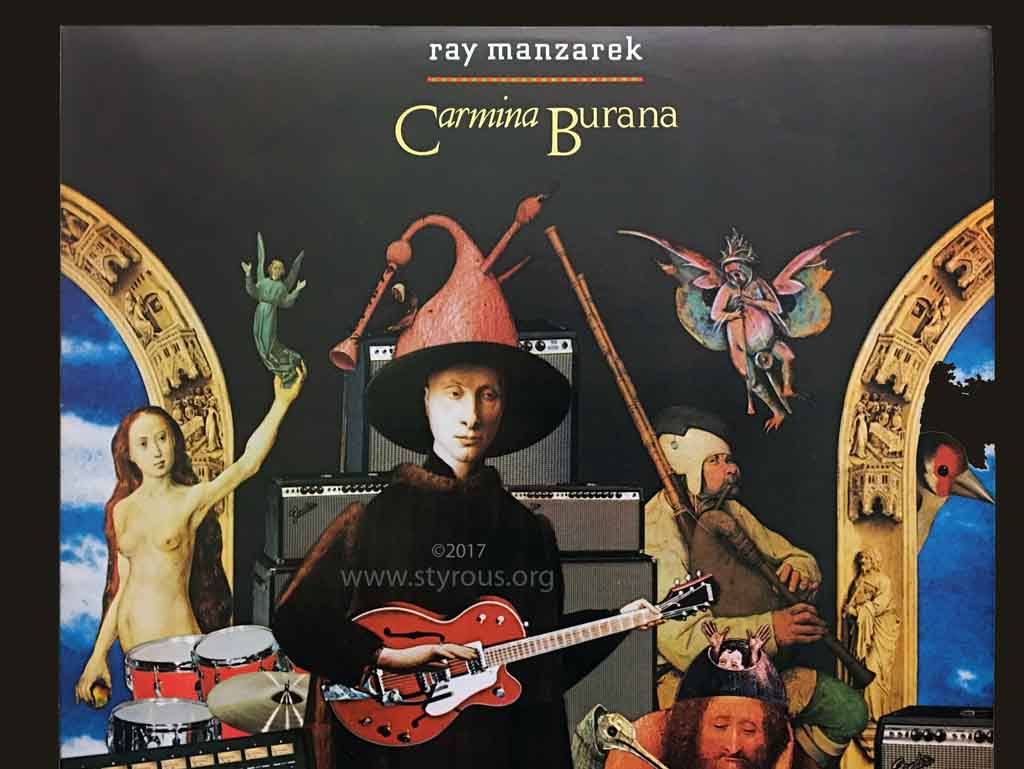
The cover art features a photo-montage of illustrations by
Hieronymus Bosch
(spelled on original release as Hieronymus Beach) and modern items like
guitar, drums, reel-to-reel and keyboards. Cover design by Lynn Robb.
There isn't a single track from the album I don't like but as usual, I have a favorite. In this case it is
The Roasted Swan (
link below).
It is slow and dreamy with a languid, mournful but intensely beautiful sax, played by
Jack Kripl,
replacing the tenor in the
original orchestral work. It suddenly erupts into a
timpani-pounding, hard-rock beat
accompanied by an all-male chorus and
organ that builds into a whopper of an ending!
vinyl LP, back cover detail
album photo by Larry Williams
The Face of Spring is a marvelous song. It starts off with a
fast, tinkly piano intro, that erupts into a very slow but determined,
hard rock beat which is joined by the chorus in
three quarter time.
It is vigorous and dreamy while it rocks out from time to time until
near the end when it erupts once more into a faster tempo that ends
abruptly.
vinyl LP, back cover detail
album photo by Larry Williams
Boiling Rage (Estuans Interius) is just that. It is the complete opposite of The Face of Spring. It is fast, bouncy with full chorus in hard rock conjunction with the group.
In 1934, Orff encountered the 1847 edition of the
Carmina Burana by
Johann Andreas Schmeller, the original text dating mostly from the 11th or 12th century, including some from the 13th century.
Michel Hofmann (de),
then a young law student and Latin and Greek enthusiast, assisted Orff
in the selection and organization of 24 of these poems into a
libretto, mostly in
Latin verse, with a small amount of
Middle High German and Old
Provençal.
The selection covers a wide range of topics, as familiar in the 13th
century as they are in the 21st century: the fickleness of
fortune and
wealth, the ephemeral nature of life, the joy of the return of Spring, and the pleasures and perils of
drinking,
gluttony,
gambling and
lust.

In addition to his career as a composer, Orff developed an influential approach toward
music education for children. In 1924
Dorothee Günther (de)
and Orff founded the Günther School for gymnastics, music, and dance in
Munich. Orff was there as the head of a department from 1925 until the
end of his life, and he worked with musical beginners. There he
developed his theories of music education, having constant contact with
children. In 1930, Orff published a manual titled
Schulwerk, in which he shares his method of conducting. Before writing
Carmina Burana, he also edited 17th-century operas.
In the mid-1920s, Orff began to formulate a concept he called
elementare Musik, or elemental music, which was based on the unity of the arts symbolized by the ancient Greek
Muses,
and involved tone, dance, poetry, image, design, and theatrical
gesture. Like many other composers of the time, he was influenced by the
Russian-French émigré
Igor Stravinsky. He also began adapting musical works of earlier eras for contemporary theatrical presentation.
Carmina Burana was hugely popular in
Nazi Germany after its premiere in
Frankfurt in 1937. Given Orff's previous lack of commercial success, the monetary factor of acclaim for
Carmina Burana was significant to him. But the composition, with its unfamiliar rhythms, was also denounced with racist taunts.
Orff's assertion that he had been anti-Nazi during the war was accepted
by the American
denazification authorities, who changed his previous
category of "gray unacceptable" to "gray acceptable", enabling him to
continue to compose for public presentation, and to enjoy the royalties
that the popularity of
Carmina Burana had earned for him.
There is a lyric sheet enclosed . . . .


Raymond Daniel "Ray" Manzarek, Jr. (né Manczarek; February 12, 1939 – May 20, 2013) was an
American musician, singer, producer, film director, and author, best known as a member of
The Doors from 1965 to 1973, which he co-founded with singer and lyricist
Jim Morrison.
Orff was an observant and active
Roman Catholic. He died of cancer in Munich in 1982 at the age of 86. He had lived through four
epochs: the
German Empire, the
Weimar Republic,
Nazi Germany and the post World War II
West German Bundesrepublik. Orff was buried in the
Baroque church of the beer-brewing
Benedictine priory of
Andechs, south of Munich.
Tracklist:
Side 1:
Destiny: Ruler Of The World
1 - The Wheel Of Fortune (O Fortuna) - 3:06
2 - The Wounds Of Fate (Fortune Plango) - 3:44
Springtime
3 - The Face Of Spring (Veris Leta Facies) - 4:16
4 - Sunrise (Omnia Sol Temperat) - 2:14
5 - Welcome (Ecce Gratum) - 2:46
6 - The Dance (Tanz) - 2:25
7 - Sweetest Boy (Dulcissime)- 0:34
8 - If The Whole World Was Mine (Were Diu Werlt) - 0:50
Side 2:
In The Tavern
9 - Boiling Rage (Estuans Interius) - 3:14
10 - The Roasted Swan (Olim Lacus) - 2:11
11 - In The Tavern (In Taberna) - 2:33
The Court Of Love
12 - Love Flies Everywhere (Amor Volat) - 2:08
13 - A Young Girl (Stetit Puella) - 2:54
14 - Come, My Beauty (Veni Veni Venias) - 2:36
15 - The Lovers (Blanziflor Et Helena) - 1:16
Destiny: Ruler Of The World
16 - The Wheel Of Fortune (O Fortuna) - 3:09
Credits:
Arranged By –
Ray Manzarek
Arranged By [Orchestrations], Conductor –
Michael Riesman
Artwork By [Design] – Lynn Robb
Artwork By [Illustration] –
Hieronymus Bosch
Bass – Doug Hodges
Composed By –
Carl Orff
Drums – Larry Anderson (2)
Engineer [2nd] – Clay Rose, Gene Wooley
Guitar – Ted Hall (2)
Mastered By – Bob Ludwig
Mixed By – Joe Chiccarelli
Piano, Organ, Keyboards [Misc.] –
Ray Manzarek
Producer –
Kurt Munkacsi,
Philip Glass
Recorded By – John Beverly Jones
Saxophone, Flute – Jack Kripl
Synthesizer –
Adam Holzman,
Michael Riesman
Personnel:
- Ray Manzarek - Piano, Organ, Keyboards, arrangements
- Michael Riesman - Synthesizers, Orchestrations, conductor
- Larry Anderson - Drums
- Ted Hall - Guitar
- Doug Hodges - Bass
- Adam Holzman - Synthesizers
- Jack Kripl - Saxophones, Flutes
Principal Singers:
- Catherine Aks
- Ma Premm Alimo
- Bruce Fifer
- Maryann Hart
- Cindy Heuues
- Michael Hume
- Elliot Levine
- Dora Ohrenstein
- Patrick Tomano
- Imball Wheeler
Notes:
Issued with 4-Page Insert with Lyrics + Credits.
Latin Lyrics: © 1937 by B. Schott's Soehne, copyright renewed.
English
Adaptation: © 1938 B. Schott's Soehne by Permission Of European
American Music Distributors Corp. Sole U.S. agent for B. Schott's
Soehne.
Lyrics used by permission.
Lyric sheet enclosed.
Ray Manzarek – Carmina Burana
Label: A&M Records – SP-4945
Format: Vinyl, LP, Album
Country: US
Released: 1983
Genre: Electronic, Rock
Style: Folk Rock, Modern Classical, Abstract, Art Rock
Net links:

.jpg)