Showing posts with label Espańa. Show all posts

August 27, 2024

Turkish Delights: Alabaster

 ~      


Alabaster lamp 
photo by Styrous®


Some of the wonderful "Turkish Delights" (link below) I have in my collections are composed of an almost magical stone called alabaster.      
       
Alabaster is a mineral and a soft rock used for carvings and as a source of plaster powder. Archaeologists, geologists, and the stone industry have different definitions for the word alabaster. In archaeology, the term alabaster includes objects and artefacts made from two different minerals: (i) the fine-grained, massive type of gypsum, and (ii) the fine-grained, banded type of calcite.           
 
The English word "alabaster" was borrowed from Old French alabastre, in turn derived from Latin alabaster, and that from Greek ἀλάβαστρος (alábastros) or ἀλάβαστος (alábastos). The Greek words denoted a vase of alabaster.          
 
The name may be derived further from ancient Egyptian a-labaste, which refers to vessels of the Egyptian goddess Bast. She was represented as a lioness and frequently depicted as such in figures placed atop these alabaster vessels. Ancient Roman authors Pliny the Elder and Ptolemy wrote that the stone used for ointment jars called alabastra came from a region of Egypt known as Alabastron or Alabastrites.         
 
The purest alabaster is a snow-white material of fine uniform grain, but it often is associated with an oxide of iron, which produces brown clouding and veining in the stone.    
 
Alabaster is mined and then sold in blocks to alabaster workshops. There they are cut to the needed size ("squaring"), and then are processed in different techniques: turned on a lathe for round shapes, carved into three-dimensional sculptures, chiselled to produce low relief figures or decoration; and then given an elaborate finish that reveals its transparency, colour, and texture.          
 
In order to diminish the translucency of the alabaster and to produce an opacity suggestive of true marble, the statues are immersed in a bath of water and heated gradually—nearly to the boiling point—an operation requiring great care, because if the temperature is not regulated carefully, the stone acquires a dead-white, chalky appearance as with this lamp. The effect of heating appears to be a partial dehydration of the gypsum. If properly treated, it very closely resembles true marble and is known as "marmo di Castellina".         
 
Much of the world's alabaster is extracted from the centre of the Ebro Valley in Aragon, Spain, which has the world's largest known exploitable deposits. In modern Europe, the centre of the alabaster trade is Florence, Italy. Tuscan alabaster occurs in nodular masses embedded in limestone, interstratified with marls of Miocene and Pliocene age. The mineral is worked largely by means of underground galleries, in the district of Volterra.        
 
In the 19th century new processing technology was introduced, allowing for the production of custom-made, unique pieces, as well as the combination of alabaster with other materials. Apart from the newly developed craft, artistic work became again possible, chiefly by Volterran sculptor Albino Funaioli. After a short slump, the industry was revived again by the sale of mass-produced mannerist Expressionist sculptures. It was further enhanced in the 1920s by a new branch that created ceiling and wall lamps in the Art Deco style, culminating in participation at the 1925 International Exposition of Modern Industrial and Decorative Arts in Paris.       
 
 
Paris - 1925 
photographer unknown


Viewfinder links:        
       
alabaster lamps       
Turkish Delights         
       
Net links:                
         
Museum of Fine Arts Boston ~ alabaster        
Wisteria ~ Alabaster for Any Aesthetic        
         
YouTube links:                
         
alabaster       
Alabaster Turning            


Styrous® ~ Saturday, August 24, 2024            


June 13, 2018

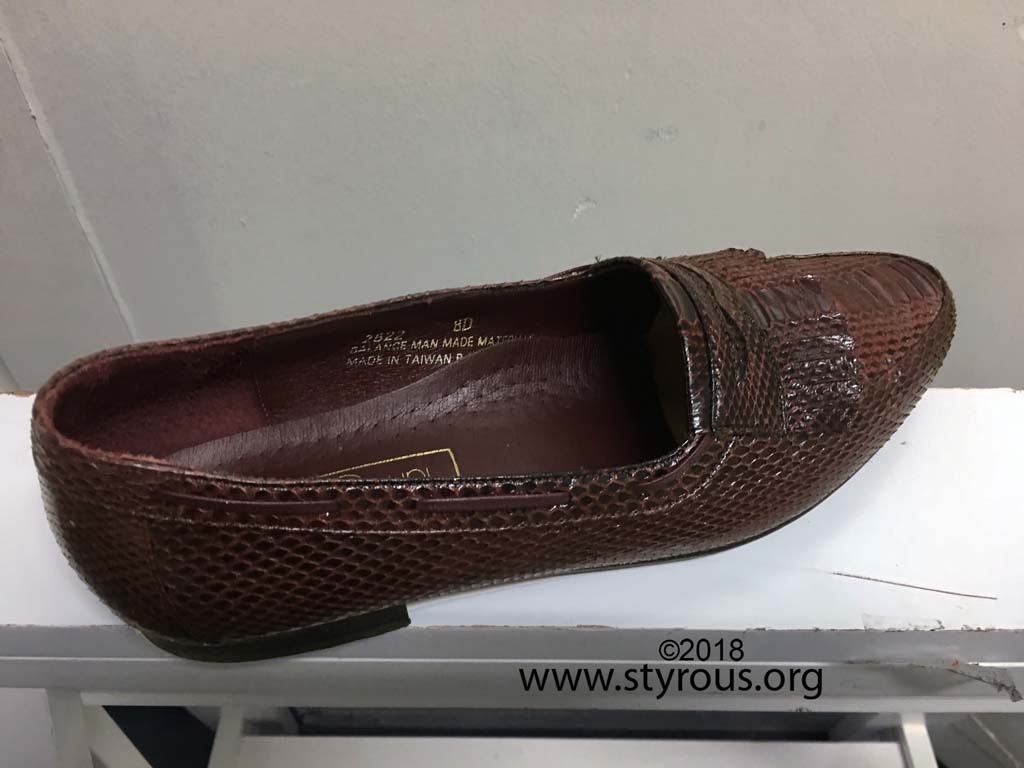
Angelo Cellini ~ brown snake skin loafers

~


photos by
Styrous®


I have always wanted a snake skin jacket. My first awareness of one was in the 1960 film, The Fugitive Kind, which starred Marlon Brando and Anna Magnani.    

      
The Fugitive Kind - move poster


movie still


When I was in the town of Alayor on Menorca, a small island off the coast of Barcelona, Spain, I came across these black snake skin loafers manufactured by Angelo Cellini. The Cellini name was trademarked in 1984 and the company still manufactures animal skin shoes that range from $500 on up.     

I have another pair I bought at the same time that are black (link below). Both are size 8D and have been in storage, like my record collection (link below), for several decades and will be for sale on eBay (link below).       


Angelo Cellini ~ brown, snake skin loafers, 8D, on eBay.     


Viewfinder links:          
          
Net links:        
          
Angelo Cellini         
The Fugitive Kind ~          
     Plot 
     Cast   


Styrous® ~ Wednesday, Jun 13, 2018    


November 24, 2017

July 23, 2014

Ana Briongos @ La Paloma, BCN, or el mundo es un pañuelo!

It seems another one of my life cycles has gone full circle recently. I have written in previous entries how persons, places and events of different periods of my life have been resurfacing for the last three or four years from times as much as 60 years ago and from locations as divergent as Europe, Asia, Mexico and San Francisco.

Although this account starts in Berkeley, it began somewhere else a long time ago. This last weekend was one of those events coming full cycle. Week before last, I was invited to a friend's house for dinner. I knew several of the people attending but some were strangers to me. It was a wonderful dinner during which I took photos of everyone present (typical). I emailed the photos I'd taken to the people who had been there, including the ones I didn't know.

Ana Briongos, right,
her daughter, Anna, & son-in-law, Nick
Berkeley, CA
photo by Styrous®


During the dinner one of the women, Ana, mentioned she had written books about Afghanistan and Iran and when I got home I went online and checked her out; after reading about her books, they sounded pretty interesting so I ordered a copy of one of them, Black on Black; Iran Revisited, from Amazon.


Black on Black; Iran Revisited
photo by Styrous®


A couple of days later, Ana, replied by email to thank me for the photos and said when she showed my photos from the dinner to her husband, who had not been there, he recognized me from her birthday party which had taken place at La Paloma in Barcelona; other than the name of the place, she gave no other clue but the second I read her words I instantly recalled the exact night of the party, December 29, 2006, because it was one of those nights one never forgets.


I was totally blown away!


At the time I did not know her but a friend who lives in Barcelona had invited us to go to a party being held at the La Paloma nightclub. I had been to it a few months earlier and was delighted to go back again as the night I had been there, they would not let me take photos because it was a public event. As this was a private party, I figured this was my opportunity to take the photos I wanted. To be honest, there were dozens of people there and the place is enormous, so other than to wish her happy birthday, I didn't get a chance to talk to her very much.

Since that dinner in Berkeley, we have gotten to know each other a little more and I have met her husband, Toni Alsina, and her son, Quico, while we spent a couple of hours exploring the Oakland gardens of Marcia Donahue (more on her to come) who creates other-world sculptures.

 
 Toni, Ana, Marcia and Quico
photo by Styrous®


Black on Black; Iran Revisited
back cover detail & title page
photo by Styrous®


Black on Black is a memoir of Ana's studies in Iran in the 1960's and her travels there and in Afghanistan in the 1970's and after. The tales she weaves of her adventures during the times before and after the Islamic Revolution of 1979 are absolutely spellbinding. The book is not a very big one but it is packed with the richness of the culture and the beauty of the countries; however, it does show another side of both countries and also recounts some of the not so pretty things as well. I learned much about the Muslim world and what it means to the people who follow it. I feel more informed after reading it and that's a nice feeling to have at the end of a book. Also, it is about life cycles unexpectedly coming full circle.

The book is published by the Australian publishing company, Lonely Planet, which is famous for its travel books but this is not a travel book. It is a look into a world most people never experience. It was originally written in Spanish; the translation by Chris Andrews is excellent. Andrews has also translated work by Roberto Bolaño, the Chilean novelist, short-story writer, poet and essayist.


Black on Black; Iran Revisited
title page dedication
detail photo by Styrous®


I have an article on the Art Nouveau night club, La Paloma, here on the Viewfinder, if you'd care to know about it. It's a fascinating subject: La Paloma, Barcelona.

Incidentally, Ana's daughter, Anna, had her baby, a boy, since the dinner. Congratulations to the proud parents and grand parents. As Ana said to me in the email about the La Paloma event in 2006:


¡El mundo es un pañuelo!

Gracias, Ana

La Paloma, Barcelona


Styrous® ~ Wednesday, July 23, 2014

September 13, 2013

Barcelona ~ Mostra de Gegants

Gegants Mostra
photo by Styrous®

From the 22nd to the 24th of September, 2010, I had the fortune to witness the grand parades with the Gegants during the La Mercè celebration in Barcelona, Espańa. And what an incredible spectacle it was! I had previously seen them on display in the courtyard of the Casa de Caritat in El Raval (see link below) where I was able to get better shots of them. But it was so much fun to see them in action.

This time the Gegants were exhibited in a building equally as beautiful as the Casa de Caritat, the Palau de la Virreina on La Rambla on the edge of El Raval. Earlier, in July, I had been in the complex to attend the OjodePez, an international conference on photography, and I heard presentations given by major photography personalities including photographer, Susan Meiselas. The Palau was used as the staging area for the Gegants entrance into the city.

a brief history of La Mercè

In 1687, Barcelona suffered a plague of locusts. To fight against the insects, Barcelona prayed to the Virgin. At the end of the invasion she was named patroness of the city of Barcelona. Every year since that time, the festival in honor of the Virgin is celebrated from the 20th to the 24th of September, the actual feast day. This patronage was only recognized by the Pope in 1868.

The many events that have been scheduled for this year, 2013, can be seen on the Barcelona Tourist Guide's website.


preparations for the parade

all photos by Styrous®

(click on any image for slideshow)


In the early years, the representation of Violant of Hungry changed from year to year and the presentation set the style women followed for that year; although that is not the case now, the presentation is still in effect. The representation of Jaume I of Aragon never changed. Poor guy!

entrance of the
Gegants into the city


Jaume I and Violant of Hungary
the presentation


Jaume I and Violant of Hungary
 the presentation


Jaume I and Violant of Hungary
entering the streets


Jaume I and Violant of Hungary


all photos by Styrous®

There is a video of the parade of the gegants in action during the 2010 La Mercè on YouTube by ki55er.

La Virreina Centre de la Imatge
Palau de la Virreina
La Rambla, 99
08002 Barcelona
T 933 161 000

Main link to La Mercé articles:
Barcelona ~ La Mercé 2010 articles

Individual links:

Styrous® ~ Friday, September 13, 2013