
Showing posts with label David Gahr. Show all posts
Showing posts with label David Gahr. Show all posts
August 28, 2023


October 27, 2020
Phil Spector articles/mentions

mentions:
Percy Faith ~ Latin Themes for Lovers
Ben E. King ~ Spanish Harlem
May 15, 2020

May 8, 2020

Phil Ochs articles/mentions

Crossroads ~ Robert Johnson
David Gahr ~ music world photographer
Minoo Hamzavi ~ The Vote is in
Phil Ochs - 1960's
photographer unknown
February 1, 2020
Bruce Springsteen articles/mentions

~
mentions:
Meat Loaf ~ Bat Out of Hell
USA For Africa ~ We Are The World
Bruce Springsteen - July 19, 1988
Weissensee, Berlin
photo by Wolfgang Kumm
June 21, 2019

December 23, 2018
20,000 vinyl LPs 162: Tim Hardin ~ Two
~

Tim Hardin ~ Tim Hardin 2
vinyl LP album cover detail
cover photo by Marshall Harmon
detail photo of album cover by Styrous®
Today, December 23, is the birthday of James Timothy "Tim" Hardin; he was born in Eugene, Oregon, two weeks after the bombing of Pearl Harbor in 1941.

He was an American folk musician and composer who wrote the Top 40 hit If I Were a Carpenter, which was covered by Bobby Darin, Joan Baez, Johnny Cash, The Four Tops, Robert Plant, and Johnny Rivers, among others. His song Reason to Believe has also been covered by many artists, notably Rod Stewart (who had a chart hit with the song), Neil Young, and The Carpenters. Hardin is also known for his own recording career.


The Stip
Discography
Tim Hardin ~
If I were a Carpenter
Lady Came From Baltimore
Joan Baez ~ Lady Came From Baltimore
Johnny Cash ~ Lady Came From Baltimore
Rickey Nelson ~ Lady Came From Baltimore

Styrous® ~ Sunday, December 23. 2018

Tim Hardin ~ Tim Hardin 2
vinyl LP album cover detail
cover photo by Marshall Harmon
detail photo of album cover by Styrous®
Today, December 23, is the birthday of James Timothy "Tim" Hardin; he was born in Eugene, Oregon, two weeks after the bombing of Pearl Harbor in 1941.

vinyl LP album cover
cover photo by Marshall Harmon
photo of album cover by Styrous®
He was an American folk musician and composer who wrote the Top 40 hit If I Were a Carpenter, which was covered by Bobby Darin, Joan Baez, Johnny Cash, The Four Tops, Robert Plant, and Johnny Rivers, among others. His song Reason to Believe has also been covered by many artists, notably Rod Stewart (who had a chart hit with the song), Neil Young, and The Carpenters. Hardin is also known for his own recording career.

vinyl LP album back cover
photo by Styrous®
If I Were a Carpenter was his big hit from this album but it was another song that I loved the most, Lady Came from Baltimore.
It is a very short song, less than two minutes but it speaks a world of
emotion. It's a tale of a bandit who comes to rob the Lady but falls in
love with her instead (link below).

vinyl LP album back cover detail
detail photo by Styrous®
Lady Came from Baltimore was covered by Bobby Darin, Joan Baez, Johnny Cash, Bob Dylan, Ricky Nelson and many others. It's pretty interesting to hear how each of them has interpreted the song (links below).

vinyl LP album back cover detail
detail photo by Styrous®

vinyl LP album back cover detail
detail photo by Styrous®
Tim Hardin died on December 29, 1980; he was found on the floor of his Hollywood apartment. He died of a heroin overdose. His remains were buried in Twin Oaks Cemetery in Turner, Oregon.

vinyl LP, side 1
photo by Styrous®

vinyl LP label, side 1
photo by Styrous®

vinyl LP, side 2
photo by Styrous®

vinyl LP label, side 2
photo by Styrous®
Tracklist:
Side 1:
A1 - If I Were A Carpenter - 2:41
A2 - Red Balloon - 2:37
A3 - Black Sheep Boy - 1:58
A4 - Lady Came From Baltimore - 1:49
A5 - Baby Close Its Eyes - 1:52
Side 2:
B1 - You Upset The Grace Of Living When You Lie - 1:47
B2 - Speak Like A Child - 3:15
B3 - See Where You Are And Get Out - 1:12
B4 - It's Hard To Believe In Love For Long - 2:17
B5 - Tribute To Hank Williams- 3:10
Companies, etc.
Record Company – Koppelman & Rubin Associates Inc.
Record Company – Sweet Reliable
Manufactured By – MGM Records Division
Record Company – Metro-Goldwyn-Mayer, Inc.
Published By – Faithful Virtue Music
Mastered At – Bell Sound Studios
Pressed By – MGM Record Manufacturing Division
Credits:
Arranged By – Don Peake
Design [Cover Design] – David Krieger
Engineer – Doc Siegel
Engineer [Director] – Val Valentin
Photography By [Cover] – Marshall Harmon
Producer – Charles Koppelman, Don Rubin
Producer [Supervisor] – Jerry Schoenbaum
Written-By – Tim Hardin
Barcode and Other Identifiers
Rights Society: BMI
Matrix / Runout (A-Side Runout Etching): [s-shaped block stamp] FTS 3022 MGS934-1 BellSound 21
Matrix / Runout (B-Side Runout Etching): [s-shaped block stamp] FTS-3022 MGS 935-1 BellSound 11
Tim Hardin – Tim Hardin 2
Label: Verve Forecast – FTS-3022, Verve Forecast – FTS3022
Format: Vinyl, LP, Album, Stereo
Country: US
Released: 1967
Genre: Rock
Style: Folk Rock
Side 1:
A1 - If I Were A Carpenter - 2:41
A2 - Red Balloon - 2:37
A3 - Black Sheep Boy - 1:58
A4 - Lady Came From Baltimore - 1:49
A5 - Baby Close Its Eyes - 1:52
Side 2:
B1 - You Upset The Grace Of Living When You Lie - 1:47
B2 - Speak Like A Child - 3:15
B3 - See Where You Are And Get Out - 1:12
B4 - It's Hard To Believe In Love For Long - 2:17
B5 - Tribute To Hank Williams- 3:10
Companies, etc.
Record Company – Koppelman & Rubin Associates Inc.
Record Company – Sweet Reliable
Manufactured By – MGM Records Division
Record Company – Metro-Goldwyn-Mayer, Inc.
Published By – Faithful Virtue Music
Mastered At – Bell Sound Studios
Pressed By – MGM Record Manufacturing Division
Credits:
Arranged By – Don Peake
Design [Cover Design] – David Krieger
Engineer – Doc Siegel
Engineer [Director] – Val Valentin
Photography By [Cover] – Marshall Harmon
Producer – Charles Koppelman, Don Rubin
Producer [Supervisor] – Jerry Schoenbaum
Written-By – Tim Hardin
Barcode and Other Identifiers
Rights Society: BMI
Matrix / Runout (A-Side Runout Etching): [s-shaped block stamp] FTS 3022 MGS934-1 BellSound 21
Matrix / Runout (B-Side Runout Etching): [s-shaped block stamp] FTS-3022 MGS 935-1 BellSound 11
Tim Hardin – Tim Hardin 2
Label: Verve Forecast – FTS-3022, Verve Forecast – FTS3022
Format: Vinyl, LP, Album, Stereo
Country: US
Released: 1967
Genre: Rock
Style: Folk Rock
Viewfinder links:
Net links:
YouTube links:
Tim Hardin ~
If I were a Carpenter
Lady Came From Baltimore
Joan Baez ~ Lady Came From Baltimore
Johnny Cash ~ Lady Came From Baltimore
Bobby Darrin ~ Lady Came From Baltimore
Bob Dylan ~ Lady Came From Baltimore Rickey Nelson ~ Lady Came From Baltimore

Tim Hardin - 1969
New York City
photo: David Gahr/Getty Images
Styrous® ~ Sunday, December 23. 2018
December 22, 2018
The United States postal music stamps ~ the "Forevers" Pt 4
~
Viewfinder links:
Miles Davis
Édith Piaf
The United States postal music stamps ~ the "Forevers"
Styrous® ~Saturday, December 22, 2018
On June 12th, 2012, the United States and France postal services jointly issued stamps honoring Édith Piaf and jazz musician Miles Davis.
Designed by Greg Breeding, the stamps depict the artists in their most
iconic poses using a photo of Davis with his trumpet in 1970 by David Gahr and a photo of Piaf from the Michael Ochs Archives.


Édith Piaf & Miles Davis postage stamp
US Postal Service

Édith Piaf & Miles Davis postage stamp
Viewfinder links:
Miles Davis
Édith Piaf
The United States postal music stamps ~ the "Forevers"
Styrous® ~Saturday, December 22, 2018
~
December 20, 2018
David Gahr ~ music world photographer
~

Joan Baez
Johnny Cash
Judy Collins
Salvador Dalí
Miles Davis
Janis Joplin
John Lennon
Pete Seeger
The United States postal music stamps ~ the "Forevers" Pt 3
David Gahr photography studio and archives

David Gahr - 1964
photo by John Byrne Cooke
David Gahr (born September 18, 1922) was an American photographer. He was one of the pre-eminent photographers of American folk, blues, jazz and rock musicians of the 1960s.
His photographic output includes more than five decades of musicians like Phil Spector, Bob Dylan, Miles Davis, Bruce Springsteen, Van Morrison, Janis Joplin, Sonny Terry, John Lennon and Pete Seeger, among others. His book, The Face of Folk Music (Citadel Press, 1968) with writer Robert Shelton captured the exploding American Folk music scene, with hundreds of images including Dylan, Joan Baez, Pete Seeger, Judy Collins, Tom Paxton, Phil Ochs, Odetta, Buddy Guy and Junior Wells, Mary Travers and Johnny Cash, among others.
The iconic photo by Gahr of Miles Davis playing his trumpet in his undershirt was used on the Davis 1971 reissue album, A Tribute To Jack Johnson, the soundtrack for the Bill Cayton documentary, on the life of boxer Jack Johnson. The photo was also used by the United States Postal Service for one of their music "Forever" stamps (link below).
He did not limit himself to music and musicians; he shot assignments for Time and Life magazines. He photographed Robert Rauschenberg, Jasper Johns, Claes Oldenburg, Salvador Dalí, Willem de Kooning and Georgia O’Keeffe. He took book-jacket photos of John Cheever and Arthur Miller.
He did not limit himself to music and musicians; he shot assignments for Time and Life magazines. He photographed Robert Rauschenberg, Jasper Johns, Claes Oldenburg, Salvador Dalí, Willem de Kooning and Georgia O’Keeffe. He took book-jacket photos of John Cheever and Arthur Miller.
Gahr died in Brooklyn, New York on May 25, 2008; he was 85 years old.
His daughter, Carla Gahr, also a
photographer, managed the David Gahr archives.
Viewfinder links:
Johnny Cash
Judy Collins
Salvador Dalí
Miles Davis
Janis Joplin
John Lennon
Pete Seeger
The United States postal music stamps ~ the "Forevers" Pt 3
Net links:
Morrison Hotel Gallery ~ David Gahr
Styrous® ~ Thursday, December 20, 2018
The United States postal music stamps ~ the "Forevers" Pt 3
~

Miles Davis
On June 12th, 2012, the United States postal service issued a stamp honoring jazz musician Miles Davis.
Designed by Greg Breeding, the stamp depicts him in his most
iconic pose using a 1970 photo by David Gahr of Davis playing his trumpet in his undershirt.

Miles Davis US postage stamp
photo of Davis by David Gahr
U. S. Postal Service
Viewfinder links:
Styrous® ~ Thursday, December 20, 2018
December 19, 2015
Edith Piaf ~ the Little Sparrow, one hundred and timeless

photographer unknown
Today, December 19, is the one hundredth anniversary of the birth of Édith Piaf in 1915. About a year and a half ago, I suddenly realized this event was coming. Because of the enormous impact the music of Piaf had made at an important point in my life when I was young, I began gathering information together for this article on her. There are links (below) to other articles I've written about her.
I hope you find as much love and compassion from reading and briefly reliving the intense life of this amazing woman, as I had putting it together.
the Édith Piaf nutshell
(green links to more info)
Édith Piaf was born Édith Giovanna Gassion at the Hôpital Tenon in Belleville, Paris, December 19, 1915. She was a French cabaret singer, songwriter and actress who became widely regarded as France's national chanteuse, as well as being one of France's greatest international stars. She was an icon in the Pantheon of entertainment.
I hope you find as much love and compassion from reading and briefly reliving the intense life of this amazing woman, as I had putting it together.
thank you
the Édith Piaf nutshell
(green links to more info)
Édith Piaf was born Édith Giovanna Gassion at the Hôpital Tenon in Belleville, Paris, December 19, 1915. She was a French cabaret singer, songwriter and actress who became widely regarded as France's national chanteuse, as well as being one of France's greatest international stars. She was an icon in the Pantheon of entertainment.
Piaf's father was Louis-Alphonse Gassion (1881–1944), a street performer of
acrobatics from Normandy. He was the son of Victor Alphonse Gassion
(1850–1928) and Léontine Louise Descamps (1860–1937), known as Maman
Tine, a "madam" who ran a brothel in Normandy.
Piaf's mother was Annetta Giovanna Maillard (1895–1945) who was of French descent on her father's side and of Italian origin on her mother's, and she was a native of Livorno, Italy. She worked as a café singer under the name Line Marsa. Her parents were Auguste Eugène Maillard (1866–1912) and Emma (Aïcha) Saïd ben Mohammed (1876–1930), daughter of Said ben Mohammed (1827–1890), a Moroccan acrobat born in Mogador, Morocco, and Marguerite Bracco (1830–1898), born in Murazzano in Italy.
Her mother abandoned Piaf at birth and when her father enlisted with the French Army in 1916 to fight in World War I, he took her to a women who ran a brothel in Normandy. There, prostitutes helped look after Piaf.
Piaf's mother was Annetta Giovanna Maillard (1895–1945) who was of French descent on her father's side and of Italian origin on her mother's, and she was a native of Livorno, Italy. She worked as a café singer under the name Line Marsa. Her parents were Auguste Eugène Maillard (1866–1912) and Emma (Aïcha) Saïd ben Mohammed (1876–1930), daughter of Said ben Mohammed (1827–1890), a Moroccan acrobat born in Mogador, Morocco, and Marguerite Bracco (1830–1898), born in Murazzano in Italy.
Her mother abandoned Piaf at birth and when her father enlisted with the French Army in 1916 to fight in World War I, he took her to a women who ran a brothel in Normandy. There, prostitutes helped look after Piaf.
In 1929, at age 14, she joined her father in his acrobatic street
performances all over France, where she first sang in public. At the age
of 15, Piaf met Simone "Mômone" Berteaut, who may have been her
half-sister, who became a companion for most of her life, and together
they toured the streets for the first time singing and earning money for
themselves. With the additional money Piaf earned as part of an
acrobatic trio, Piaf and Mômone were able to rent their own place. She separated from her father and took a room at Grand Hôtel de Clermont (18 rue Veron, Paris 18ème), working with Mômone as a street singer in Pigalle, Ménilmontant, and the Paris suburbs (cf. the song Elle fréquentait la Rue Pigalle).

photographer unknown
In
1932, she met and fell in love with Louis Dupont. In February 1933,
when Piaf was 17 years old, her daughter, Marcelle, known as Cécelle,
was born in the Hôpital Tenon. She returned to street singing, until the
summer of 1933, when she opened at Juan-les-Pins, Rue Pigalle. Marcelle
died of meningitis at age two. It is rumoured that Piaf slept with a man to pay for Marcelle's funeral.
In 1935, Piaf was discovered in the Pigalle area of Paris by nightclub owner Louis Leplée, whose club Le Gerny off the Champs-Élysées.
He persuaded her to sing despite her extreme nervousness, which,
combined with her height of only 142 centimetres (4 ft 8 in), inspired
him to give her the nickname that would stay with her for the rest of
her life and serve as her stage name, La Môme Piaf (Paris slang
meaning "The Waif Sparrow" or "The Little Sparrow"). Leplée taught her
the basics of stage presence and told her to wear a
black dress, which became her trademark apparel. Later, she would always
appear in black.
Her opening night attracted many celebrities,
including actor Maurice Chevalier. Her nightclub gigs led to her first two records produced that same year, with one of them penned by Marguerite Monnot,
a collaborator throughout Piaf's life and one of her favourite
composers.
On 6 April 1936, Leplée was murdered which generated negative
media attention and threatened her career. To rehabilitate her image,
she recruited Raymond Asso,
with whom she would become romantically involved. He changed her stage
name to "Édith Piaf" and commissioned Monnot to write songs that reflected or alluded to
Piaf's previous life on the streets.
In 1940, Piaf co-starred in the successful one-act play, Le Bel Indifférent, by Jean Cocteau. She began forming friendships with prominent people, including Chevalier and poet Jacques Borgeat.
She wrote the lyrics of many of her songs and collaborated with
composers on the tunes. In the spring of 1944 she began the first collaboration (and love
affair) with Yves Montand at the Moulin Rouge.

Paris Cancan (1890)
Moulin Rouge poster by Jules Chéret
In December of 1944, she performed on stage for the Allied forces together with Montand in Marseille, France.
Piaf's signature song, La vie en rose, was written in 1945 and was voted a Grammy Hall of Fame Award in 1998. The song's title can be translated as Life in Rosy Hues or Life
Through Rose-Tinted Glasses; its literal meaning is "Life in Pink". The lyrics and melody of the song were written by Piaf herself,
but the melody was said officially to have been composed and registered
by Louis Guglielmi
(known as Louiguy) only, since at the time, due to the stringent
registration requirements of SACEM, Piaf did not have the necessary
qualifications to be able to copyright her work with SACEM. The song made Piaf internationally famous, with its lyrics telling
about the joy of finding true love and appealing to those who had
survived the difficult wartime.

La Vie en rose was released on a 10" single in 1947 by Columbia Records, a division of EMI, with Un refrain courait dans la rue on the B-side.
It met with a warm reception and sold a million copies in the USA. It
was the biggest-selling single of 1948 in Italy, and the ninth
biggest-selling single in Brazil in 1949. Piaf performed the song in the
1948 French movie Neuf garçons, un coeur.
In 1947, she wrote the lyrics to the song Mais qu'est-ce que j'ai! (music : Henri Betti)
for Montand. Within a year, he became one of the most famous singers in
France. She broke off their relationship when he had become almost as
popular as she was.
In 1948, Piaf met and had an affair with boxing champion, Marcel Cerdan, who was married. The affair lasted from summer 1948 until his death in autumn 1949. They were devoted to each other and Piaf wrote one of her most famous songs, Hymne à l'amour, for Cerdan. Piaf and Cerdan's affair made international headlines, as Cerdan was the former middleweight world champion and a legend in France in his own right.
In 1948, Piaf met and had an affair with boxing champion, Marcel Cerdan, who was married. The affair lasted from summer 1948 until his death in autumn 1949. They were devoted to each other and Piaf wrote one of her most famous songs, Hymne à l'amour, for Cerdan. Piaf and Cerdan's affair made international headlines, as Cerdan was the former middleweight world champion and a legend in France in his own right.
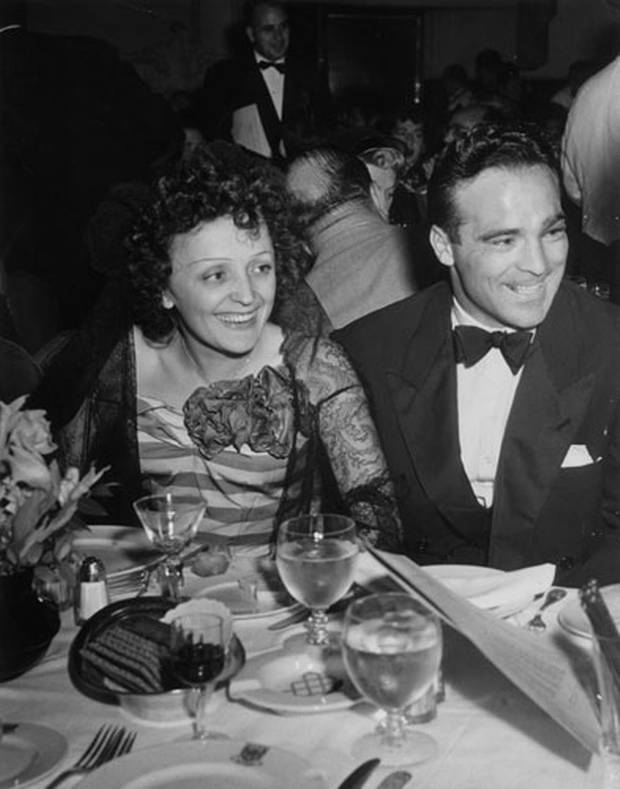
New York, World Championship
September 21, 1948
family archives
September 21, 1948
family archives
Cerdan began boxing professionally on November 4, 1934 in Meknes, Morocco,
beating Marcel Bucchianeri by a decision in six rounds. Cerdan then ran
a streak of 47 wins in a row between that first bout and January 4,
1939, when he lost for the first time, to Harry Craster by a
disqualification in five rounds in London.

Marcel Cerdan 1948
photographer unknown
photographer unknown
Cerdan, who was afraid to fly, died in a plane crash in the Azores in October 1949, while flying from Paris to New York City to meet Piaf at her insistence. Cerdan's Air France flight, flown on a Lockheed Constellation, killed everyone on board including several celebrities.

photographer unknown
In 1951, Piaf was seriously injured in a car crash along with Charles Aznavour, breaking her arm and two ribs, and thereafter had serious difficulties arising from morphine and alcohol addictions. Two more near-fatal car crashes exacerbated the situation. Singer Jacques Pills took her into rehabilitation on several occasions with no success.
Piaf married Jacques Pills (real name René Ducos), her first husband, in 1952 (her matron of honour was Marlene Dietrich). Piaf divorced him in 1957. In 1962, she wed Théo Sarapo
(Theophanis Lamboukas), a Greek hairdresser-turned-singer and actor who
was 20 years her junior. The couple sang together in some of her last
engagements.

Rotterdam performance, December 13, 1962
negative strips black / white,
number access 2.24.01.05, part number 914-6437
number access 2.24.01.05, part number 914-6437
National Image Archive:
Photo Collection Standard Dutch Fotopersbureau
Piaf died of liver cancer on the 10th of October, 1963. She was 47. She was buried in the Père Lachaise cemetery in Paris. The Roman Catholic
church denied a funeral mass because of her lifestyle. However, her
funeral procession was attended by more than 100,000 fans. It wasn’t
until 50 years after her death, in 2013, that the Catholic church
granted a proper funeral mass for her.
Having by Gallic law inherited Piaf's seven million francs worth of debts, Sarapo was evicted from the apartment they shared on Boulevard Lannes on Christmas Day 1963; he recorded La maison qui ne chante plus (the house which no longer sings), which became a hit. Another hit of his was Le jour viendra, which in English is, Our Day Will Come. Sarapo, was buried next to Piaf seven years later when he died in a car accident on August 28, 1970.


On June 12th, 2012, the United States and France postal services jointly issued stamps honoring Édith Piaf and jazz musician Miles Davis. Designed by Greg Breeding, the stamps depict the artists in their most iconic poses using a photo of Davis with his trumpet in 1970 by David Gahr and a photo of Piaf from the Michael Ochs Archives.
Having by Gallic law inherited Piaf's seven million francs worth of debts, Sarapo was evicted from the apartment they shared on Boulevard Lannes on Christmas Day 1963; he recorded La maison qui ne chante plus (the house which no longer sings), which became a hit. Another hit of his was Le jour viendra, which in English is, Our Day Will Come. Sarapo, was buried next to Piaf seven years later when he died in a car accident on August 28, 1970.


photographers unknown
On June 12th, 2012, the United States and France postal services jointly issued stamps honoring Édith Piaf and jazz musician Miles Davis. Designed by Greg Breeding, the stamps depict the artists in their most iconic poses using a photo of Davis with his trumpet in 1970 by David Gahr and a photo of Piaf from the Michael Ochs Archives.
Édith Piaf & Miles Davis postage stamp
US Postal Service
photo of Davis by David Gahr
photo of Davis by David Gahr
Édith Piaf & Miles Davis postage stamp
On Tuesday,
April 14, 2015, an exhibition opened at the Bibliothèque nationale de France celebrating the 100th anniversary of the birth of Édith Piaf.
The Piaf legacy
has survived, and her music is still relevant. Many films
and plays based on her life have been made. One of the most recent
biopics about her, La Vie En Rose, directed by Olivier Dahan, won an Academy Award for Best Actress (Marion Cotillard). The film also starred Gérard Depardieu as Louis Leplée who discovered Piaf singing on a Paris street corner in 1935. It is a moving and brilliant film!

La Vie En Rose movie poster
Viewfinder links:
Édith Piaf
Miles Davis
Marlene Dietrich
David Gahr
The United States postal music stamps ~ the "Forevers"
Net links:
films about Édith Piaf
Édith Piaf Discography
songs by Édith Piaf
YouTube links:
Édith Piaf ~ Songs
Théo Sarapo ~ Le jour viendra
According to Time Magazine, the last words of Piaf were . . .
"Every damn fool thing you do in this life, you pay for."
Styrous® ~Saturday, December 19, 2015
Subscribe to:
Posts (Atom)