~

Yesterday was the birth of Li'l Abner, so to speak. Written and illustrated by Al Capp (1909–1979), the strip was published on August 13, 1934, the strip ran for 43 years, from August 13, 1934, through November 13, 1977.
The strip featured an amazing array of totally unbelievable but lovable (more or less) characters, the lead, of course, Li'l Abner, his sweetheart Daisy Mae Yokum, his mother Mammy Yokum, his father Pappy Yokum, Honest Abe Yokum Daisey and Abner's son, his brother Tiny Yokum, Salomey the pet pig, Moonbeam McSwine and her father Moonshine McSwine, Hairless Joe and Lonesome Polecat moonshine purveyors, Senator Jack S. (Jackass) Phogbound, Stupefyin' Jones: A walking aphrodisiac who is very dangerous on Sadie Hawkins Day, the tycoon Bashington T. Bullmoose, the cannibal Wolf Gal, the wrestler Earthquake McGoon, Evil Eye Fleagle (the name says it all) and there are dozens of many other characters as well as mythical creatures such as the Shmoos.

One of the offshoots of Li'l Abner was Fearless Fosdick, a comic strip-within-the-strip parody of the Chester Gould plainclothes detective, Dick Tracy. Fearless Fosdick was licensed for use in an advertising campaign for Wildroot Cream-Oil, a popular men's hair tonic.
Fosdick's profile on advertising displays became a prominent fixture in
barbershops across America — advising readers to "Get Wildroot
Cream-Oil, Charlie!" A series of ads appeared in newspapers, magazines
and comic books featuring Fosdick's battles with Anyface, a murderous
master of disguise. Anyface was always given away by his dandruff and messy hair. I used Wildroot Cream-Oil from the mid 50's until the mid 80's.

The local for these characters, which includes every stereotype of Appalachia, is Dogpatch the impoverished community which consists mostly of ramshackle log cabins, turnip fields, pine trees,
and hogwallows. Most Dogpatchers are shiftless, ignorant scoundrels and
thieves. The men are too lazy to work, and Dogpatch girls are desperate
enough to chase them. Those who farm their turnip fields watch turnip
termites swarm by the billions every year to devour Dogpatch's only crop
(along with their homes, their livestock, and all their clothing). Capp intended for suffering Americans in the midst of the Great
Depression, to laugh at the residents of Dogpatch even worse off than
themselves. In his words, Dogpatch was "an average stone-age community nestled in a
bleak valley, between two cheap and uninteresting hills somewhere."
The characters of Li'l Abner were brought to life several times in many ways: in 1946 Capp wrote a song for Daisy Mae, entitled, (Li'l Abner) Don't Marry That Girl!! and it was recorded by Frank Sinatra as well as Helen Carroll and the Satisfiers (their version was the best). The group also recorded the theme song for the television series, Little Lulu.
With John Hodiak in the title role, the Li'l Abner radio drama ran weekdays on NBC from Chicago, from November 20, 1939, to December 6, 1940.
In 1940, Li'l Abner was brought to the big screen with Daisy Mae played by Martha O'Driscoll and Li'l Abner Yokum played by Granville Owen (aka Jeff York): it also featured Buster Keaton.


Beginning in 1944, Li'l Abner was adapted into a series of color theatrical cartoons by Screen Gems for Columbia Pictures, directed by Sid Marcus, Bob Wickersham, and Howard Swift.
Evil-Eye Fleegle makes an animated cameo appearance in the United States Armed Forces Special Weapons Project training film, Self Preservation in an Atomic Attack (1950).
In 1952, Fearless Fosdick was incorporated into a short-lived TV series. The puppet show was created and directed by puppeteer Mary Chase, written by Everett Crosby, and voiced by John Griggs, Gilbert Mack, and Jean Carson. Fearless Fosdick premiered on Sunday afternoons on NBC; 13 episodes featuring the Mary Chase marionettes were produced.
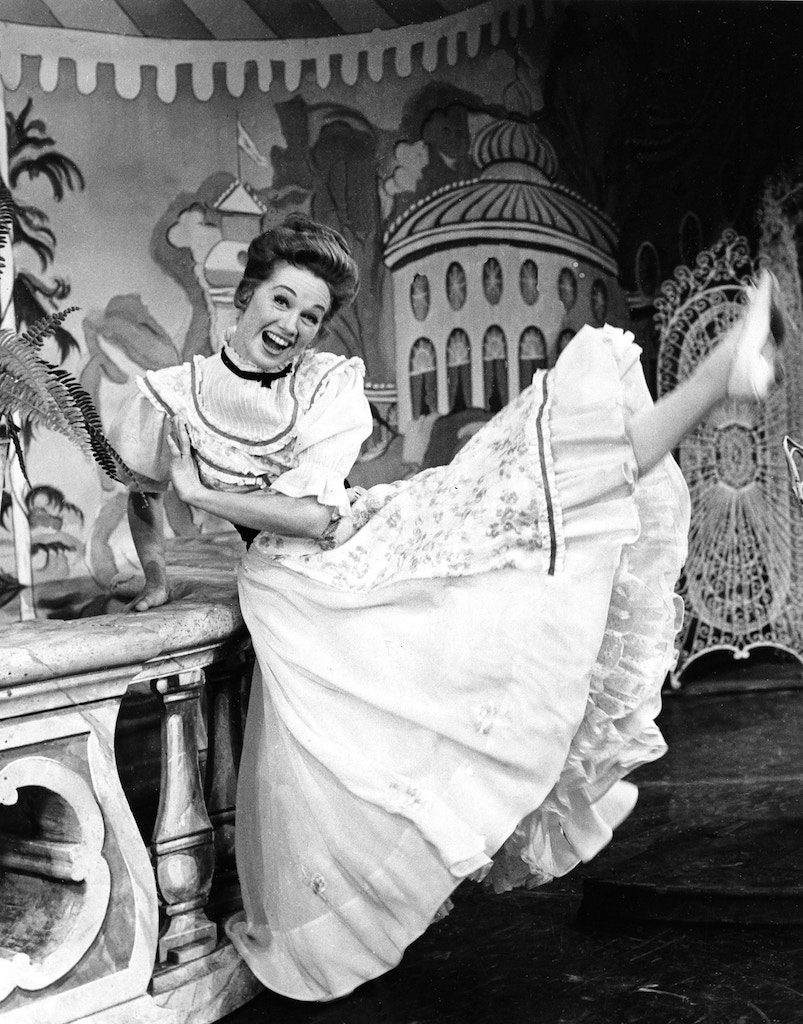
In 1956, the musical, Li'l Abner, opened on Broadway on November 15, 1956, at the St. James Theatre where it ran for 693 performances. The producers conducted a long search for the actor to play the title
role: over 400 actors auditioned for the part, and at one time, Dick Shawn was reported to be their preferred choice. However, the producers eventually chose unknown singer Peter Palmer, who had been serving in an army entertainment unit; Panama and Frank saw him perform on a segment of The Ed Sullivan Show featuring talented American soldiers. Palmer was a trained singer with a music degree from the University of Illinois, where he had also played football; at 6'4" and 228 pounds, Palmer had the right "look" to play Li'l Abner.

It was adapted into a Technicolor motion picture at Paramount Pictures in 1959 by producer Norman Panama and director Melvin Frank, with an original score by Nelson Riddle.
Lena the Hyena makes a brief animated appearance in the live and animated film, Who Framed Roger Rabbit (1988).

Sadie Hawkins Day is an American folk event and pseudo-holiday originated by Capp's hillbilly comic strip Li'l Abner (1934–1977). The annual comic strip storyline inspired real-world Sadie Hawkins events,
the premise of which is that women ask men for a date or dancing.
"Sadie Hawkins Day" was introduced in the comic strip on November 15,
1937; the storyline ran until the beginning of December. The storyline was revisited the following October/November, and inspired a fad on college campuses. By 1939, Life reported that 201 colleges in 188 cities held a Sadie Hawkins Day event. Capp finally set the date for Sadie Hawkins Day as November 26, in his last Li'l Abner daily strip on November 5, 1977.
Fans of the strip include novelist John Steinbeck, who called Capp "very possibly the best writer in the world today" in 1953 and recommended him for the Nobel Prize in literature, media critic. Theorist Marshall McLuhan considered Capp "the only robust satirical force in American life": in his book Understanding Media, McLuhan called Li'l Abner's Dogpatch "a paradigm of the human situation". Comparing Capp to other contemporary humorists, McLuhan wrote: "Arno, Nash, and Thurber are brittle, wistful little précieux beside Capp!".
John Updike called Li'l Abner a "hillbilly Candide" said that the strip's "richness of social and philosophical commentary approached the Voltairean." Capp has been compared to Fyodor Dostoevsky, Jonathan Swift, Laurence Sterne, and François Rabelais. Journalism & Mass Communication Quarterly and Time called him "the Mark Twain of cartoonists". Charlie Chaplin, William F. Buckley, Al Hirschfeld, Harpo Marx, Russ Meyer, John Kenneth Galbraith, Ralph Bakshi, Shel Silverstein, Hugh Downs, Gene Shalit, Frank Cho, Daniel Clowes, and Queen Elizabeth are all reportedly fans of Li'l Abner.
Li'l Abner characters were often featured in mid-century American advertising campaigns including Grape-Nuts cereal, Kraft caramels, Ivory soap, Oxydol, Duz and Dreft detergents, Orange Crush, Nestlé cocoa, Cheney neckties, Pedigree pencils, Strunk chainsaws, U.S. Royal tires, Head & Shoulders shampoo, General Electric light bulbs and Fruit of the Loom.

There were Dogpatch-themed family restaurants called "Li'l Abner's" in Louisville, Kentucky, Morton Grove, Illinois, and Seattle, Washington.
Wildroot Cream-Oil: Fearless Fosdick was licensed for use in an advertising campaign for Wildroot Cream-Oil, a popular men's hair tonic. Fosdick's profile on advertising displays became a prominent fixture in barbershops across America — advising readers to "Get Wildroot Cream-Oil, Charlie!" A series of ads appeared in newspapers, magazines and comic books featuring Fosdick's battles with Anyface, a murderous master of disguise. Anyface was always given away by his dandruff and messy hair.
Dogpatch characters were heavily licensed throughout the 1940s and 1950s: the main cast was produced as a set of six hand puppets and 14-inch (360 mm) dolls by Baby Barry Toys in 1957. A 10-figure set of carnival chalkware statues of Dogpatch characters was manufactured by Artrix Products in 1951, and Topstone introduced a line of 16 rubber Halloween masks prior to 1960. After the introduction of the Shmoos, they were licensed everywhere in 1948 and 1949. A garment factory in Baltimore made a line of Schmoo apparel — including "Shmooveralls", Shmoo dolls, clocks, watches, jewelry, earmuffs, wallpaper, fishing lures, air fresheners, soap, ice cream, balloons, ashtrays, comic books, records, sheet music, toys, games, Halloween masks, salt and pepper shakers, decals, pinbacks, tumblers, coin banks, greeting cards, planters, neckties, suspenders, belts, curtains, and fountain pens. In one year, Shmoo merchandise generated over $25 million in sales. Close to a hundred licensed Shmoo products from 75 different manufacturers were produced, some of which sold five million units each.
Capp once told one of his assistants that he knew Li'l Abner had finally "arrived" when it was first pirated as a pornographic Tijuana bible parody in the mid-1930s.

The Adventures of a Fuller Brush Man, published c. 1936
Li'l Abner ran until November 13, 1977, when Capp retired. Capp, a lifelong chain smoker, died from emphysema two years later at age 70, at his home in South Hampton, New Hampshire, on November 5, 1979.
Viewfinder links:
Net links:
Helen Carroll and the Satisfiers ~
Styrous® ~ Wednesday, August 13, 2025