Showing posts with label chicken. Show all posts

September 22, 2020

Brian O'Driscoll articles/mentions

~        


Brian O'Driscoll      
date & photographer unknown      


September 21, 2020

Corona Virus isolation ~ Day 189: Chicken, Avocado & Tomato

~
chicken, avacado & tomato salad 
prepared by Tom White
photo by Styrous®


My top-of-the-list meat to eat is chicken! I could eat chicken seven days a week! Well, I LOVE avocados equally! Tomato fits in there as well, so, what could have been a better dish to enjoy?!?      
 
Chickens come in an amazing array of types as I discovered when I visited Marcia Donahue at her wonderful world in the flat lands of Berkeley (link below).    

Vincent Damon Furnier (Alice Cooper) has been known to have a passing acquaintance with chickens during his on stage performances (link below).    

There is a string band named The Chickens on Wood here in the east bay. I've seen them perform a couple of times and they are a whole lot of fun to see in performance (link below).      
 
Did I mention I like chicken?        
  

The Chicken
 
The chicken (Gallus gallus domesticus) is a type of domesticated fowl, a subspecies of the red junglefowl (Gallus gallus). Chickens are one of the most common and widespread domestic animals, with a total population of 23.7 billion as of 2018.    
 
 
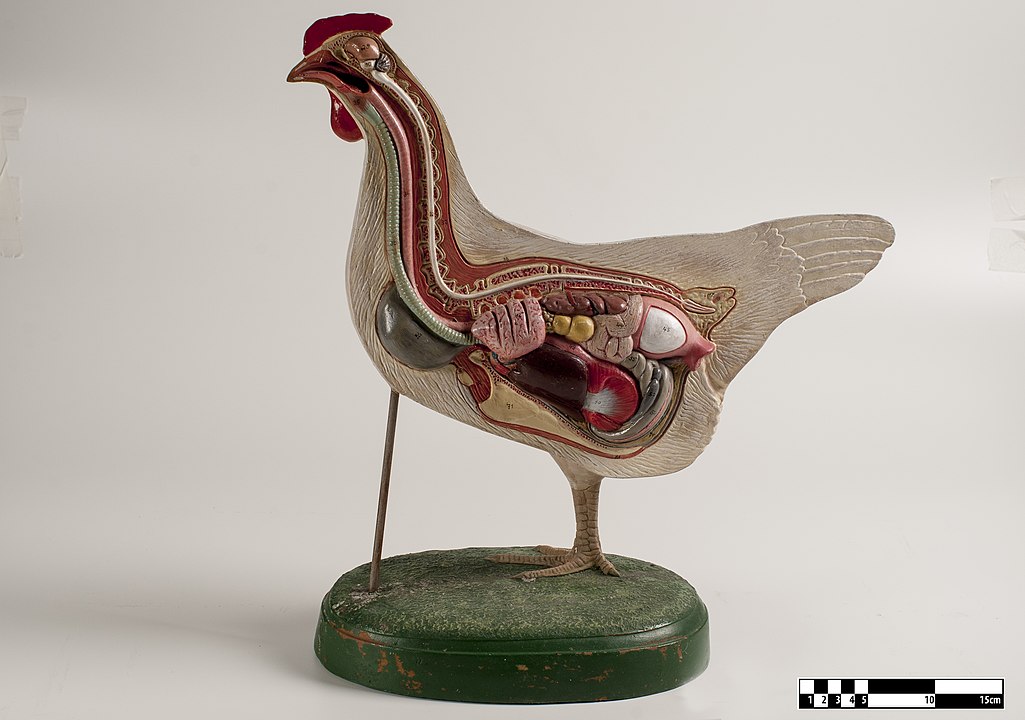
Anatomy of a chicken
 

Genetic studies have pointed to multiple maternal origins in South Asia, Southeast Asia, and East Asia, but with the clade found in the Americas, Europe, the Middle East and Africa originating in the Indian subcontinent
 
From ancient India, the domesticated chicken spread to Lydia in western Asia Minor, and to Greece by the 5th century BC. Fowl had been known in Egypt since the mid-15th century BC, with the "bird that gives birth every day" having come to Egypt from the land between Syria and Shinar, Babylonia, according to the annals of Thutmose III.       
 
In the UK and Ireland, adult male chickens over the age of one year are primarily known as cocks, whereas in the United States, Canada, Australia and New Zealand, they are more commonly called roosters. Males less than a year old are cockerels. Castrated or neutered roosters are called capons (surgical and chemical castration are now illegal in some parts of the world). Females over a year old are known as hens, and younger females as pullets, although in the egg-laying industry, a pullet becomes a hen when she begins to lay eggs, at 16 to 20 weeks of age. In Australia and New Zealand (also sometimes in Britain), there is a generic term chook /ʊk/ to describe all ages and both sexes. The young are often called chicks.         
 
 
"Is that a chicken joke?"
                  ~ Ruth Buzzi
 
     
The Avocado
    
I can eat an avocado just by itself with a pinch of salt and a touch of pepper or with just one other thing and be TOTALLY satisfied!         
 
 
avocado & hamburger patty 
prepared by Tom White
photo by Styrous®
     
 
The avocado (Persea americana), a tree likely originating from south-central Mexico, is classified as a member of the flowering plant family Lauraceae. The fruit of the plant, also called an avocado (or avocado pear or alligator pear), is botanically a large berry containing a single large seed.      

Avocados are cultivated in tropical and Mediterranean climates throughout the world. I learned about Mediterranean climates when I did a photo shoot for the Museu de Ciències Naturals de Barcelona in Barcelona almost ten years ago (link below).   

Avocados have a green-skinned, fleshy body that may be pear-shaped, egg-shaped, or spherical. Commercially, they ripen after harvesting. Avocado trees are partially self-pollinating, and are often propagated through grafting to maintain predictable fruit quality and quantity. In 2017, Mexico produced 34% of the world supply of avocados.     

Persea americana is a tree that grows to 20 m (66 ft), with alternately arranged leaves 12–25 cm (5–10 in) long. Panicles of flowers with deciduous bracts arise from new growth or the axils of leaves.[7] The flowers are inconspicuous, greenish-yellow, 5–10 mm (31638 in) wide.      
 
 
"I love things that are indescribable, 
like the taste of an avocado or the smell of a gardenia."
                                ~ Barbra Streisand 


The Tomato
         
I went through a period of time when I became allergic to raw tomatoes; I was devastated! I could eat them cooked with no problem. This allergy disappeared when I got older; change in body chemistry maybe?     
 

photo by Styrous®


The tomato is the edible, often red berry of the plant Solanum lycopersicum, commonly known as a tomato plant. The species originated in western South America and Central America. The Nahatl (the language used by the Aztecs) word tomatl gave rise to the Spanish word tomate (it was the way my father pronounced it), from which the English word tomato derived. Its domestication and use as a cultivated food may have originated with the indigenous peoples of Mexico. The Aztecs used tomatoes in their cooking at the time of the Spanish conquest of the Aztec Empire, and after the Spanish encountered the tomato for the first time after their contact with the Aztecs, they brought the plant to Europe. From there, the tomato was introduced to other parts of the European-colonized world during the 16th century.        
 
The word "tomato" comes from the Spanish tomate, which in turn comes from the Nahuatl word tomatl [ˈtomat͡ɬ], meaning "the swelling fruit". The native Mexican tomatillo is tomate (in Nahuatl: tomātl About this soundpronunciation (help·info), meaning "fat water" or "fat thing").     
 
When Aztecs started to cultivate the fruit to be larger, sweeter, and red, they called the new species xitomatl (or jitomates) (pronounced [ʃiːˈtomatɬ]), ("plump with navel" or "fat water with navel"). The scientific species epithet lycopersicum is interpreted literally from Latin in the 1753 book, Species Plantarum, as "wolfpeach", where wolf is from lyco and peach is from persicum.       

While tomatoes are fruitsbotanically classified as berries—they are commonly used as a vegetable ingredient or side dish.        


"Knowledge is knowing that a tomato is a fruit. 
Wisdom is knowing not to put it in a fruit salad."
                                 ~ Brian O'Driscoll


Viewfinder links:            
                   

Ruth Buzzi            
Corona Virus articles              
Brian O'Driscoll          
Barbra Streisand       
Styrous®        
Tom White                          


Styrous® ~ Monday, September 21, 2020         


~
~


July 2, 2020

Corona Virus isolation ~ Day 109: chicken, spinach & Parmesan

~          
pasta dinner
 prepared by Tom White


chicken       
spinach      
pasta     
pesto
Parmesan cheese (grated)  

Tom White:
Instead of basil, spinach was used for this pesto.

toast pine nuts
cool then pulse or grind nuts with wilted spinach, fresh Italian parsley and garlic
add olive oil and process until it's begging for Parmesan 
dice grilled chicken breast then mix with "pesto" 
boil organic spaghetti to texture preference   
pour "pesto" and chicken over pasta 
grate Parmesan over all.  
Serve hot!   
 
Parmesan cheese

According to legend, Parmigiano-Reggiano was created during the Middle Ages in Bibbiano, in the province of Reggio Emilia and spread to the Parma and Modena areas. Historical documents show that in the 13th and 14th centuries, Parmigiano was already very similar to that produced today. Some evidence suggests that the name was used for Parmesan cheese in Italy and France in the 17th-19th century.    
        
It was praised as early as 1348 in the writings of Boccaccio; and in his Decameron he writes:
'. . .  a mountain, all of grated Parmesan cheese', on which 'dwell folk that do nought else but make macaroni and ravioli, and boil them in capon's broth, and then throw them down to be scrambled for; and hard by flows a rivulet of Vernaccia, the best that ever was drunk, and never a drop of water therein.'      
During the Great Fire of London of 1666, Samuel Pepys buried his "Parmazan cheese, as well as his wine and some other things" to preserve them.  
         
In the memoirs of Giacomo Casanova, he remarked that the name "Parmesan" was a misnomer common throughout an "ungrateful" Europe in his time (mid-18th century), as the cheese was produced in the town of Lodi, Lombardy, not Parma. Though Casanova knew his table and claimed in his memoir to have been compiling a dictionary of cheeses (never completed), his comment has been taken to refer mistakenly to a grana cheese similar to "Parmigiano", Grana Padano, which is produced in the Lodi area.     
        
Parmigiano-Reggiano has been the target of organized crime in Italy, particularly the Mafia or Camorra, which ambush delivery trucks on the Autostrada A1 in northern Italy between Milan and Bologna, hijacking shipments. The cheese is ultimately sold in southern Italy. Between November 2013 and January 2015, an organized crime gang stole 2039 wheels of Parmigiano-Reggiano from warehouses in northern and central Italy.          
       

Parmigiano-Reggiano factory - 2005
photo: Sputnikcccp


pesto

Pesto originated in Genoa, the capital city of Liguria, Italy. It traditionally consists of crushed garlic, European pine nuts, coarse salt, basil leaves, hard cheese such as Parmigiano-Reggiano (also known as Parmesan cheese) or Pecorino Sardo (cheese made from sheep's milk), all blended with olive oil.       

It goes back as far as the Roman age. The ancient Romans used to eat a similar paste called moretum, which was made by crushing garlic, salt, cheese, herbs, olive oil and vinegar together. The use of this paste in the Roman cuisine is mentioned in the Appendix Vergiliana, an ancient collection of poems where the author dwells on the details about the preparation of moretum. During the Middle Ages, a popular sauce in the Genoan cuisine was agliata, which was basically a mash of garlic and walnuts, as garlic was a staple in Liguria; a name given to the region by the Ancient Greeks. The introduction of basil, the main ingredient of modern pesto, occurred in more recent times and is first documented only in the mid-19th century, when gastronomist Giovanni Battista Ratto published his book La Cuciniera Genovese in 1863.      


Viewfinder links:         
   
Corona virus articles      
Corona virus food articles        
Tom White           
         
         
Che piatto divino!
      
          
Styrous® ~ Thursday, July 2, 2020         


~
~


February 4, 2019

Alice Cooper ~ chickens & snakes

~      
Vincent Damon Furnier, aka Alice Cooper, was born seventy-one years ago, on February 4, 1948; as well as one of my favorite musicians, he is an American singer, performer and showman extraordinaire!     


photographer unknown


Cooper is known for his elaborate stage presentations and though not the originator, he is the most famous of the  heavy metal, punk rock performers of the music form known as "Shock Rock."   

Many of his performances feature chickens (link below), snakes, straight jackets, electrocutions and hangings; videos of performances on YouTube below. His first snake was named Kachina. She was the snake on the cover of the Killer album (links below). Neal Smith, his original drummer, gave it to him. A Kachina is a spirit being in the religious beliefs of the Pueblo people, Native American cultures located in the southwestern part of the United States.         
      
According to Sick Things, UK (link below):      
"Neal took care of it [Kachina], made it fat and sassy for Alice to use on stage at night. One night Neal asked me to go to the pet store at the Totem Department Store that used to be on 32nd street and Thomas in Phoenix. He wanted me to buy live white mice, Kachina's favorite, she wouldn't eat dead mice or brown mice, she liked them white and alive. When I told the sales girl what I wanted and what for she said, "I don't think I can sell them to you for that." Then I asked to speak to her manager he said "Our business is to sell them the mice, what they do with them after they are sold is their business." Well, the story has a happy ending for Kachina and Alice.        

They sold me the mice. Kachina ate before the gig that night feeling fat and sassy, and Alice was spared for another show that night.       

Neal said months later that they had to catch a plane and they couldn't find her. They looked all over, since she was nowhere to be found they had to leave thinking someone must have taken her. Shep got a phone call from the the Holiday Inn, evidently she had crawled up under the bed springs and was left in the room. The next person to get the room was Charley Pride, a black country singer popular at the time. He called room service because there was a snake in his room! LOL"          


Viewfinder links:     
      
Alice Cooper   
Killer Vinyl LP  
Killer (reel to reel tape)            
         
Net links:     
      
Deadline News ~ No more Poison for Alice Cooper snake      
Rolling Stone ~ How Cooper’s Infamous Chicken Incident Really Happened    
Sick Things, UK ~ The snakes   
Spinditty ~ Things You May Not Know About Alice Cooper
The Telegraph ~ Cooper: "I lost a boa constrictor in a hotel"     
        
YouTube links:     
      
Is It My Body (with SNAKE) LIVE IN CONCERT 8/19/2011         
From The Inside (Live 1979)         
1971 Studio Filming Ballad of D Fry (9 min., 31 sec.)     


Happy birthday, you wild 'n crazy guy!


Styrous® ~ February 4, 2019