Showing posts with label Tom Lehrer. Show all posts

June 30, 2026

Lena Horn & The Cotton Club

 ~     
             
Lena Horn - 1947 
photographer unknown 


Today is the birthday of one of the Great Entertainers in the Pantheon of Gods, Mrs. Lena Horn, who got her start at the Cotton Club at the age of sixteen and became a nightclub performer before moving on to Hollywood and Broadway.            
 
She was a groundbreaking Black American performer who advocated for civil rights and took part in the March on Washington in August 1963. Later she returned to her roots as a nightclub performer and continued to work on television while releasing well-received record albums.       
 
Lena Horn was born in Bedford–Stuyvesant, Brooklyn to Edwin and Edna Horne on June 30, 1917. She belonged to the well-educated upper stratum of Black New Yorkers at the time. She lived the first five years of her life in a brownstone on Macon Street.  
     
Her father, a one-time owner of a hotel and restaurant, was a gambler who left the family when Lena was three years old and moved to an upper-middle-class African-American community in the Hill District of Pittsburgh, Pennsylvania. Her mother, Edna Louise Scottron, was an actress with a Black theater troupe and traveled extensively. Edna's maternal grandmother, Amelie Louise Ashton, was from modern Senegal. Horne was raised mainly by her paternal grandparents, Cora Calhoun and Edwin Horne. From 1923 to 1927 she lived in a scattered and confusing whirl.     
     
In 1933, Horne joined the chorus line of the Cotton Club in Harlem (New York City), which at this time featured some black performers but a whites-only audience. In the spring of 1934, she had a featured role in the Cotton Club Parade starring Adelaide Hall, who took Lena under her wing. Horne made her first screen appearance as a dancer in the musical short Cab Calloway's Jitterbug Party in 1935. A few years later, she joined the Noble Sissle Orchestra, with which she toured and with whom she made her first records, issued by Decca. After she separated from her first husband, Horne toured with bandleader Charlie Barnet in 1940–41, but disliked the travel and left the band to work at the Café Society in New York. She replaced Dinah Shore as the featured vocalist on NBC's popular jazz series The Chamber Music Society of Lower Basin Street. The show's resident maestros, Henry Levine and Paul Laval, recorded with Horne in June 1941 for RCA Victor. Horne left the show after only six months when she was hired by former Cafe Trocadero (Los Angeles) manager Felix Young to perform in a Cotton Club-style revue on the Sunset Strip in Hollywood.     
 
 
Lena Horn - 1947 
photo by Carl Van Vechten 
 
     
She made her debut at Metro-Goldwyn-Mayer in Panama Hattie (1942) and performed the title song of Stormy Weather (1943) based loosely on the life of Adelaide Hall, for 20th Century Fox, while on loan from MGM. That same year she appeared in Cabin in the Sky with an entirely African-American cast. She was not featured in a leading role because of her ethnicity and the fact that her films were required to be re-edited for showing in cities where theaters would not show films with black performers. As a result, most of Horne's film appearances were stand-alone sequences that had no bearing on the rest of the film, so editing caused no disruption to the storytelling. One number from Cabin in the Sky was cut before release because it was considered too suggestive by the censors: Horne singing Ain't It the Truth while taking a bubble bath.         
 
During World War II, when entertaining the troops for the USO, she refused to perform "for segregated audiences or for groups in which German POWs were seated in front of Black servicemen." Because the US Army refused to allow integrated audiences, she staged her show for a mixed audience of Black US soldiers and white German POWs. Seeing the Black soldiers had been forced to sit in the back seats, she walked off the stage to the first row where the Black troops were seated and performed with the Germans behind herShe also worked with Eleanor Roosevelt in attempts to pass anti-lynching laws. She also worked with Eleanor Roosevelt in attempts to pass anti-lynching laws. Tom Lehrer mentions her in his song "National Brotherhood Week" in the line "Lena Horne and Sheriff Clark are dancing cheek to cheek" referring (wryly) to her and to Sheriff Jim Clark, of Selma, Alabama, who was responsible for a violent attack on civil rights marchers in 1965 mentions her in his song "National Brotherhood Week" in the line "Lena Horne and Sheriff Clark are dancing cheek to cheek" referring (wryly) to her and to Sheriff Jim Clark, of Selma, Alabama, who was responsible for a violent attack on civil rights marchers in 1965 
 
She was blacklisted during the 1950s for her affiliations in the 1940s with communist-backed groups. She would subsequently disavow communism.         
 
She left Hollywood and headlined at clubs and hotels throughout the US, Canada, and Europe, including the Sands Hotel in Las Vegas, the Cocoanut Grove in Los Angeles, and the Waldorf-Astoria in New York. From the fifties to the sixties, she appeared in Kraft Music Hall, The Ed Sullivan Show, The Dean Martin ShowHarry BelafonteTony Bennetthe Muppet Show, Sesame StreetSanford and Son, Peggy LeeVic DamoneThe Bell Telephone HourThe Judy Garland Show, The Hollywood Palace and The Andy Williams Show.       
 
She announced her retirement in March 1980, but the next year starred in a one-woman show, Lena Horne: The Lady and Her Music (link below), which ran for more than 300 performances on Broadway.  
Lena Horne died of congestive heart failure at age 92 on May 9, 2010. Her funeral took place at St. Ignatius Loyola Church on Park Avenue in New York, where she had been a member. Thousands gathered and attendees included Leontyne Price, Dionne Warwick, Liza Minnelli, Jessye Norman, Chita Rivera, Cicely Tyson, Diahann Carroll, Leslie Uggams, Lauren Bacall, Robert Osborne, Audra McDonald and Vanessa Williams.  Her remains were cremated.    


Viewfinder links:        
          
Lauren Bacall                
Charlie Barnet        
Harry Belafonte       
Cab Calloway         
Diahann Carroll          
The Cotton Club          
Vic Damone               


Lena Horn    
          
       
Peggy Lee      
Tom Lehrer                
Audra McDonald            
Liza Minnelli       
Jessye Norman        
Robert Osborne               
    
Chita Rivera                      
Dinah Shore          
Cicely Tyson             
Dionne Warwick            
Vanessa Williams       
        
Net links:         


YouTube links:         
        
        
Duke is Tops (aka Bronze Venus) 1938 Full Movie        


Panama Hattie ~     
      It's the Sping with Lena Horn      
      Movie Trailer    
Lena Horne ~ Ain't It the Truth           


Styrous® ~ Tuesday, June 30, 2026   


January 1, 2021

Beemer memory 32: Biker days, Enrico Banducci & a hungri i

~      
The hungry i 
date & photographer unknown 
 

About this time every year I remember January of 1980, the last days of my dancing career at the hungry i nightclub on Broadway in San Francisco, more about this below.       
 
When the hungry i opened in 1950 it played a major role in the history of stand-up comedy and music in the US. It was launched by Eric "Big Daddy" Nord, who sold it to Enrico Banducci in 1951; Banducci also owned Finocchio's Club, an upscale nightclub where famous people, movie and stage celebrities, politicians, etc., came to see the drag shows staged there.   
       

Enrico Banducci - 1969 
photographer unknown
 
 
In its heyday the hungry i featured comedy and folk and other music, with acts such as Maya Angelou (as a Caribbean singer, early in her career), Woody Allen, Malcolm Boyd, Lenny Bruce, Godfrey Cambridge, Dick Cavett, Professor Irwin Corey, Bill Cosby, the Gateway Singers, Vince Guaraldi, The Kingston Trio, Tom Lehrer, The Limeliters, John Phillips (of The Mamas & the Papas led the house band), The Journeymen), Mort Sahl, Ronnie Schell, Barbara Streisand, Jackie Vernon, We Five, Jonathan Winters, and Glenn Yarborough, among others.           

A young Barbra Streisand begged Banducci for a single night at his nightclub, insisting that she would soon be a huge star. Banducci agreed to sign the singer, who had never performed professionally but was soon starring in I Can Get It for You Wholesale on Broadway. The resulting concerts (March–April 1963) were well-attended, giving Streisand nationwide acclaim.      

The hungry i moved to Ghiradelli Square in 1967, where it was primarily a rock venue; it closed there in 1970. When it opened in a new location at 546 Broadway at the corner of Romolo Place in the North Beach neighborhood of San Francisco, it became a strip club.   
 
It would be six or so years later, during my early biker days, that I found myself dancing there. It's hard to believe this was over forty years ago.        
         
The hungry i is where I danced with Pillow, long past its glory days, it became our home base. But we also danced at the Roaring Twenties (where the first of the Dirty Harry series with Clint Eastwood was filmed), Big Al's, the Mabuhay Gardens (when punk bands weren't performing) The Garden of Eden and the On Broadway on the corner of Columbus and Broadway.  
 
I will never forget my time at the hungry i as it was an intrinsic part of my early biker days; I have so many wonderful tales from those days (link below); some I can and will retell; others I cannot and will not. I miss those days but their memories bring me great joy!       
 
The hungry i is still there. The barkers are still hawking on the sidewalk in front and the girls are still doing their thing inside.            


Viewfinder links:       
               
Joan Baez         
Lenny Bruce          
Ace Cannon         
Bill Cosby         
Clint Eastwood        
hungry i articles       
The Kingston Trio         
The Mamas & the Papas        
John Phillips         
Pillow (She-Beast)       
Barbra Streisand          
Styrous®                
Jonathan Winters          
     
Net links:                    
      
MisterSF ~ Farewell Favorites: hungry i      
   
     
YouTube links:       
     
Hungry i Club, San Francisco - Video Tour     


“Life moves on but memories linger.“
                           ~ Styrous®


Styrous® ~ Tuesday, Jamuary 1, 2021            


August 25, 2018

20,000 Vinyl LPs 145: Leonard Bernstein ~ Trouble In Tahiti

~


August 25, 1918
~
 October 14, 1990


Leonard Bernstein was born one hundred years ago on August 25, 1918. As it is the centennial of his birth, there will be thousands of memorials to him; this is one of them.

He was an American composer, conductor, author, music lecturer, and pianist. He was among the first conductors born and educated in the US to receive worldwide acclaim. According to music critic Donal Henahan, he was "one of the most prodigiously talented and successful musicians in American history."

 Bernstein conducting a rehearsal in one of the Tanglewood barns, ca 1971 
(Photograph by Heinz Weissenstein, Whitestone Photo, BSO Archives)


For my tribute to Bernstein, I've selected a beautiful, very small and almost unknown gem of an opera he wrote in 1952, his first, Trouble in Tahiti. I have loved it since I first heard this 1953 recording in the late fifties. It is a one-act opera in seven scenes composed by Bernstein with an English libretto by him; he dedicated the opera to Marc Blitzstein. There is a superb video of a complete performance of the opera by the English group, Opera North, on YouTube (link below) that is well worth the time (51 minutes) to watch.   


vinyl LP, back cover detail
detail photo by Styrous®


Tihiti is the darkest of his "musicals", and the only one for which he wrote the words as well as the music. The opera received its first performance on June 12, 1952 at the Bernstein Festival of the Creative Arts on the campus of Brandeis University in Waltham, Massachusetts to an audience of nearly 3,000 people.           


During the post–World War II economic expansion of the late 1940s and the 1950s, many persons from rural and urban backgrounds moved to single-family detached homes in the suburbs or in "horizontally developed cities".


Aerial view of Levittown, Pennsylvania
 photographer unknown

The early to middle fifties was a time when it was dawning on people that Suburbia and the suburban "Leave It To Beaver" existence was not what it was all cracked up to be. It was a time of transition from a major world power and prestige to something a bit less that lead to the disillusionment of the sixties.       

vinyl LP, front cover detail
detail photo by Styrous®


Trouble predates the 1956 book by John Keats, The Crack In the Picture Window. It was not uncommon for some of these homes to have a picture window, in contrast to the smaller sash windows typical of urban and rural housing; although many of these new suburban homes did not necessarily have picture windows, Keats in his title used the term to characterize this new housing in general, and by extension the new social forms arising from this change in how people housed themselves (as well as other social changes of the time).    

It also predates the song by Malvina Reynolds, Little Boxes, which was a big hit for Pete Seeger in 1963. The song is a political satire about the development of suburbia, and associated conformist middle-class attitudes. The effectiveness of the satire was attested to by a university professor quoted in 1964 in Time magazine as saying, "I've been lecturing my classes about middle-class conformity for a whole semester. Here's a song that says it all in 1½ minutes." However, according to Christopher Hitchens, satirist Tom Lehrer described Little Boxes as "the most sanctimonious song ever written".  
Trouble in Tahiti is the story of a disintegrating middle-class suburban marriage and it was startling that it appeared at that prosperous time in the history of the US.    

The opera is performed with minimal scenery (although Bernstein gave detailed instructions for drops and props) and very simple costumes. There are only two soloists, a married couple named Sam (baritone) David Atkinson,  and Dinah (mezzo-soprano), Beverly Wolff. Their son, Junior, is referred to but is never seen or heard (however, the video version I've linked to below does have a "Junior"). Other characters are addressed in certain scenes but also are never seen or heard: Sam's client Mr Partridge (on the telephone); his friend Bill (present and interacting with Sam but intended to be invisible); his secretary Miss Brown (present but intended to be invisible); Dinah's psychoanalyst ("invisible"); her milliner ("imaginary").       
The plot is of one day in the life of these desperately unhappy, though married people, lonely, longing for love, and unable to communicate. It is is about emotional isolation in the suburbs. This is a couple that has everything they could ever need; but they have lost themselves and one another.

A trio, two men and a woman, perform the function of the "Greek Chorus" throughout the opera, happily but cynically extolling the virtues of Suberbia and Sam, the hopeless frustration of Dinah and helps propel the action. They open with: Daa/Daa, Day, a delightful, bouncing diddy that blissfully extolls the joys of suburban life with the innocence of the above mentioned Leave It To Beaver but there is an underlying current with a bite to it (link to lyrics & music below).

We're taken to Sam's day at the bank in his office where we see his shallow dealings with his clients; the trio sings of his "marvelous/generous" handling of them.    

In one scene, Dinah tells her psychiatrist about a dream she had, There Is a Garden (13 minutes into the complete version below). In the dream, she is in a dead garden but a voice tells her there is another one filled with "love, harmony, and grace." She tries to find the voice, but every step she takes is filled with terror and horrible things. Finally, she finds the owner of the voice, but when she touches his hand, he vanishes and she wakes. The aria is one of the most brilliant works in modern opera as it fluctuates between moments of agonizing emotional turmoil and incredibly beautiful melody (link below). To me it is the highlight of the opera. It is magnificent!     

After her appointment, Sam and Dinah accidentally encounter each other on the street, Well, of all people Duet (link Below), a variation on the Garden motif, but end up walking off in opposite directions. It is a sad and grim encounter.         


vinyl LP, front cover detail
detail photo by Styrous®

At the gym, Sam sings about the natural superiority of some men, There's a Law, and how they "always will win" while the rest are just losers; he, of course, is one of the winners. He sings about physical superiority but you know he is referring to superiority on other levels (link below).   
    
Dinah goes to see a movie, Trouble in Tahiti, from which the title of the opera is derived, and is a metaphor for what is happening in her life but she does not acknowledge this. Afterwards, at the milliner, Dinah sings about the sillyness of the film, What a Movie; it is a rollicking, silly and delightful segement but at the end in her heart she must know it strikes too close to home (link below).    

At the end of the opera, Sam and Dinah show a willingness to sacrifice for each other, out of commitment to the marriage, but there seems to be no joy in it.       

The theme of modern familial disillusionment was revisited by Bernstein years later in 1983 with his sequal to Trouble, A Quiet Place (link below), with a libretto by Stephen Wadsworth. It tells the story of a contemporary American family struggling to connect, forgive, and accept one another's differences.  


vinyl LP, side 1
photo by Styrous®


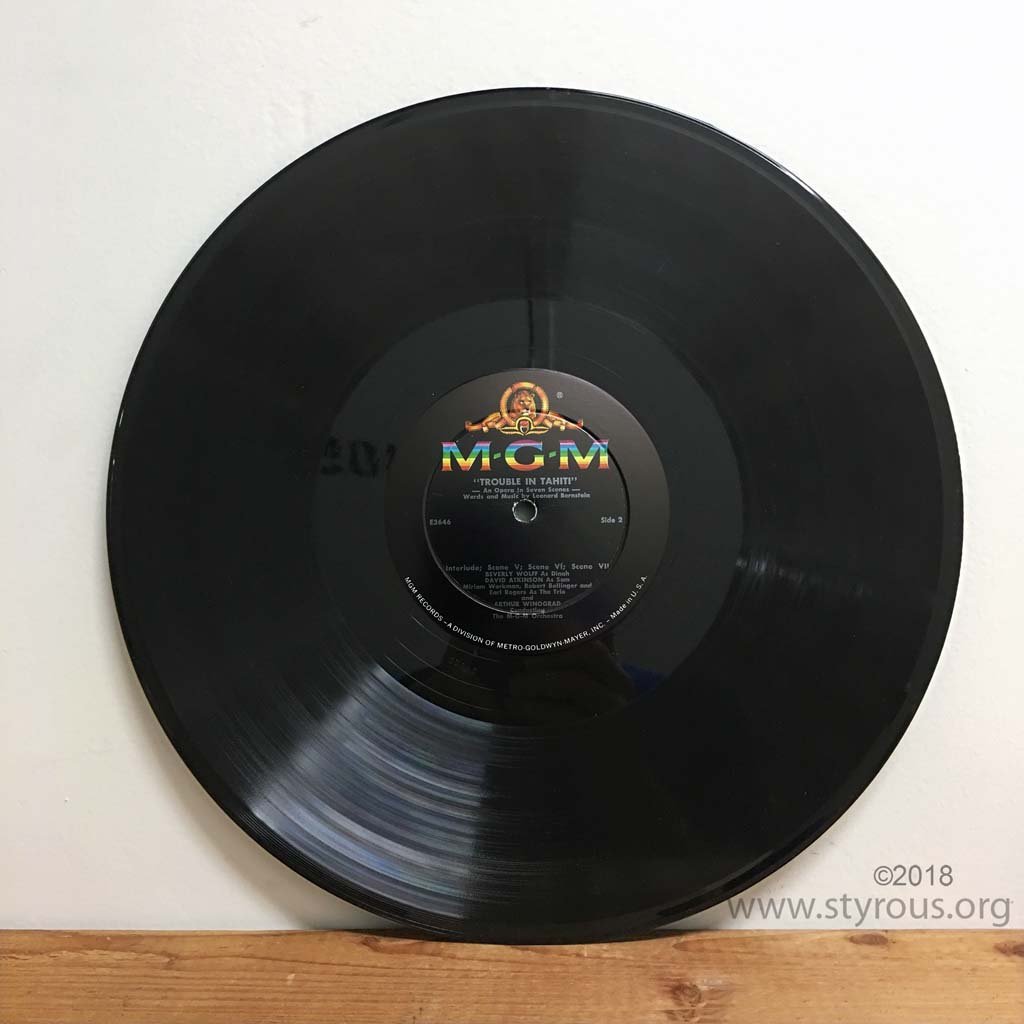
vinyl LP, side 2
photo by Styrous®


Tracklist:

Side 1:

A1     Prelude    
A2     Scene I    
A3     Scene II    
A4     Scene III    
A5     Scene IV    

Side 2:

B1     Interlude    
B2     Scene V    
B3     Scene VI    
B4     Scene VII    

Credits:

    Composed By – Leonard Bernstein
    Conductor – Arthur Winograd
    Orchestra – The M-G-M Orchestra*
    Vocals [Dinah, A Suburban Wife In Her Early Thirties] – Beverly Wolff
    Vocals [Sam, Her Husband, Same Age] – David Atkinson
    Vocals [The Trio, A Greek Chorus Born Of The Radio Commercial] – Earl Rogers, Miriam Workman, Robert Bollinger

Beverly Wolff, David Atkinson, The M-G-M Orchestra*, Arthur Winograd, Miriam Workman, Robert Bollinger, Earl Rogers ‎– Leonard Bernstein's Trouble In Tahiti (An Opera In Seven Scenes)
Label: MGM Records ‎– E3646
Format: vinyl LP
Country: US
Released: 1953
Genre: Classical, Stage & Screen
Style: Opera, Musical


Viewfinder links:        
            
Trouble in Tahiti lyrics          
           
Net links:        
            
Leonard Berstein ~ Trouble In Tahiti          
NYTimes ~ Bernstein's Trouble in Tahiti           
A Quiet Place               
Opera North Grand Theatre        
           
YouTube links:        
            
Trouble In Tahiti (complete - 51:04)          
       - Prelude ("Doa--Daa--Day--Day"), Scene 1 and 2
       - There Is a Garden (9:04)   
       - Well, of all people Duet      
       - Gym scene - There's a law
       - Scene 6 ("What a Movie!...Island Magic")       
       - Final scene              
The Girl Choir of South Florida ~ There Is a Garden     
Trouble in Tahiti ~ Quirijn de Lang interview     
Leonard Bernstein on A Quiet Place         


Leonard Bernstein
date & photographer unknown


Styrous® ~ Saturday, August 25, 2018