Showing posts with label Exploratorium. Show all posts

November 14, 2021

The K Gallery presents Radiance at the Rhythmix Cultural Works

 ~     

 
In conjunction with The Crucible, K Gallery presents Radiance at the Rhythmix Cultural Works. The show features works, most of which have lighting of some kind involved.       

I was interested to see the show as years ago, in 2007, I had done a photo shoot for plasma artist, Michael Pargette for his online website which i just discovered has since disappeared. I'll do an blog on his work.             
     
         
photos by Styrous®


Robert Graf is Senior Software Engineer at Pixar Animation Studios in Emeryville, California; Pixar is best known for its computer animated feature films.    
 
 
Robert Graf ~ Rattlesnake


Rob Neiring received his BFA from the University of Milwaukee, Wisconsin, in Inter-arts that included theatre, dance and sculpture. After professionally dancing for seventeen years and eighteen years in the candy business he dropped everything to come take a class at The Crucible. His definition of sculpture is, “Something you back into when looking at a painting,” he tries to incorporate his audience with more than just the sense of sight. He currently works at The Crucible as the Director of Program Operations. 
 
 
Rob Neiring ~ Not My Dream


Anne Pinkowski says, “I am a Bay Area artist who works with found objects. My heart and soul is fundamentally connected to objects that have been handled or created by human beings. My work often includes a story.”          
 
 
Anne Pinkowski ~ Exploding Time


Billy Hiebert uses injection molded, cast resin, carved marble, cast bronze and a variety of other materials for his sculpture.             


Billy Hiebert ~ Ripple


Ralph Reed has been drawing the sky every day since the first of September, 1973. With over 17,000 daily drawings, The Sky Diary may be the longest ongoing art piece.           


Ralph Reed ~ Turning On a Memory


Dan Caven was born and raised in Boulder, Colorado in the mid sixties and settled in San Rafael, California in the mid nineties. He got his art education through workshops, studio visits and art collaborations. Since 2008 he has taken classes and helps in the neon light department at The Crucible in Oakland.            
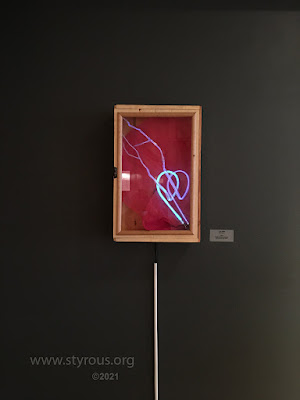
 
 
Dan Caven ~ Floor Stars


Charistian Schiess is a San Francisco Bay area artist originally from New Mexico. He completed a Fulbright post-graduate Fellowship at the Royal College of Art in London, UK, and is the author of the book The Light Artist Anthology.             
 
 
Charistian Schiess ~ A Tree That Grows Eggs


Kua Patten teaches Neon for the youth program at The Crucible and previously worked at the Exploratorium from 1993 until 2013, building exhibits after earning his Master’s Degree in Sculpture at Montana State University.             


Just outside of the K Gallery is a wonderful sculpture created by Ed Holmes and Marc Ribaud, Cameraman, which is just that, a man created from old cameras that is not to be missed (link below).  


Viewfinder links:      
         
K Gallery        
Rhythmix Cultural Works                 
     
Net links:       
        
The Crucible         
Rhythmix Cultural Works                          


Styrous® ~ Sunday, November 14, 2021        


December 5, 2017

San Francisco Panama–Pacific International Exposition ~ 1915


Yesterday, December 4, was the anniversary of the closing of the 1915 Panama–Pacific International Exposition after an almost year-long run.             
    
The Panama–Pacific International Exposition (PPIE) was a world's fair held in San Francisco, in the United States, between February 20 and December 4 in 1915. Its ostensible purpose was to celebrate the completion of the Panama Canal, but it was widely seen in the city as an opportunity to showcase its recovery from the 1906 earthquake. There was a postcard printed showing new buildings in San Francisco, with earthquake ruins and bear in foreground, and two small images of buildings of the Exposition at bottom.         


The fair was constructed on a 635 acre (2.6 km2) site in San Francisco, along the northern shore, between the Presidio and Fort Mason, now known as the Marina District.  


aeroplane view -1915

          
The centerpiece was the Tower of Jewels, which rose to 435 feet and was covered with over 100,000 cut glass Novagems. The 34 to 2 inch colored "gems" sparkled in sunlight throughout the day and were illuminated by over 50 powerful electrical searchlights at night.

Tower of Jewels_night

At the west end of the central court group was the Palace of Fine Arts which was designed by Bernard Maybeck, who took his inspiration from Roman and Ancient Greek architecture in designing what was essentially a fictional ruin from another time..     


designed by Bernard Maybeck


designed by Bernard Maybeck
         

It was one of ten palaces at the heart of the Exhibition. It is the only surviving structure. Constructed from temporary materials (primarily staff, a combination of plaster and burlap fiber), almost all the fair's various buildings and attractions were pulled down in late 1915. Intended to fall into pieces at the close of the fair (reportedly because the architect believed every great city needed ruins), the only surviving building on the Exposition grounds, Palace of Fine Arts, remained in place, slowly falling into disrepair (although the hall used to display painting and sculpture during the Fair was repurposed as a garage for jeeps during World War II). The Palace, including the colonnade with its signature weeping women and rotunda dome, was completely reconstructed in the 1960s and a seismic retrofit was completed in early 2009. The  Exploratorium, an interactive science museum, occupied the northern 2/3 of the Palace from 1969 to 2013; the city-owned Palace of Fine Arts Theater, has occupied the southern 1/3 since 1970.   

photo by Styrous®
          

There are other buildings from the Exposition that still stand today, the Bill Graham Civic Auditorium at Civic Center Plaza (link below) and the Japanese Tea house, which was barged down the Bay to Belmont, California and currently operates as a restaurant.

The Legion of Honor Museum, in Lincoln Park, was the gift of Alma de Bretteville Spreckels, wife of the sugar magnate and thoroughbred racehorse owner/breeder Adolph B. Spreckels. The building is a full-scale replica of the French Pavilion from the 1915 Panama Pacific International Exposition, which in turn was a three-quarter-scale version of the Palais de la Légion d'Honneur also known as the Hôtel de Salm in Paris by George Applegarth and H. Guillaume. At the close of the exposition, the French government granted Spreckels permission to construct a permanent replica of the French Pavilion, but World War I delayed the groundbreaking until 1921.


images from Wikipedia:
 
Fountain of Energy


India Block


 Palace of Horticulture


Palace of Horticulture & the Tower of Jewels


Panama Canal 


more  postcards 


Tower of Jewels - left, Italian Tower - right
Panama–Pacific International Exposition - Project Gutenberg
            
          
Viewfinder links:           


Net links:           
               
SF Public Library ~ Panama-Pacific International Exposition virtual tour   


Styrous® ~ Tuesday, December 5, 2017