Showing posts with label Boston Pops Orchestra. Show all posts

December 17, 2020

20,000 vinyl LP 260: Arthur Fiedler ~ Pops Goes Christmas

~       
vinyl LP front cover 
cover photo by David B. Hecht 
photo of album cover by Styrous®


Today is the birthday of Arthur Fiedler who was born in n Boston, Massachusetts, in 1894, to parents who were Austrian Jewish immigrants. His father was a violinist who played in the Boston Symphony Orchestra, and his mother was a pianist.         
 
What better tribute to this event at this time of year than his Christmas album? All the songs are standards so nothing to really say about them other than his treatment of them.   


vinyl LP back cover 
back cover photo by David B. Hecht 
photo of album back cover by Styrous®


The one stand out on the album is the now traditional song, The Toy Trumpet. The song was written in 1937 by Raymond Scott who was an American composer, band leader, pianist, record producer, and inventor of electronic instruments (link below). The trumpet solo is by Al Hirt who uses a trumpet mute so that it sounds distant, however, the arrangement is jazzy and fast. A very nice treatment of the song. 
 
In the finale of the 1938 film, Rebecca of Sunnybrook Farm, Shirley Temple and Bill Robinson sing and dance to the song and they use the original version by Scott. The  musical comedy film was directed by Allan Dwan and in addition, it starred  Randolph Scott (no relation to Raymond) and Jack Haley who would portray the Tin Man the following year in the MGM film The Wizard of Oz.   
 
 
Randolph Scott & Shirley Temple ~ Rebecca of Sunnybrook Farm                                                       
 
 
                                         Bill "Bojangles" Robinson ~ Shirley Temple ~ Rebecca of Sunnybrook Farm 


The original version of The Toy Trumpet was recorded by The Raymond Scott Quintette in New York City on February 20, 1937 (link below). It was much faster, jazzier and stopped for a vamp stroll near the end. It featured Pete Pimiglio on clarinet, Dave Harris on sax, Dave Wade took the trumpet part, Raymond Scott played piano and Johnny Williams was on drums. Williams would later be the father of film score composer and Boston Pops Conductor John Williams. Funny how things come around.  


A Christmas Festival was written by Leroy Anderson, in 1950. It was first performed on June 12, 1950, and recorded by Arthur Fiedler & the Boston Pops on June 19 of the same year. It is a medley of standard Christmas songs and ends with Joy To the World and a grand organ.       


Tracklist:

Side 1:

        Arthur Fiedler, Boston Pops Orch.* – A Christmas Festival - (8:34)
A1a    Joy To The World   
A1b    Deck The Halls   
A1c    Good King Wenceslas   
A1d    God Rest Ye Merry, Gentlemen   
A1e    Hark! The Herald Angels Sing   
A1f    The First Nowell   
A1g    Silent Night   
A1h    Jingle Bells   
A1i    O Come, All Ye Faithful    

A2    Arthur Fiedler And His Chorus And Orchestra* – The Little Drummer Boy - 2:28
A3    Arthur Fiedler, Boston Pops Orch.* – What Child Is This? - 5:34
A4    Arthur Fiedler, Boston Pops Orch.* – The Toy Trumpet, Trumpet – Al Hirt - 2:32
A5    Arthur Fiedler And His Chorus – Carol Of The Bells - 1:10
A6    Arthur Fiedler, Boston Pops Orch.* – March Of The Toys - 3:46

Side 2:

B1    Arthur Fiedler, Boston Pops Orch.* – White Christmas, Violin – Alfred Krips - 2:46
 
        Arthur Fiedler And His Chorus And Orchestra* – Medley - (5:05)
B2a    Here We Come A-Caroling   
B2b    O Christmas Tree   
B2c    I Saw Three Ships    

B3    Arthur Fiedler, Boston Pops Orch.* – Parade Of The Wooden Soldiers - 3:52
B4    Arthur Fiedler, Boston Pops Orch.* – Sleigh Ride - 2:52
B5    Arthur Fiedler, Boston Pops Orch.* – Rudolph The Red-Nosed Reindeer - 2:08
B6    Arthur Fiedler, Boston Pops Orch.* – Santa Claus Is Comin' To Town - 2:35
B7    Arthur Fiedler, Boston Pops Orch.* – Winter Wonderland - 2:54
B8    Arthur Fiedler And His Chorus And Orchestra* – Silent Night - 2:20

Companies, etc.

    Copyright © – RCA Records
    Pressed By – RCA Records Pressing Plant, Indianapolis

Credits:

    Conductor – Arthur Fiedler
    Engineer [Recording] – Bernard Keville
    Photography By – David B. Hecht
    Producer – Peter Dellheim

Notes:

 ℗ © 1972, RCA Records

The label style, with "RCA" above the center hole to the left of Nipper and "Red Seal" on its side to the right of the center hole, indicates a 1976 to late-1980s pressing.
 
Barcode and Other Identifiers

    Matrix / Runout (Side A label): BRRS-3815
    Matrix / Runout (Side B label): BRRS-3816
    Matrix / Runout (Side A runout, etched): BRRS-3815-7S I A1
    Matrix / Runout (Side B runout, stamped except "I" and "K" etched): BRRS 3816 36 I A1K
    Rights Society: ASCAP
    Pressing Plant ID (Etched in runouts): I
 
Arthur Fiedler / Boston Pops* And Arthur Fiedler Chorus* And Orchestra* – Pops Goes Christmas
Label: RCA Red Seal – LSC-3324
Format: Vinyl, LP, Album, Reissue
Country: US
Original release: 1972
Released: 1976 - 1980
Genre: Pop, Classical
Style: Religious, Choral, Light Music


Viewfinder links:        
         
Leroy Anderson          
Arthur Fiedler         
Al Hirt         
Bill Robinson        
Randolph Scott        
Raymond Scott        
Shirley Temple         
John Williams       
    
Net links:        
        
Boston Pops ~ A Brief History of the Boston Pops        
PBS.org ~ Once Upon a Sleigh Ride: Leroy Anderson       
    
YouTube links:        
         
Arthur Fiedler & The Boston Pops ~       
       Medley: A Christmas Festival          
       The Little Drummer Boy         
       What Child Is This          
       The Toy Trumpet         
       Carol Of The Bells           
       March Of The Toys          
       White Christmas                
       Medley              
       Parade Of The Wooden Soldiers          
       Sleigh Ride            
       Rudolph The Red-Nosed Reindeer                
       Santa Claus Is Comin' To Town               
       Winter Wonderland            
       Silent Night                      
Raymond Scott Quintette ~ The Toy Trumpet             
Shirley Temple & Bill Robinson ~ The Toy Trumpet      


Styrous® ~ Thursday, December 17, 2020       


December 17, 2017

Arthur Fiedler ~ The "Pop" King

~     
Today, December 17, is the birthday of Arthur Fiedler who was the conductor of the Boston Pops Orchestra from 1930 to 1979, almost fifty years! That's quite a run!    

Fiedler was also associated with the San Francisco Pops Orchestra for 26 summers (beginning in 1949).     


photographer unknown


He was born in Boston, Massachusetts, on December 17, 1894. His father was an Austrian violinist who played in the Boston Symphony Orchestra, and his mother was a pianist. When his father retired in 1910 they moved to Vienna, Austria. The family soon moved again, to Berlin, where from 1911 to 1915 young Fiedler studied violin at the Royal Academy of Music (Hochschule für Musik Berlin) under Willy Hess. He returned to Boston at the beginning of World War I. In 1915 he joined the Boston Symphony Orchestra under Karl Muck as a violinist. He also worked as a pianist, organist, and percussionist.

In 1924 he formed the Boston Sinfonietta, a chamber orchestra, made up of Boston Symphony Orchestra members, of which he was the conductor; its aim was to bring greater variety to the music heard both in Boston and throughout the surrounding areas. This group was also known on records as the Arthur Fiedler Sinfonietta. In an effort to bring as much music to the public as possible, Fiedler initiated a campaign for a series of free outdoor concerts in Boston and his efforts were rewarded in 1929 with the first Esplanade Concerts on the Charles River. These concerts programmed American and European light music and featured musicians from the Boston Symphony Orchestra: they were so successful that Fiedler was appointed the eighteenth conductor of the Boston Pops in 1930.    

Fiedler was one of the most successful recording artists of the twentieth century, with his recordings for RCA selling in excess of fifty million copies. He made his first recordings with the Boston Pops Orchestra in 1935, and together they continued to turn out best-selling records until his death: their account of the Jacob Gade song, Jealousy, was the first recording by a symphony orchestra to sell over one million copies.   

Many albums were made for RCA as part of the company’s Living Stereo series, and their excellent technical qualities, combined with Fiedler’s unique style in this repertoire, have ensured that many of these recordings have remained in the catalogue. Fiedler’s discography (link below) with the Boston Pops is so vast and so stylish that it is difficult to highlight specific recordings above others. Nonetheless among the best are the coupling of Gaîté Parisienne by Offenbach with La Boutique Fantasque by Rossini; Classics for Children, which includes Petr and the Wolf by Prokofiev, and The Carnival of the Animals by Saint-Saëns; Fiedler on the Roof, a compilation of hits from several of the most successful major Broadway musicals; and Boston Tea Party which includes shorter pieces by composers as varied as Balfe, Nicolai and Vaughan Williams. A good example of Fiedler’s way with popular tunes may be heard in the album Peace, Love and Pops, a collection of some of the most popular songs of the 1960s and 1970s.  

The musicians in the Pops Orchestra didn’t so much speak to Fiedler as bicker, according to his daughter Johanna, in her 1994 tell-all Arthur Fiedler, Papa, the Pops and Me (link below). Although the conductor who made the Boston Pops world famous seemed a cheery, red-cheeked Santa Claus in his last years before the public, here he behaves nastily to his family, to his underlings in the orchestra and to unsuspecting fans who get in his way. According to his daughter, he was a womanizing husband, a neglectful parent and a self-deceiving alcoholic.        


 Johanna Fiedler - 1994
photo by Janet Knott/ Globe Staff


She described the musicians, members of the Boston Symphony Orchestra, as openly contemptuous of her father. They despised the light music he loved. They were incensed they had to sing “Yeah, yeah, yeah” when he programmed the Beatles song, I Want To Hold Your Hand. His signature piece, Stars and Stripes Forever, was one of their least favorites. Sometimes the musicians would toss their music in the air at the end of a piece they didn’t like. Fiedler would respond by tossing his score higher. The musicians would retaliate and the stage would be littered with sheet music. Fiedler hated what he viewed as the musicians’ elitism. “This damned snobbism is the thing I’ve been trying to fight all my life, every chance I get,” he once said.          

He was associated with the San Francisco Pops Orchestra (1812 link below) for 26 summers (beginning in 1949), and conducted many other orchestras throughout the world. He was a featured conductor on several of NBC's The Standard Hour programs in 1950 and 1951, conducting the San Francisco Symphony in the War Memorial Opera House; the performances were preserved on transcription discs and later released on audio cassette.        

I remember going to the Civic Center Auditorium (now called the Bill Graham Civic Auditorium) on Grove Street in San Francisco in the late fifties and early sixties to hear his "Pop" concerts (link below).  

Among his many interests (which included coast guarding), Fiedler was a keen observer of fires, and on the occasion of his seventy-fifth birthday his son Peter presented him with a surprise gift on behalf of his whole family: a full-size fire engine! He was witness to the devastating Cocoanut Grove fire in Boston in 1942 (link below).      

Arthur Fiedler died on July 10, 1979 after having been in failing health for some time. During the previous winter, he suffered a stroke that temporarily left him unable to speak, but he quickly recovered and in May conducted a concert to celebrate his 50th anniversary as conductor of the Pops. A few days later, he had a mild heart attack after another performance. He collapsed while studying music scores in his Brookline, Massachusetts home and suffered cardiac arrest. After his death, Boston named a footbridge over Storrow Drive after him and honored him with a stylized, oversized bust of him near the Charles River Esplanade.    


This area is home of the free concert series that continues through the present day. Composer John Williams succeeded Fiedler as the orchestra's nineteenth director.


Viewfinder links:       
                 
Arthur Fiedler articles/mentions       
Pyotr Ilyich Tchaikovsky ~ 1812 Overture        
Tchaikovsky ~ 1812 Overture (Antal Dorati)
John Williams ~ A Soundtrack King             
                
Net links:       
                
Discography           
PBS ~ Arthur Fiedler: Evening at the Pops             
NY Times - You're the Pops ~ Arthur Fiedler Papa, the Pops and Me       
                
YouTube links:       
                
Arthur Fiedler & the Boston Pops     


date & photographer unknown


Styrous® ~ Sunday, December 17, 2017       


November 6, 2017

20,000 Vinyl LPs 114: Pyotr Ilyich Tchaikovsky ~ 1812 Overture & Arthur Fiedler


vinyl LP album cover detail 
 detail photo by Styrous®


On this date, November 6, in 1893, Pyotr Ilyich Tchaikovsky (/ˈpjtər ɪˈljɪ ˈkɒfski/; Russian: Пётр Ильи́ч Чайко́вский) often anglicized as Peter Ilyich Tchaikovsky, died. He was a Russian composer of the late-Romantic period, some of whose works are among the most popular music in the classical repertoire. He was the first Russian composer whose music made a lasting impression internationally, bolstered by his appearances as a guest conductor in Europe and the United States.  

The first classical music album I bought was this recording of the 1812 Overture by Tchaikovsky, so, I have chosen it to commemorate him. The recording was conducted by the funky, fun and marvelous Arthur Fiedler.    


I would go to the Civic Center Auditorium (now called the Bill Graham Civic Auditorium) on Grove Street in San Francisco in the late fifties to hear him as he led the San Francisco Pops Orchestra on wild and thrilling orchestral rides (link below).      


vinyl LP album back cover
 photo by Styrous®


Fiedler was born in Boston, Massachusetts; he died on July 10, 1979. Composer John Williams succeeded Fiedler as the orchestra's nineteenth director (Pop King link below).         


vinyl LP album back cover detail
 detail photo by Styrous®
 

Fiedler was fascinated by the work of firefighters and would travel in his own vehicle to large fires in and around Boston at any time of the day or night to watch the firefighters at work. The biography of Fiedler reports that the conductor once helped in the rescue efforts at the tragic Cocoanut Grove fire in Boston in 1942 (link below).                 


vinyl LP album back cover detail
 detail photo by Styrous®
 

Peter Ilich Tchaikovsky was born on May 7, 1840, in Votkinsk, a small town in Vyatka Governorate (present-day Udmurtia) in the Russian Empire, into a family with a long line of military service. Although musically precocious, he was educated for a career as a civil servant.

He entered the new Saint Petersburg Conservatory and graduated from it in 1865. The formal Western-oriented teaching he received there set him apart from composers of the contemporary nationalist movement embodied by the Russian composers of The Five: Mily Balakirev (the leader), César Cui, Modest Mussorgsky, Nikolai Rimsky-Korsakov and Alexander Borodin all of whom lived in Saint Petersburg,     


vinyl LP album back cover detail
 detail photo by Styrous®


Tchaikovsky's training from the conservatory set him on a path to reconcile what he had learned with the native musical practices to which he had been exposed from childhood. From this reconciliation, he forged a personal but unmistakably Russian style; not an easy task. The principles that governed melody, harmony and other fundamentals of Russian music ran completely counter to those that governed Western European music; this seemed to defeat the potential for using Russian music in large-scale Western composition or for forming a composite style. Russian culture exhibited a split personality, with its native and adopted elements having drifted apart increasingly since the time of Peter the Great. This resulted in uncertainty among the intelligentsia about the country's national identity—an ambiguity mirrored in Tchaikovsky's career.       


vinyl LP, Side 1
 photo by Styrous®


Tchaikovsky's life was punctuated by personal crises and depression. Contributory factors included his early separation from his mother for boarding school followed by his mother's early death, the death of his close friend and colleague Nikolai Rubinstein, and the collapse of the one enduring relationship of his adult life, which was his 13-year association with the wealthy widow Nadezhda von Meck. His homosexuality, which he kept private, has traditionally also been considered a major factor, though some musicologists now downplay its importance.

While his music has remained popular among audiences, critical opinions were initially mixed. Some Russians did not feel it was sufficiently representative of native musical values and expressed suspicion that Europeans accepted the music for its Western elements. In an apparent reinforcement of the latter claim, some Europeans lauded Tchaikovsky for offering music more substantive than base exoticism and said he transcended stereotypes of Russian classical music. Others dismissed Tchaikovsky's music as "lacking in elevated thought," according to longtime New York Times music critic Harold C. Schonberg, and derided its formal workings as deficient because they did not stringently follow Western principles.       

However, Tchaikovsky was honored in 1884, by Emperor Alexander III, and awarded a lifetime pension. So there!  


vinyl LP label, Side 1
 photo by Styrous®


Tchaikovsky's sudden death at the age of 53 is generally ascribed to cholera; there is an ongoing debate as to whether cholera was indeed the cause of death, and whether it was accidental or self-inflicted.     

There is a recording of Tchaikovsky's voice made in Moscow in January 1890, by Julius Block on behalf of Thomas Edison on Wikipedia (link below).     


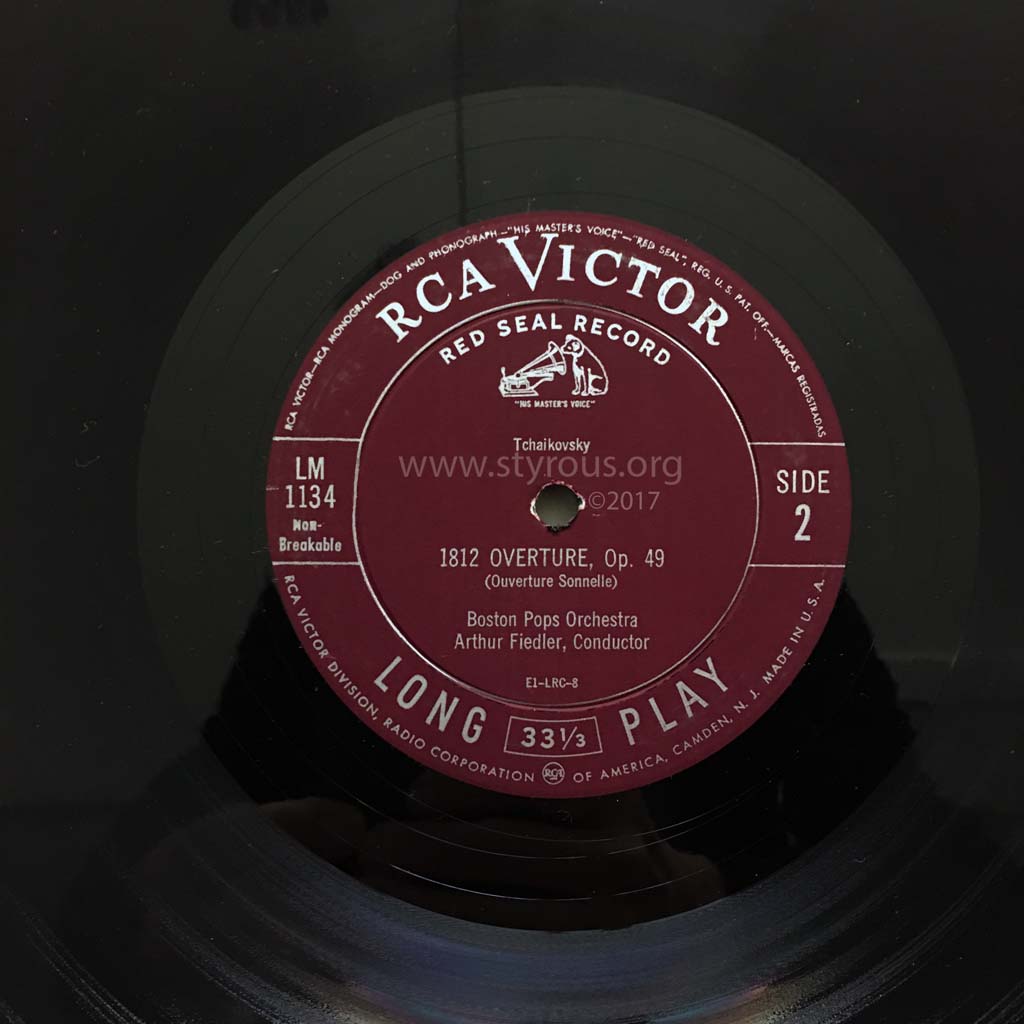
vinyl LP, Side 2
 photo by Styrous®


The Festival Overture In E major, Op. 49, popularly known as the 1812 Overture, was written in 1880 by Tchaikovsky to commemorate Russia's defence of its motherland against the Napoleon Grande Armée invasion  of 1812. The overture debuted in Moscow on August 20, 1882.

Some productions have chimes played and cannons fired in the finale. One famous version of this was performed and recorded by Antal Doráti in 1954 (link below).         


vinyl LP label, Side 2
 photo by Styrous®


Tracklist:

Side 1:

A1 - Capriccio Italien, Op. 45   

Side 2:

B1 - 1812 Overture, Op. 49   

Credits:

    Composed By – Tchaikovsky*
    Conductor – Arthur Fiedler
    Orchestra – Boston Pops Orchestra*
    
Notes:
  2nd cover version - Release with same cat # has different cover art and center labels thanks Capriccio Italien, 1812 Overture           

Tchaikovsky* - Boston Pops Orchestra*, Arthur Fiedler ‎– Capriccio Italien, 1812 Overture
Label: RCA Victor Red Seal ‎– LM 1134
Format: Vinyl, LP, Album
Country: US
Released: 1953
Genre: Classical


Viewfinder links:       
   
1812 Overture (Antal Dorati)       
1812 Overture (Arthur Fiedler)          
The Nutcracker        
Symphony #6: (Pathétique)         
Swan Lake       

Van Cliburn & Sputnik ~ 1958       
Arthur Fiedler articles/mentions        
Arthur Fiedler ~ The "Pop" King             
Arthur Fiedler, Mickey Alpert & the Cocoanut Grove fire 
The SF Civic Auditorium, Motorama & Arthur Fiedler       
John Willimas ~ A Soundtrack King                     
PIL (Public Image Ltd.)       
       

Net links:              
              
Scotty Moore ~ Civic Auditorium       
Tchaikovsky's voice on Wikipedia              
Recording history                       
      
YouTube links:             
           
Antal Doráti ~ 1812 Overture (w/chimes & cannons)          
Arthur Fiedler ~ Tchaikovsky: Overture 1812, Op.49                                


Styrous® ~ Monday, November 6, 2017