Showing posts with label Architecture. Show all posts

June 17, 2022

Las Taulas y los Talaiots de Menorca, Espaňa

 ~     

 
photos by Styrous®
   
 
Thirty-three years ago this month I saw for the first time one of the wonders of the ancient world which is never mentioned, the monoliths, megaliths and structures on the island of Menorca, in the western part of the Mediterranean Sea, off the coast of Barcelona, Espaňa.     


   monolith
 
 
A talaiot, or talayot, is a Bronze Age megalith found on the islands of Menorca and Majorca forming part of the Talaiotic Culture or Talaiotic Period. Talaiots date back to the late second millennium and early first millennium BC. There are at least 274 of them, in, near, or related to Talaiotic settlements and the Talaiotic chamber tombs known as navetas.          
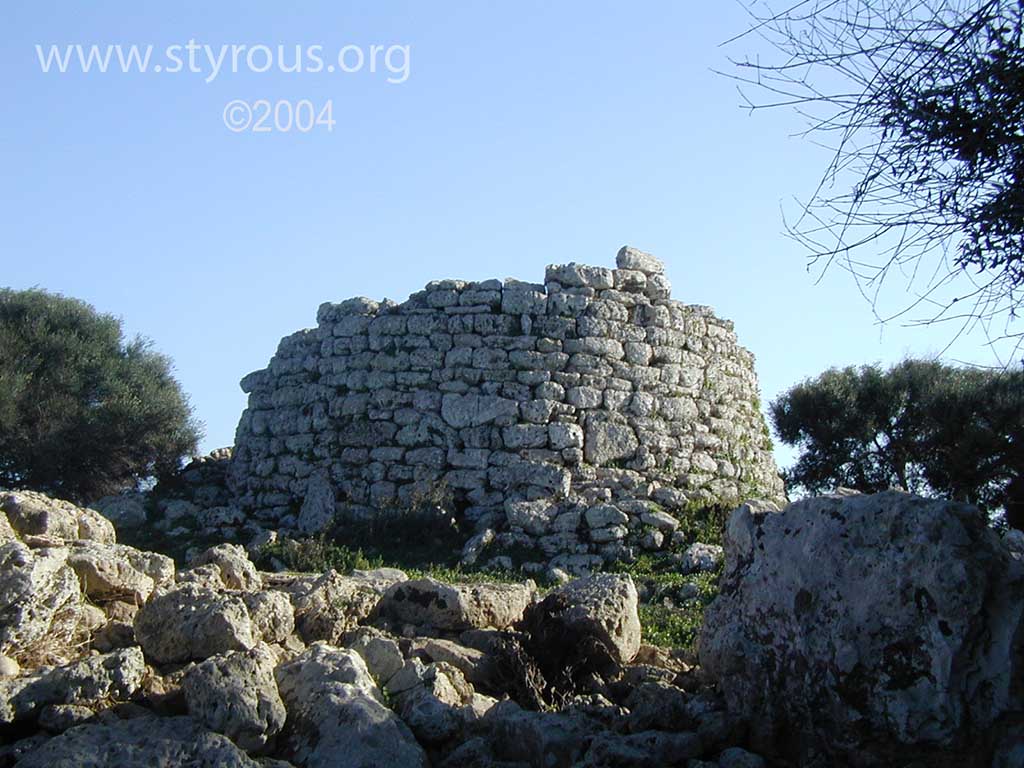


Some Talaiots are thought to have had a defensive purpose, the use of others is not clearly understood. Some believe them to have served the purpose of lookout or signalling towers, as on Menorca, where they form a network. Talaiots pre-date the megalithic structures known as taulas (each stone of these structures weigh tons) which are usually found nearby.        


The Spanish word for table is mesa; Taula is the Catalan version, although, only a gegant (link below) would be comfortable sitting at one of these.          

Taulas can be up to 5 metres high and consist of a vertical pillar (a monolith or several smaller stones on top of each other) with a horizontal stone lying on it. A U-shaped wall often encloses the structure. 
 
They were built by the Talaiotic culture between 500 BC and 300 BC. Their exact cultural meaning remains unknown, but they probably had religious and/or astronomical purposes. Most of the taulas face south, which seems to suggest some astronomical meaning.       


The word megalith was first used in 1849 by the British antiquarian Algernon Herbert in reference to Stonehenge and derives from the Ancient Greek words "mega" for great and "lithos" for stone. Most extant megaliths were erected between the Neolithic period (although earlier Mesolithic examples are known) through the Chalcolithic period and into the Bronze Age.           


While "megalith" is often used to describe a single piece of stone, it also can be used to denote one or more rocks hewn in definite shapes for special purposes. It has been used to describe structures built by people from many parts of the world living in many different periods (link below). The most widely known megaliths are not tombs. However, there are some on Menorca that are underground.        


Humans have been known to exist on Menorca since at least 2000 BC, perhaps even earlier. Some experts suggest the first seafaring people to arrive were of the eastern Mediterranean, such as the Minoans in Crete. The period during which their culture would flourish and evolve would become known as the Talayotic period of Menorca. The Talayots would thrive there for thousands of years until the arrival of the Romans in 123 BC.         


Viewfinder links:     
      
Menorca, Espaňa      
      
Net links:     
      
Historic Mysteries ~ The Megalithic Taulas of Menorca           
      
YouTube links:     
       
Talatí de Dalt 1           


Styrous® ~ Friday, June 17, 2022      


~
~


November 12, 2019

San Francisco Bay Bridge ~ Octogenarian

~ 


photos by Styrous®
except where indicated


San Francisco Bay Bridge - 2006      
photo by Styrous®   


The San Francisco Bay Bridge opened on November 12, 1936, six months before the Golden Gate Bridge. Designed by Charles H. Purcell, and built by American Bridge Company, it originally carried automobile traffic on its upper deck, and trucks and commuter trains on the lower, but after the Key System abandoned rail service, the lower deck was converted to all-road traffic as well.     


Key System logo
  

During the 1989 Loma Prieta earthquake, a portion of the eastern section's upper deck collapsed onto the lower deck and the bridge was closed for a month.                       


San Francisco Bay Bridge - 1989      
photo by Gary Weber/AFP   


On March 5, 2013, a public art installation called The Bay Lights was activated on the western span's vertical cables. The installation was designed by artist Leo Villareal to commemorate the 75th anniversary of its opening. and consists of 25,000 LED lights.            


photo by Leo Villareal  


photos by Styrous®


From Oakland . . . 


 . . . to San Francisco  


In 1986 the bridge was unofficially dedicated to James Rolph.    


Viewfinder links:    
  
Architecture       


Net links:    


Styrous® ~ November 12, 2019


Architecture

~
Transamerica Pyramid - 2003   
San Francisco, California       
photo by Styrous®      


España ~        

California ~
Falkirk Cultural Center
Moss Landing Power Plant         
Redman House      
      
Oakland ~    

Bellevue-Staten       
Fox Theater         
         

San Francisco ~
City Hall Civic Auditorium       
Mission Dolores     
San Francisco Bay Bridge           
          
Nevada ~    
Burning Man ~ 2003        
        
Texas ~    
Austin       
The Capital         


November 10, 2019

Falkirk Cultural Center

~


photos by Styrous®


Falkirk, an excellent example of a Queen Anne Victorian, was originally built in 1888 in San Rafael by Ella Nichols Park, a wealthy and reclusive young widow.    

In October 1886, Ms. Park purchased the 11-acre estate from railroad magnate James D. Walker and had his house removed and in February 1888 she commissioned E. F. Chisholm to build her home, designed by architect Clinton Day.  By August of that year, this elegant country home was completed for a cost of $30,000.       

After Ella’s death in 1905,  Captain Robert Dollar purchased the estate in 1906. Dollar was born in 1844 in Falkirk, Scotland and became very wealthy, first through the timber industry and later in the shipping business. He founded the Dollar Steamship Company, established trade with the Orient, and began the first regularly scheduled round-the-world passenger/freight line. Captain Dollar is often credited with founding the Merchant Marine. An active member of civic life in San Rafael and one of the drafters of the City Charter, Dollar donated much of the city’s adjacent open space on San Rafael Hill. He also gave lavishly to his hometown of Falkirk, Scotland, where he is remembered today and in October 1988 San Rafael and Falkirk became sister cities.         

The Falkirk center houses a contemporary art gallery where the exhibition Counter Point is currently showing (link below) and an educational center for cultural arts and provides subsidized space for other organizations including the Marin Poetry Center.        


Falkirk Cultural Center
1408 Mission Avenue at E Street
San Rafael, CA 94901 
(415) 485-3328  


Viewfinder link:            
                            
(Point) Counter Point             
          
Net links:            
                     
Falkirk Cultural Center         
Falkirk History 


Styrous® ~ Sunday, November 10, 2019