~
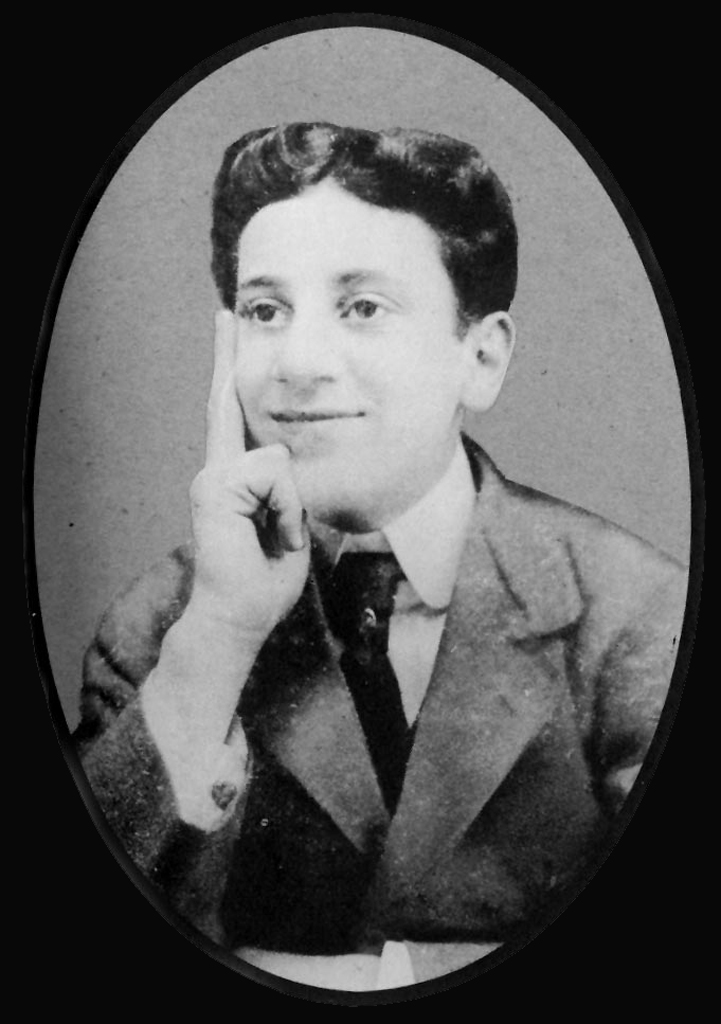
photographer unknown
Of the fourteen
comic operas they wrote between 1871 and 1896, the
The Mikado is my favorite, mostly because I starred in the opera as the
Mikado (the
Emperor of Japan, in
Japanese the emperor
is called Tennó, literally "heavenly sovereign") in a production by the Shadow Players at the San Francisco Lighthouse for the Blind.
I was horrendously miscast as the role of the Mikado is written for a bass-baritone; I was a lyric tenor at the time and the vocal range was WAY over my capabilities, or rather I should say, way below my vocal range. But for the lead role, they needed a good actor, not a good singer, I guess. I did my best but I think I was pretty pathetic!
However, a couple of years before my catastrophic performance, I'd come across this recording of The Mikado with Groucho Marx playing the role of Ko-Ko, The Lord High Executioner of Titipu. This recording is of a 1960 Bell Telephone Hour (TV Series) production. It was one of the first TV series to be telecast exclusively in color, using the color TV system perfected by RCA in 1954.
vinyl LP front cover
I didn't actually see the TV show when it was broadcast but listening to the recording is a hoot (links below) and it must have been quite something to see (link below).
Anyway, I figured if Groucho could do it, I could play it for laughs as
well as it is a comedy after all. Also, I was inspired by a 1939 production based on the opera
I'd heard about, The Hot Mikado.
Fortunately, ours was an abridged version of the opera, my singing was limited to the single song, Mia Sama,
and I was constantly interrupted by "The Daughter-In-Law Elect". The
weird part of the adventure is it didn't turn out to be so bad. It wasn't brilliant comedy nor a Hot Mikado parody, but it worked!
As for the Groucho version, fortunately for music history the recording sessions for the Bell Telephone Hour production were photographed by Dick Miller.
The Mikado recording sessions with Groucho Marx
photos by Dick Miller
vinyl LP front cover detail
On 14 August 1888
George Gouraud introduced the
Thomas Edison
phonograph to London in a press conference, including the playing of a
piano and cornet recording of
The Lost Chord by Sullivan, one of the
first recordings of music ever made.
At a party on 5 October 1888 given to demonstrate the technology,
Sullivan recorded a speech to be sent to Edison, saying, in part:
"I am astonished and somewhat terrified at the result of this evening's
experiments: astonished at the wonderful power you have developed, and
terrified at the thought that so much hideous and bad music may be put
on record forever. But all the same I think it is the most wonderful
thing that I have ever experienced, and I congratulate you with all my
heart on this wonderful discovery."
These recordings were found in the Edison Library in New Jersey in the 1950s. The first commercial recordings of Sullivan's music, beginning in 1898, were of individual numbers from the Savoy operas. In 1917 the
Gramophone Company (HMV) produced the first album of a complete Gilbert and Sullivan opera,
The Mikado, followed by eight more.
Electrical recordings of most of the operas issued by HMV and
Victor followed from the 1920s, supervised by
Rupert D'Oyly Carte. The D'Oyly Carte Opera Company continued to produce recordings until 1979.
Sullivan died of heart failure, following an attack of bronchitis, at his flat in London on November 22, 1900. His
Te Deum Laudamus, written in expectation of victory in the
Boer War, was performed posthumously.
Tracklist:
Side 1:
A1 Overture
Act I
A2.a If You Want To Know Who We Are
A2.b A Wand'ring Minstrel I
A2.c Behold The Lord High Executioner
A2.d As Some Day It May Happen
A2.e Comes A Train Of Little Ladies
A2.f Three Little Maids
-
Act II
A3.a Were You Not To Ko-Ko Plighted
A3.b With Aspect Stern
A3.c Braid The Raven Hair
Side 2:
B1.a The Sun, Whose Rays Are All Ablaze
B1.b Here's A How-De-Oo
-
Act III
B2.a Miya Sama
B2.b A More Humane Mikado
B2.c The Criminal Cried
B2.d The Flowers That Bloom In The Spring
B2.e Alone, And Yet Alive
B2.f Willow, Tit Willow
B2.g There Is Beauty
B2.h For He Is Gone And Married Yum-Yum
Credits:
Choir – The Norman Luboff Choir*
Conductor – Donald Voorhees
Orchestra – The Bell Telephone Orchestra
Written-By – Gilbert And Sullivan*
Notes:
As Presented on The Bell Telephone Hour over NBC-TV.
Gray and black label with six "eye" logos.
Groucho Marx With Robert Rounseville, Stanley Holloway, Barbara Meister, Dennis King (4), Helen Traubel – The Mikado
Label: Columbia Masterworks – OS 2022
Format: Vinyl, LP, Album, Stereo
Country: US
Released: 1960
Genre: Stage & Screen
Style: Soundtrack, Musical
YouTube links:
"Those are my principles, and if you don't like them...
well, I have others."
~ Groucho Marx