
It's hard to believe it was 40 years ago today, May 25, 1977, that the film and the soundtrack for Star Wars were simultaneously released. And, as they say, the rest is history. There is a link to my impressions about that momentous event below.


photo by Styrous®
I had no knowledge of what I was about to see other than the movie trailer playing at the time (link below). Because I only had a tiny, 13" Sonny, rabbit ears with bad reception and tinny sound as the TV was not connected to a sound system, I was not prepared for what was to come.

My album is the original 1977 release of the soundtrack, entitled Star Wars - Original Soundtrack. It includes a 24" x 36" fold-out poster of a painting by science fiction artist John Berkey, depicting the final battle over the Death Star from the film's end.

photo by Styrous®

photo by Styrous®
To me, the film score for Star Wars by John Williams is the best one he ever composed. Great examples are The Dune Sea Of Tatooine episode, the quirky and delightful music from the Cantina scene, the Princess Lea Theme and many others (links below).

photo by Styrous®
On the recommendation of his friend Steven Spielberg, Lucas hired composer John Williams. Williams had worked with Spielberg on the film Jaws, for which he won an Academy Award.
Lucas felt that the film would portray visually foreign worlds, but
that the musical score would give the audience an emotional familiarity;
he wanted a grand musical sound for Star Wars, with leitmotifs
to provide distinction. Therefore, he assembled his favorite orchestral
pieces for the soundtrack, until Williams convinced him that an
original score would be unique and more unified. However, a few of
Williams' pieces were influenced by the tracks given to him by Lucas:
the Main Title Theme was inspired by the theme from the 1942 film Kings Row, scored by Erich Wolfgang Korngold; and the track Dune Sea of Tatooine drew from the soundtrack of Bicycle Thieves, scored by Alessandro Cicognini.

photo by Styrous®
The score for Star Wars
was recorded over eight sessions at Anvil Studios in Denham, England on
March 5, 8–12, 15 and 16, 1977. The score was performed by the London Symphony Orchestra with Williams conducting. The score was orchestrated by Herbert W. Spencer, who also orchestrated The Empire Strikes Back and Return of the Jedi. The score was recorded by engineer Eric Tomlinson and edited by Kenneth Wannberg, and the scoring sessions were produced by Star Wars director George Lucas and supervised by Lionel Newman, head of 20th Century Fox's music department.
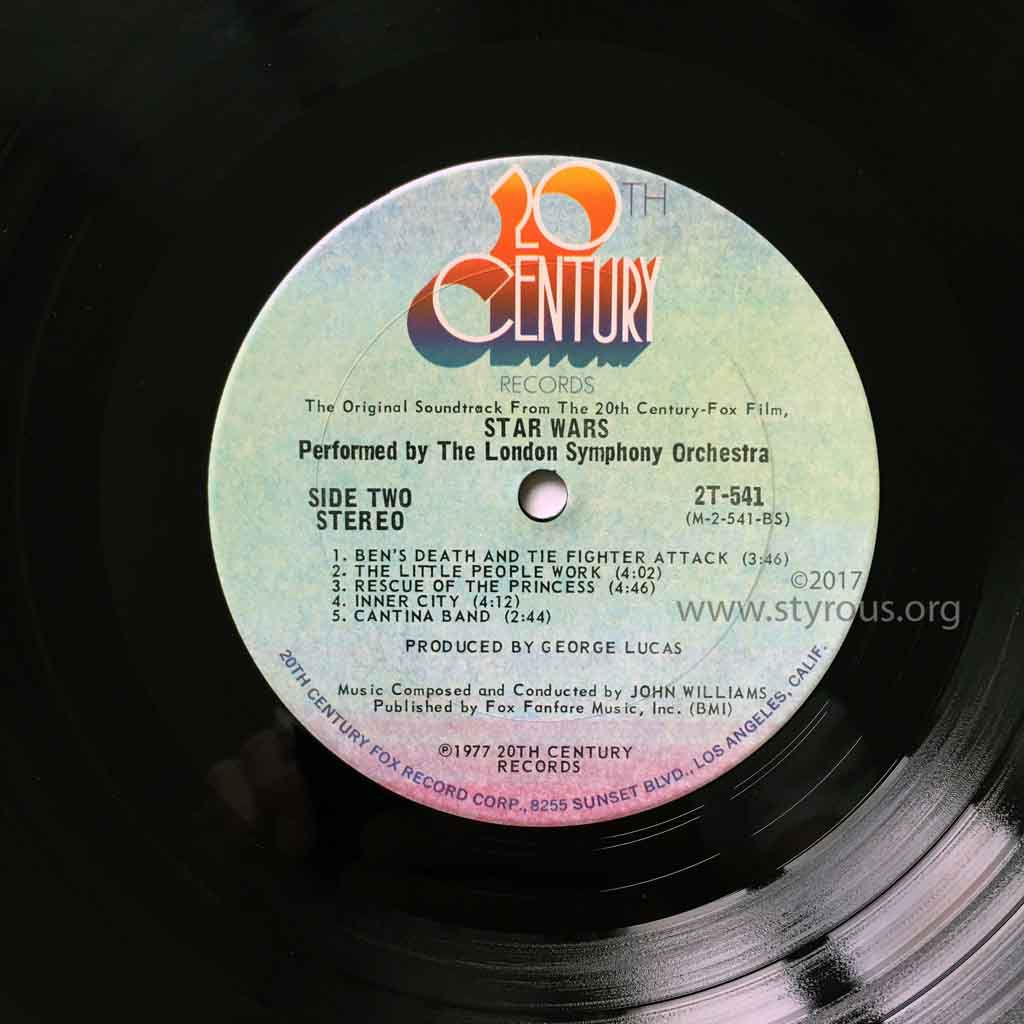
The 20th Century Fox's second logo was used from 1953 to 1987. This version was designed by Pacific Title artist Rocky Longo, and was originally created for the new CinemaScope process.

20th Century Records also released The Story of Star Wars that same year, a narrated audio drama adaptation of the film utilizing some of its original music, dialogue, and sound effects (this recording will be a future article).
The 20th Century Fox's second logo was used from 1953 to 1987. This version was designed by Pacific Title artist Rocky Longo, and was originally created for the new CinemaScope process.

20th Century Records also released The Story of Star Wars that same year, a narrated audio drama adaptation of the film utilizing some of its original music, dialogue, and sound effects (this recording will be a future article).

photo by Styrous®
The album includes some of the best notes ever; one page has a synopsis of the film, Williams and LSO bios, etc, and another a detailed, track by track breakdown of how the music program was put together.
notes, bios, etc.


tracks info


The giant color, fold out poster which depicts the Rebel Alliance dogfighting the Empire near and
along the Death Star. This John Berkey illustration, featuring the
frenzied dogfight, was published as a free poster inserted into the first
pressings of the Star Wars vinyl LP soundtrack album and measures 22" x 33".

Star Wars poster
illustration by John Berkey
photo by Styrous®
Star Wars stars Mark Hamill, Harrison Ford, Carrie Fisher, Peter Cushing, and Alec Guinness. David Prowse, James Earl Jones, Anthony Daniels, Kenny Baker, and Peter Mayhew co-star in supporting roles.

Star Wars was released theatrically in the United States on May
25, 1977. It earned $461 million in the U.S. and $314 million overseas,
totaling $775 million. It surpassed Jaws (1975) to become the highest-grossing film of all time until the release of E.T. the Extra-Terrestrial (1982). When adjusted for inflation, Star Wars is the second-highest-grossing film in North America, and the third-highest-grossing film in the world. It received ten Academy Award nominations (including Best Picture), winning seven. It was among the first films to be selected as part of the U.S. Library of Congress National Film Registry
as being "culturally, historically, or aesthetically significant". At
the time, it was the most recent film on the registry and the only one
chosen from the 1970s. Its soundtrack was added to the U.S. National Recording Registry in 2004. Today, it is often regarded as one of the best films of all time, as well as one of the most important films in the history of motion pictures.


The film's success led to two critically and commercially successful sequels, The Empire Strikes Back (1980) and Return of the Jedi (1983). The film was originally released in 1977 with the title "Star Wars". The subtitles Episode IV and A New Hope were only added to the opening crawl in subsequent re-releases. Star Wars ~ A New Hope was reissued multiple times incorporating many changes including modified computer-generated effects, altered dialogue, re-edited shots, remixed soundtracks, and added scenes.

According to Lucas, different concepts of the film were inspired by numerous sources, such as Beowulf and King Arthur for the origins of myth and religion. Lucas originally intended to rely heavily on the 1930s Flash Gordon film serials; however, he resorted to the 1958 Akira Kurosawa film, The Hidden Fortress, and the book by Joseph Campbell, The Hero with a Thousand Faces, because of copyright issues with Flash Gordon. Star Wars features several parallels to Flash Gordon, such as the conflict between Rebels and Imperial Forces, the wipes between scenes, the fusion of futuristic technology and traditional mythology, and the famous opening crawl that begins each film. The film has also been compared to The Wizard of Oz.


Lucas described a "used future" concept to the production designers in
which all devices, ships, and buildings looked aged and dirty. Instead of following the traditional sleekness and futuristic architecture of science fiction films that came before, the Star Wars
sets were designed to look inhabited and used. Barry said that the
director "wants to make it look like it's shot on location on your
average everyday Death Star or Mos Eisley Spaceport or local cantina."
Lucas believed "what is required for true credibility is a used
future", opposing the interpretation of "future in most futurist movies"
that "always looks new and clean and shiny." Christian supported Lucas's vision, saying "All science fiction before was very plastic and stupid uniforms and Flash Gordon stuff. Nothing was new. George was going right against that."


During the chaos of production and post-production, the team made decisions about character voicing and sound effects. Sound designer Ben Burtt
had created a library of sounds that Lucas referred to as an "organic
soundtrack". Blaster sounds were a modified recording of a steel cable,
under tension, being struck. The lightsaber sound effect was developed by Burtt as a combination of the hum of idling interlock motors in aged movie projectors and interference caused by a television set on a shieldless microphone. Burtt discovered the latter accidentally as he was looking for a buzzing, sparking sound to add to the projector-motor hum.
For Chewbacca's growls, Burtt recorded and combined sounds made by
dogs, bears, lions, tigers, and walruses to create phrases and
sentences. Lucas and Burtt created the robotic voice of R2-D2 by
filtering their voices through an electronic synthesizer. Darth Vader's
breathing was achieved by Burtt breathing through the mask of a scuba regulator implanted with a microphone.

Tracklist:
Side One:
A1 Main Title 5:20
A2 Imperial Attack 6:10
A3 Princess Leia's Theme 4:18
A4 The Desert And The Robot Auction 2:51
Side Two:
B1 Ben's Death And TIE Fighter Attack 3:46
B2 The Little People Work 4:02
B3 Rescue Of The Princess 4:46
B4 Inner City 4:12
B5 Cantina Band 2:44
Side Three:
C1 The Land Of The Sand People 2:50
C2 Mouse Robot And Blasting Off 4:01
C3 The Return Home 2:46
C4 The Walls Converge 4:37
C5 The Princess Appears 4:04
Side Four:
D1 The Last Battle 12:05
D2 The Throne Room And End Title 5:28
Companies, etc.
Recorded At – Anvil Recording Studios
Remixed At – The Burbank Studios
Mastered At – The Mastering Lab
Published By – Fox Fanfare Music, Inc.
Phonographic Copyright (p) – 20th Century Records
Copyright (c) – Twentieth Century Fox Film Corporation
Pressed By – Columbia Records Pressing Plant, Terre Haute
Credits:
Bass – A. Griffiths*, B. Mollinson*, G. Neal, G. Newson*, J. Cooper*, P. Dimitroff*
Bassoon – P. Francis*, R. Bourton*
Cello – C. Gillinson*, D. Powrie*, D. Cummings*, F. Saunders*, J. Long*, K. Glossop*, K. Law*, M. Meulien*, R. Adams*, T. Storer*
Clarinet – J. Brymer*, R. Moore*, R. Jowitt*
Composed By, Conductor – John Williams (4)
Engineer [Recording] – Eric Tomlinson
Flute – F. Nolan*, L. Sanders*, R. Taylor*
Harp – J. Marson*, R. Scheffel-Stein*
Horns – A. Chidell*, D. Cripps*, G. Warren*, J. Brown*, J. Quaife*, J. Butterworth*, J. Rooke*, S. Reading
Liner Notes – Charles Lippincott
Oboe – A. Camden*, R. Lord*
Orchestra – The London Symphony Orchestra
Percussion – M. Frye*, R. Northcott*
Piano, Celesta – M. Round, R. Noble*
Producer – George Lucas
Remix – John Neal
Timpani – K-H. Goedicke*
Trombone – D. Wick*, E. Crees*, F. Mathison*
Trumpet – M. Murphy*, N. Archibald*, R. Izen*, W. Lang*
Tuba – J. Fletcher*, S. Wick*
Viola – A. Taylor*, B. Clarke*, D. Hume*, E. Cuthbertson*, M. Mitchell*, P. Hooley*, P. Vermont*, P. Norriss*, W. Krasnik*, W. Sumpton*
Violin – B. Thomas, B. Gaulton*, C. Reuben*, D. Llewellyn*, D. Williams*, D. Gaines*, D. Stewart*, G. Creese*, I. Arditti*, J. Steadman*, M. Weber*, N. Freeman, N. Watson*, N. Taweel*, R. Studt*, R. Clark*, R. Retallick*, R. Brightman*, S. Artis*, S. Castle*, S. Colter*, T. Morton*, T. Cook*, T. Swift*, W. Hill*, W. Brown*
Notes:
Recorded over eight sessions at Anvil Studios in Denham, England on March 5, 8-12, 15-16, 1977
Remixed at The Burbank Studios, Burbank, California
Published by Fox Fanfare Music, Inc. (BMI)
© 20th Century-Fox Film Corporation
Has an insert with the list of each instrument and its performer and a color fold-out poster.
Also comes with 16-page color booklet describing characters and behind the scenes info, and poster of fighters over the Death Star.
Release is Auto-Coupled - sides are organized for use with an auto-changing player.
Record 1: Sides A and D
Record 2: Sides B and C
Barcode and Other Identifiers
Rights Society: BMI
Matrix / Runout (Side A Label): M-2-541-AS
Matrix / Runout (Side B Label): M-2-541-BS
Matrix / Runout (Side C Label): M-2-541-CS
Matrix / Runout (Side D Label): M-2-541-DS
Matrix / Runout (Side A Etchings [Variant 1]): M-2-541-AS-3
Matrix / Runout (Side B Etchings [Variant 1]): M-2-541-BS-1C
Matrix / Runout (Side C Etchings [Variant 1]): M-2-541-CS-4
Matrix / Runout (Side D Etchings [Variant 1]): M-2-541-DS
Matrix / Runout (Side A Etchings [Variant 2]): M-2-541-AS-7 TI
Matrix / Runout (Side B Etchings [Variant 2]): M-2-541-BS-5 TI
Matrix / Runout (Side C Etchings [Variant 2]): M-2-541-CS-8 TI
Matrix / Runout (Side D Etchings [Variant 2]): M-2-541-DS-4 TI
Matrix / Runout (Side A & B Mastering Facility Stamp): TML-M
Matrix / Runout (Side C & D Mastering Facility Stamp): TML-S
John Williams, The London Symphony Orchestra – Star Wars
Label: 20th Century Records – 2T-541
Format: 2 × Vinyl, LP, Album, Gatefold
Country: US
Released: May 25, 1977
Genre: Classical, Stage & Screen
Style: Soundtrack, Modern Classical, Contemporary, Score
Viewfinder links:
Star Wars
Episode VII ~ The Force Awakens in 3D (or am I cross-eyed yet?)
All things Star Wars
Carrie Fisher ~ Forever Princess Lea
Net links:
Star Wars: Episode IV - A New Hope Official Site
John Williams website
Star Wars: Episode IV Cast
Star Wars: Episode IV Plot
YouTube links:
Star Wars ~ Original Trailer (1977)
Star Wars - Opening Scene
Star Wars music
Main Title
The Dune Sea Of Tatooine
Cantina song
Princess Leia's Theme
Bicycle Thieves
The list of best film scores, by the American Film Institute, ranks the Star Wars soundtrack at number one.
Styrous® ~ Thursday, May 25, 2017
~
~


